


A Malaysian Catholic newspaper will be allowed to continue publication after the government withdrew a controversial decision to cancel its publishing license, the editor said yesterday.
The Herald said earlier last week that the government had told it that its license for next year had not been approved. Under Malaysian law, all publications must renew their license every year.
The move came amid a long-running dispute over the weekly’s use of “Allah” as a translation for “God” in its Malay-language section. The government argued “Allah” should be used only by Muslims, who dominate the country’s population.
The Herald’s editor, Father Lawrence Andrew, said government officials in a meeting on Friday said the paper’s license would be approved, but rejected its request to publish a supplement in a language used by an Aboriginal group on Borneo island.
“They have asked us to ignore the September letter which says the license is not approved and stick to an earlier letter in August stating a new license will be given, there is no more confusion,” Andrew said. “On our application to publish an additional page in the Kadazandusun language, we are sad it has been rejected. We will put the plan on hold and won’t be using the language for the time being.”
A home ministry official confirmed the Herald was allowed to continue publishing and attributed the controversy to “miscommunication.”
“We are processing their license renewal. We never disapproved their application, [the September letter] was because of miscommunication, but it has all been solved now,” said the official, who requested anonymity. “We only rejected their application to publish in the Kadazandusun language.”
The Herald, circulated among the country’s 850,000 Catholics, nearly lost its publishing license last year for using the word “Allah.” The paper is printed in four languages, with a circulation of 14,000 copies a week.
Meanwhile, the government has warned another newspaper that its coverage of a fatal police shooting of five ethnic Indian criminal suspects could stir racial tensions and cause the publication to be suspended, the daily’s chief executive said.
The warning underscores efforts by authorities to quell perceptions among the ethnic Indian minority that the police force, dominated by majority Malay Muslims, often uses excessive force against Indian suspects while trying to arrest them or during interrogation.
Authorities have defended the killing of the five Indians, saying they shot first at police who were chasing them. The suspects were accused of a spate of armed robberies.
The Home Ministry sent a letter to the Tamil Nesan saying its coverage of a Nov. 8 fatal shooting of five young Indian men would “provoke the Indians in the country and could affect the country’s harmony,” the newspaper’s chief executive, S. Vell Paari, said in a statement late on Saturday.
The ministry warned the Tamil-language newspaper’s license would be revoked if it continued such coverage, Vell Paari said.
Vell Paari denied the newspaper’s coverage had been provocative, saying it had a right to report what had happened.
Ministry officials familiar with the matter could not immediately be contacted yesterday.
The Tamil Nesan is one of the main newspapers catering to ethnic Indians, who comprise less than 10 percent of Malaysia’s 28 million people. Indians, many of whom are among the country’s poorest citizens, have increasingly complained of government discrimination.


Through the noise of rushing papers and whirring belts at a print factory in Kyoto, two creators watch their photo essay come to life in broadsheet form — part of an effort to win new audiences in the age of artificial intelligence (AI). Despite the decline of the publishing industry, self-publication and handmade “zine” magazines are growing in popularity in Japan, reflecting the nation’s enduring love of paper in the digital era. While speaking to Agence France-Presse at the plant, his hands black with ink, one of the creators, Kazuma Obara, said: “I think [paper] is a medium that engages all five
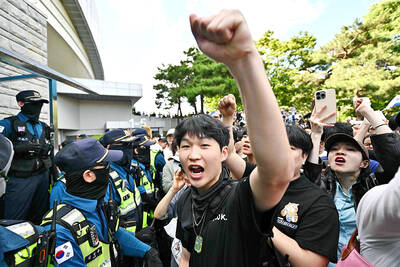
‘ABSURD MISTAKE’: The election commission said that there had been a failure to anticipate turnout after 14 polling stations ran short of ballot papers South Korean riot police yesterday cleared protesters from a Seoul polling station after a 35-hour blockade sparked by a shortage of ballot papers during local elections earlier this week. Wednesday’s election was the first nationwide vote since South Korean President Lee Jae-myung took office following the ouster of Yoon Suk-yeol over his short-lived martial law declaration. Lee’s ruling Democratic Party swept most races, but failed to flip the crucial Seoul mayoral seat. The South Korean National Election Commission apologized, blaming a failure to anticipate turnout after 14 polling stations in Seoul ran short of ballot papers. Some polling stations stayed open until 10pm to

France experienced its hottest spring on record, the French weather service said on Tuesday, after an exceptional early heat wave that also broke highs for the season in England and Wales. Meteo-France said the average nationwide temperature over March to May was 13.8°C — about 1.7°C above the norm, and surpassing records set in 2011 and 2020. “The warmest spring since records began in 1900,” it said in a bulletin. All three months were warmer than average, but the onset of an “unprecedented heatwave” late last month pushed the mercury to highs typically seen at the height of the summer. “Our country had never

A Sherpa guide was found crawling to base camp on Mount Everest a week after he went missing and was reunited with his family, who had given up hope he would return. Dawa Sherpa was last seen on Friday last week descending the mountain, but he did not reach base camp even though his client did. The pair were among the last climbers on the mountain as the climbing season came to an end and the route was dismantled. Dawa was located by a cleaning crew on Thursday morning as he was crawling down the snowy slopes around the Khumbu Icefall, just above


 RSS
RSS