


UN Under-Secretary General for Humanitarian Affairs John Holmes appealed to Sri Lanka yesterday to halt its military offensive against the Tamil Tigers in order to allow aid workers to help civilians trapped in the northeastern war zone.
Holmes told government leaders that months of fierce fighting had taken “a terrible toll” on civilians, as international pressure grew for an immediate ceasefire.
His plea came as the ruling party won a sweeping victory in an election seen as a referendum on its fight against ethnic Tamil rebels.
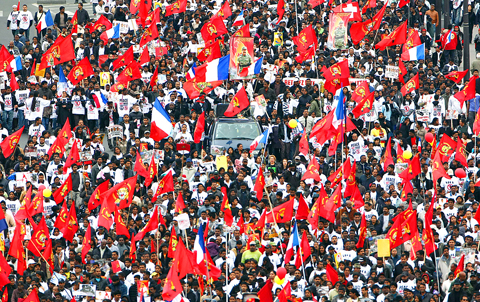
PHOTO: AFP
The government has pushed deep into the Tamil Tigers’ strongholds in the north in recent months, surrounding the beleaguered rebels and promising to end the quarter-century war. But reports have grown of starvation and casualties among the tens of thousands of civilians trapped by the fighting.
Holmes held meetings yesterday with senior officials in Colombo and was “underscoring the urgent need for humanitarian access by the UN to the combat zone,” UN spokesman Gordon Weiss said.
Aid workers have been barred from the region since fighting escalated in September.
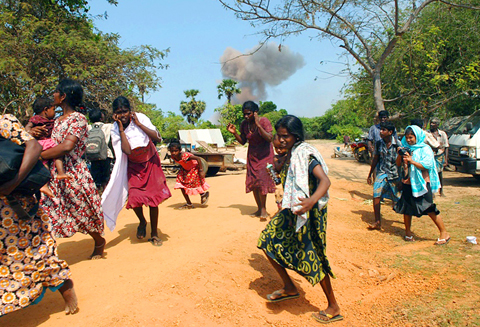
PHOTO: AFP/TAMILNET
Holmes, who arrived late on Saturday, had previously called on the government to suspend its offensive to allow the estimated 50,000 trapped civilians to escape.
The government has brushed off calls for a ceasefire, saying the rebels will use a pause to regroup. Meanwhile, the fighting continued, with the military reporting a string of battles and sniper attacks in the war zone on Saturday.
Holmes was to head today to the northern region of Vavuniya to inspect displacement camps and hospitals that have been overwhelmed by the more than 100,000 civilians who fled the war zone over the past week.
Despite growing international criticism of the offensive against the Tamil rebels, it is wildly popular with many in the Sinhalese majority, and the ruling party has used it to cement its power in a succession of provincial elections.
Yesterday Sri Lankan President Mahinda Rajapaksa’s coalition was declared the overwhelming winner in the latest poll, sweeping nearly two-thirds of the vote in the Western Province. The coalition even won in the capital, Colombo, long a stronghold of the opposition United National Party, which advocated talks with the rebels.
The governing United People’s Freedom Alliance coalition won 68 of 104 seats in the council. The main opposition United National Party captured a total of 30 seats while the Marxist People’s Liberation Front won three seats in Saturday’s elections, said the Department of Elections.
The governing coalition now controls all eight of the country’s provincial councils.
“The electorate ... clearly responded to the call of the president for a united Sri Lanka,” Media Minister Anura Yapa said. “The president believed in himself in wiping out terrorism, and the people also believed in him.”
The rebels, listed as a terrorist group by many Western nations, have been fighting since 1983 for an ethnic Tamil state in the north and east after decades of marginalization by governments dominated by the Sinhalese majority.
The UN says nearly 6,500 civilians have been killed in the fighting over the past three months.
Holmes said on Saturday that the trapped civilians were suffering a “very high” casualty rate, and from lack of food, clean water and medical supplies.
“The situation of those people is very dire and that’s why we need to find a way to stop the fighting and get them out of there so we can look after them properly,” he told AP Television News in Thailand en route to Sri Lanka.
The government insists it has sent food and medicines and accuses the rebels of holding the civilians as human shields. It is not possible to verify the claims because the government has barred independent journalists from the war zone, arguing that it is too dangerous for them to work.
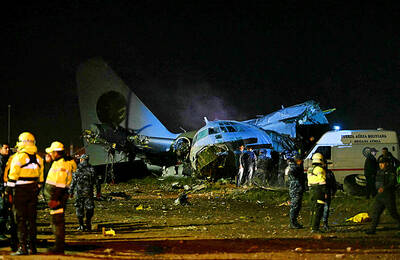
MONEY GRAB: People were rushing to collect bills scattered on the ground after the plane transporting money crashed, which an official said hindered rescue efforts A cargo plane carrying money on Friday crashed near Bolivia’s capital, damaging about a dozen vehicles on highway, scattering bills on the ground and leaving at least 15 people dead and others injured, an official said. Bolivian Minister of Defense Marcelo Salinas said the Hercules C-130 plane was transporting newly printed Bolivian currency when it “landed and veered off the runway” at an airport in El Alto, a city adjacent to La Paz, before ending up in a nearby field. Firefighters managed to put out the flames that engulfed the aircraft. Fire chief Pavel Tovar said at least 15 people died, but

LIKE FATHER, LIKE DAUGHTER: By showing Ju-ae’s ability to handle a weapon, the photos ‘suggest she is indeed receiving training as a successor,’ an academic said North Korea on Saturday released a rare image of leader Kim Jong-un’s teenage daughter firing a rifle at a shooting range, adding to speculation that she is being groomed as his successor. Kim’s daughter, Ju-ae, has long been seen as the next in line to rule the secretive, nuclear-armed state, and took part in a string of recent high-profile outings, including last week’s military parade marking the closing stages of North Korea’s key party congress. Pyongyang’s official Korean Central News Agency (KCNA) released a photo of Ju-ae shooting a rifle at an outdoor shooting range, peering through a rifle scope
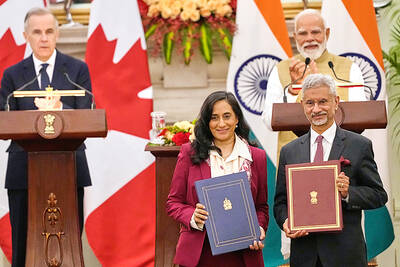
India and Canada yesterday reached a string of agreements, including on critical mineral cooperation and a “landmark” uranium supply deal for nuclear power, the countries’ leaders said in New Delhi. The pacts, which also covered technology and promoting the use of renewable energy, were announced after Indian Prime Minister Narendra Modi and Canadian Prime Minister Mark Carney hailed a fresh start in the relationship between their nations. “Our ties have seen a new energy, mutual trust and positivity,” Modi said. Carney’s visit is a key step forward in ties that effectively collapsed in 2023 after Ottawa accused New Delhi
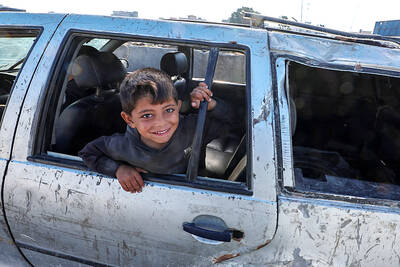
Gaza is rapidly running out of its limited fuel supply and stocks of food staples might become tight, officials said, after Israel blocked the entry of fuel and goods into the war-shattered territory, citing fighting with Iran. The Israeli military closed all Gaza border crossings on Saturday after announcing airstrikes on Iran carried out jointly with the US. Israeli authorities late on Monday night said that they would reopen the Kerem Shalom crossing from Israel to Gaza yesterday, for “gradual entry of humanitarian aid” into the strip, without saying how much. Israeli authorities previously said the crossings could not be operated safely during


 RSS
RSS