


The Chinese navy has added sophisticated nuclear submarines, destroyers and missile systems, but the holy grail of surface ships — an aircraft carrier — has stayed out on the horizon.
That may be about to change.
The navy will have one “very soon,” said the commander of the East China Fleet, Admiral Xu Hongmeng. The navy’s commander, Admiral Wu Shengli (吳勝利), spoke last week of plans for “large combat warships,” an apparent reference to carriers.
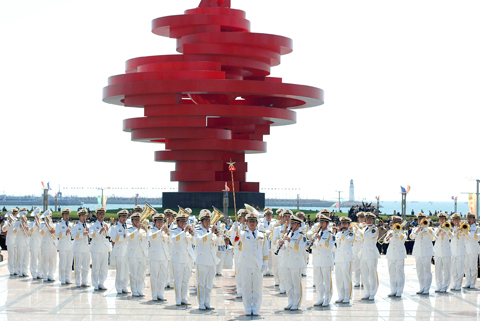
PHOTO: EPA
The comments come ahead of an unprecedented international fleet review tomorrow marking the 60th anniversary of the People’s Liberation Army (PLA) Navy and spotlighting its recent rapid development.
The navy is expected to take on even more ambitious goals in the next few years as it seeks to strengthen its ability to operate far from coastal bases and boost China’s international prestige.
“As China’s navy takes on missions that go beyond simple coastal defense, an aircraft carrier becomes an obvious addition to maritime power projection platforms,” said John Pike, a defense analyst and director of GlobalSecurity.org.
In his remarks to Xinhua news agency, Wu said the navy would speed up development of a technologically advanced, oceangoing fleet, stepping away from its traditional missions of coastal protection and blocking permanent independence for Taiwan.
No Chinese official has offered a specific timeframe for putting a carrier in the water or said how many might be built.
Operating a carrier would be a step toward a “sea-control capability” in Northeast Asia and the Indian Ocean, a strategy that could bring Beijing into conflict with the US, Japan, South Korea and India and raise doubts about Beijing’s self-declared defensive military posture, Pike said.
“It is not clear how such a long-range power projection and sea control strategy would fit in with China’s peaceful rise,” he said.
Having a carrier allows a navy to operate fixed-wing aircraft beyond the range of aircraft based on land. That would be key on missions to defend China’s territorial aspirations, especially in the South China Sea, where a half-dozen countries have overlapping claims.
US officials say they don’t think a Chinese carrier would pose much of a threat to their operations in the region, although that would depend on how China intended to use it.
In China to attend this week’s festivities, Admiral Gary Roughead, chief of US naval operations, said on Sunday there is “no doubt in my mind” that Beijing wants a carrier, but he said US forces would take such a development in stride.
“The advent of an aircraft carrier on the part of the PLA Navy, to me, really doesn’t change the nature of our operations at all,” Roughead said.
China insists it has both the financial muscle and shipbuilding ability to construct and operate a carrier and the development of sophisticated new home-built vessels seems to support that view.
Such expansion has been made possible by two decades of near-annual double-digit increases in military spending. China has announced a 14.9 percent rise in military spending in its budget for this year, to 480.6 billion yuan (US$70.3 billion).
The 225,000-sailor PLA Navy already operates more submarines than any other Asian country, with up to 10 nuclear-powered vessels and as many as 60 diesel-electric subs. It boasts almost 80 destroyers and frigates — more than a dozen of which have entered service since the 1990s — along with hundreds of smaller craft and support ships.
China’s second-generation, nuclear-powered Jin and Shang class submarines are considered just a notch below cutting-edge US and Russian craft.
The diesel-electric Yuan class boasts a Chinese-developed air-independent propulsion system that allows it to remain submerged for weeks, while Chinese Luyang destroyers and Jiangkai missile frigates incorporate stealth features and a mix of latest-generation Chinese and Russian weapon systems.
Still, operating an aircraft carrier requires orchestrating a highly complex matrix of sailors, aircraft, missile defenses, power plants, support ships, fuel and weather. In that, the Chinese navy has little experience.
“Carrier operations are very complex, difficult, and dangerous,” said retired Rear Admiral Eric McVadon, a former US Navy pilot who is now director of Asia-Pacific Studies at the Institute for Foreign Policy Analysis. “China’s current navy is not designed for carrier warfare.”
McVadon said China would build up to three modest carriers considerably smaller than the US Navy’s 100,000-tonne displacement Nimitz class carriers.
Unconfirmed reports have emerged on the Internet pointing to the construction of a dedicated carrier-building dock outside Shanghai.


Through the noise of rushing papers and whirring belts at a print factory in Kyoto, two creators watch their photo essay come to life in broadsheet form — part of an effort to win new audiences in the age of artificial intelligence (AI). Despite the decline of the publishing industry, self-publication and handmade “zine” magazines are growing in popularity in Japan, reflecting the nation’s enduring love of paper in the digital era. While speaking to Agence France-Presse at the plant, his hands black with ink, one of the creators, Kazuma Obara, said: “I think [paper] is a medium that engages all five
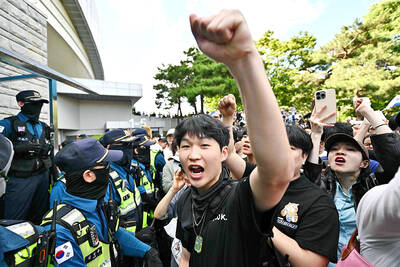
‘ABSURD MISTAKE’: The election commission said that there had been a failure to anticipate turnout after 14 polling stations ran short of ballot papers South Korean riot police yesterday cleared protesters from a Seoul polling station after a 35-hour blockade sparked by a shortage of ballot papers during local elections earlier this week. Wednesday’s election was the first nationwide vote since South Korean President Lee Jae-myung took office following the ouster of Yoon Suk-yeol over his short-lived martial law declaration. Lee’s ruling Democratic Party swept most races, but failed to flip the crucial Seoul mayoral seat. The South Korean National Election Commission apologized, blaming a failure to anticipate turnout after 14 polling stations in Seoul ran short of ballot papers. Some polling stations stayed open until 10pm to

France experienced its hottest spring on record, the French weather service said on Tuesday, after an exceptional early heat wave that also broke highs for the season in England and Wales. Meteo-France said the average nationwide temperature over March to May was 13.8°C — about 1.7°C above the norm, and surpassing records set in 2011 and 2020. “The warmest spring since records began in 1900,” it said in a bulletin. All three months were warmer than average, but the onset of an “unprecedented heatwave” late last month pushed the mercury to highs typically seen at the height of the summer. “Our country had never

A Sherpa guide was found crawling to base camp on Mount Everest a week after he went missing and was reunited with his family, who had given up hope he would return. Dawa Sherpa was last seen on Friday last week descending the mountain, but he did not reach base camp even though his client did. The pair were among the last climbers on the mountain as the climbing season came to an end and the route was dismantled. Dawa was located by a cleaning crew on Thursday morning as he was crawling down the snowy slopes around the Khumbu Icefall, just above


 RSS
RSS