


The discovery of more than 50 ancient rock engravings in Tonga has excited archaeologists, who say they demonstrate the links between the Pacific island and Hawaii before Europeans arrived.
“The site is a truly significant discovery in illustrating the remarkable Polynesian voyaging capacity,” said archaeologist David Burley, a specialist in Tongan history.
“In the pre-European era, whether Tongans went to Hawaii, Hawaiians to Tonga or some other possibility, it illustrates a connectedness of west and east Polynesia in later pre-history that is under-appreciated,” he said.
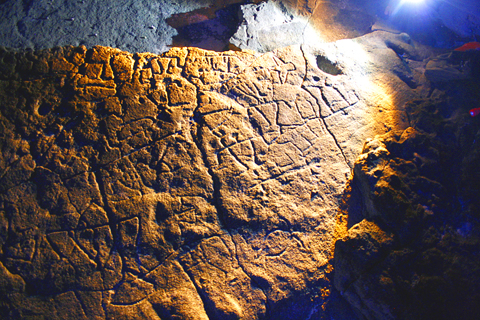
PHOTO: AFP
Tonga, where Burley has documented a fishing village established 2,900 years ago as the first settlement in Polynesia, is 5,060km from Hawaii.
The rock drawings, or petroglyphs, include images of humans and animals and are on two slabs of beach-rock that were exposed by erosion on Tonga’s Foa island.
They are in the style of the earliest stick figure forms in Hawaii, which would place them between the years 1250 and 1550.
Burley said the dates correlated closely with two adjacent archaeological sites on Foa, a village and a pigeon-snaring mound — between 1450 and 1650.
“In short, I am fully convinced that the site is pre-Captain Cook,” he said referring to the English explorer who stayed in Tonga for three months in 1777.
Tongan resident artist Shane Egan, who was alerted to the drawings by two Australian tourists late last year, called in Burley from Simon Fraser University in Canada to investigate and document the site with him.
“Having an average height of 20 to 30 centimeters, some much larger, there are very nicely stylized images of men and women, turtles, dogs, a bird, a lizard, as well as footprints and some weird exotic combinations,” Egan told the Matangi Tonga Web site.
Burley, in an e-mail interview, said that, stylistically, the images were clearly Hawaiian and nothing remotely close had been found elsewhere in west Polynesia.
“Not only are the petroglyphs executed in Hawaiian style but there is one image suggesting the person was knowledgeable of their cultural protocols and meaning. In particular, there appears to be a kapu stick image which marks, in Hawaii, a sacred place,” he said.
Tonga’s previously reported rock art has been limited to simple geometric engravings, though there is also a single engraved outline of a foot on a stone at a royal tomb. Burley said the petroglyphic foot was so rare he had assumed it was intentionally carved in a symbolic fashion, but the latest find meant he was not so sure.
He said it might have been on a stone that was quarried for the tomb. The Foa site was recently found to have been a quarry for blocks used in tomb construction.
Egan, who has a keen interest in archaeology and the early history of Tonga, said that now the images had been exposed they were within the tidal range and were constantly being eroded.
“The grooves are now shallow and in the broad light of day one would be excused for passing them by unnoticed,” he said.
“At night, with torch lighting from the side the glyphs immediately take form and in greater detail jump up at you, revealing a myriad of images dancing about the rock,” he said.

‘CROSSING THE LINE’: China’s embassy in Seoul criticized US Forces Korea Commander General Xavier Brunson, asking if his ‘hostile’ remarks were authorized by Washington South Korea and the US are in talks over recent public remarks by the commander of US Forces Korea, Seoul’s presidential office said yesterday, after the comments drew sharp criticism from China. In a recent podcast interview, US Forces Korea Commander General Xavier Brunson described South Korea as “the dagger in the heart of Asia” from China’s east coast, prompting the Chinese embassy in Seoul to say that he had “truly crossed the line.” The interview came amid growing speculation that Washington might seek to expand the role of US Forces Korea in countering the growing regional influence of China, a key

SEEKING ORDER: Rodrigo Paz said that ‘anyone who wants to destroy the nation will have to deal with this president and the full force of the constitution’ Bolivian President Rodrigo Paz on Wednesday said that the nation was at a “breaking point” after nearly a month of protests that have caused shortages of food, fuel and medicine. Paz, who took office six months ago amid the worst economic crisis there in four decades, is battling a groundswell of fury over his policies. The political capital, La Paz, has been besieged by low-income workers and members of the indigenous majority calling for his resignation. “The country needs order and is reaching breaking point,” the 58-year-old said at a public event in La Paz, renewing his appeal for dialogue. On Tuesday, the Bolivian

Through the noise of rushing papers and whirring belts at a print factory in Kyoto, two creators watch their photo essay come to life in broadsheet form — part of an effort to win new audiences in the age of artificial intelligence (AI). Despite the decline of the publishing industry, self-publication and handmade “zine” magazines are growing in popularity in Japan, reflecting the nation’s enduring love of paper in the digital era. While speaking to Agence France-Presse at the plant, his hands black with ink, one of the creators, Kazuma Obara, said: “I think [paper] is a medium that engages all five

Australian researchers have trained lab-grown brain cells on a silicon computer chip to play the 1990s shooter game Doom and said they are just scratching the surface of what the neurons could be capable of doing. It is the science-fiction work of biotech boffins at Cortical Labs, who researched and developed the technology that harnesses the workings of the brain’s networking system. Each so-called “biological computer” contains about 200,000 living human brain cells, grown from stem cells that were harvested from blood donations. Having mastered the simple computer game Pong, where a paddle is moved up and down to send a ball


 RSS
RSS