


Japan launched the first satellite to monitor greenhouse gases worldwide, a tool to help scientists better judge where global warming emissions are coming from, and how much is being absorbed by the oceans and forests.
The orbiter, together with a similar US satellite to be launched next month, will represent an enormous leap in available data on carbon dioxide and methane in the atmosphere, now drawn from scattered ground stations.
“I’m saying Christmas is here,” said an enthusiastic Inez Fung, an atmospheric scientist at the University of California, Berkeley. “Now, we get about 100 observations every two weeks. With the satellite, we’ll get a million.”
The satellite — named “Ibuki,” which means “breath” — was sent into orbit on Friday along with seven other piggyback probes on a Japanese H2A rocket. Japan’s space agency, JAXA, said the launch was a success, and officials said they were monitoring the satellites to ensure they entered orbit properly.
Ibuki, which will circle the globe every 100 minutes, is equipped with optical sensors that measure reflected light from the Earth to determine the density of the two gases.
Carbon dioxide, the biggest contributor to global warming, is emitted by the burning of fossil fuels by power plants, motor vehicles and other sources. Methane has a variety of sources, including livestock manure.
International science agencies report that carbon dioxide emissions rose 3 percent worldwide from 2006 to 2007. If emissions are not reined in, a UN scientific panel says, average global temperatures will increase by between 2.4°C and 6.3°C by the year 2100, causing damaging disruptions to the climate.
“Global warming is one of the most pressing issues facing the international community, and Japan is fully committed to reducing CO2,” said Yasushi Tadami, an official working on the project for Japan’s Environment Ministry. “The advantage of Ibuki is that it can monitor the density of carbon dioxide and methane gas anywhere in the world.”
Scientists depend on 282 land-based stations — and scattered instrumented aircraft flights — to monitor carbon dioxide at low altitudes. Ibuki, orbiting at an altitude of about 670km, will be able to check gas levels in entire columns of atmosphere at 56,000 locations.
With the current network, “due to the relatively small number of locations, only large-scale regional averages could be determined” for greenhouse-gas emissions, said Swiss climatologist Fortunat Joos, of the University of Bern.
With satellite readings, he said, “one would perhaps be able to discriminate carbon emissions from different countries.”
The data could help negotiators in global climate talks to determine more precisely who would need to reduce emissions by how much to protect the climate.
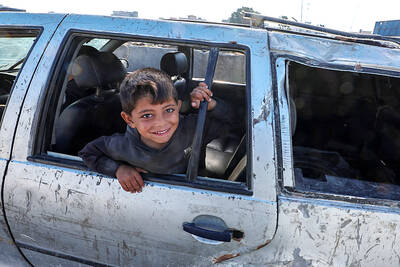
Gaza is rapidly running out of its limited fuel supply and stocks of food staples might become tight, officials said, after Israel blocked the entry of fuel and goods into the war-shattered territory, citing fighting with Iran. The Israeli military closed all Gaza border crossings on Saturday after announcing airstrikes on Iran carried out jointly with the US. Israeli authorities late on Monday night said that they would reopen the Kerem Shalom crossing from Israel to Gaza yesterday, for “gradual entry of humanitarian aid” into the strip, without saying how much. Israeli authorities previously said the crossings could not be operated safely during
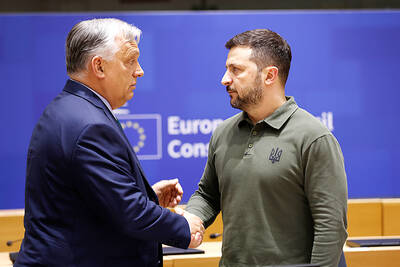
Hungarian authorities temporarily detained seven Ukrainian citizens and seized two armored cars carrying tens of millions of euros in cash across Hungary on suspicion of money laundering, officials said on Friday. The Ukrainians were released on Friday, following their detention on Thursday, but Hungarian officials held onto the cash, prompting Ukraine to accuse Hungary’s Russia-friendly government of illegally seizing the money. “We will not tolerate this state banditism,” Ukrainian Minister of Foreign Affairs Andrii Sybiha said. The seven detained Ukrainians were employees of the Ukrainian state-owned Oschadbank, who were traveling in the two armored cars that were carrying the money between Austria and
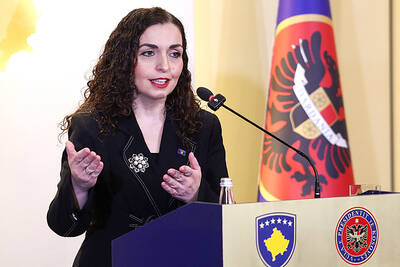
Kosovar President Vjosa Osmani on Friday after dissolving the Kosovar parliament said a snap election should be held as soon as possible to avoid another prolonged political crisis in the Balkan country at a time of global turmoil. Osmani said it is important for Kosovo to wrap up the upcoming election process and form functional institutions for political stability as the war rages in the Middle East. “Precisely because the geopolitical situation is that complex, it is important to finish this electoral process which is coming up,” she said. “It is very hard now to imagine what will happen next.” Kosovo, which declared

MORE BANS: Australia last year required sites to remove accounts held by under-16s, with a few countries pushing for similar action at an EU level and India considering its own ban Indonesia on Friday said it would ban social media access for children under 16, citing threats from online pornography, cyberbullying, online fraud and Internet addiction. “Accounts belonging to children under 16 on high-risk platforms will start to be deactivated, beginning with YouTube, TikTok, Facebook, Instagram, Threads, X, Bigo Live and Roblox,” Indonesian Minister of Communications and Digital Meutya Hafid said. “The government is stepping in so that parents no longer have to fight alone against the giants of the algorithm. Implementation will begin on March 28, 2026,” she said. The social media ban would be introduced in stages “until all platforms fulfill their


 RSS
RSS