


Hungry flood survivors looted supermarkets on Wednesday and emergency crews tried to get aid to nearly 80,000 people driven from their homes, as rain-spawned mud slides and overflowing rivers killed at least 97 people and isolated cities in southern Brazil.
Amid mounting misery in the disaster zone, 20 people were arrested for ransacking a supermarket in the hard-hit city of Itajai, where many streets were still submerged following torrential weekend rains.
Besides food, the looters tried to cart away beer, plasma TVs and a refrigerator, state police inspector Carlos Quilante said in a statement.
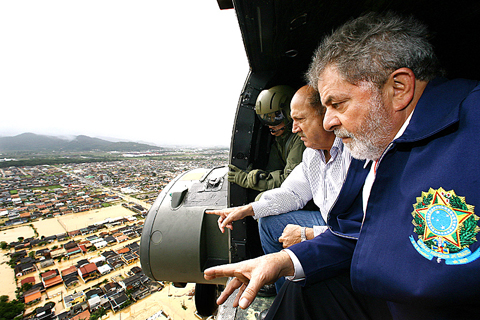
PHOTO: AFP
Nearly 100,000 people remained cut off by flooding in eight cities in Santa Catarina state, civil defense officials said in a statement.
Helicopters — some provided by the government, others donated by businesses — rescued 1,100 people, authorities said.
“The cities in the south still cannot be reached, it’s going to take some time,” Army Lieutenant Colonel Jose Henrique Ruffo told Globo TV.
The weekend downpours dumped as much water on the area as it usually receives in months, cutting residents off from electricity, drinking water and food. The water shortage was so extreme that civil defense officials advised people to drink swimming pool water after boiling it for 10 minutes.
State Governor Luiz Henrique da Silveira flew with President Luiz Inacio Lula da Silva over areas devastated by floodwaters and said Lula was “shocked when he saw the Dantesque spectacle below him.”
“This is the worst environmental calamity we have ever faced,” Lula told reporters afterwards.
Civil defense officials said mud slides and floods killed at least 97 people, down from the 99 reported earlier after two could not be confirmed.
As many as 30 were missing.
Itajai civil defense worker Gilvan Muniz told the Agencia Estado news service that residents of the flooded riverside city were seeing much of the damage for the first time as floodwater receded on Wednesday.
“We endured two moments of horror: when we saw the water rise and then when it receded and we saw the destruction,” he said.
New reports emerged of looting and price gouging as food and supplies ran short in isolated towns.
Wal-Mart Stores Inc said in a statement that two of its nine stores in Santa Catarina state were closed because of the floods and one was ransacked on Tuesday.
Thousands of civil defense workers, troops and police were trying to deliver aid and about 3 tonnes of medicine, food, water and other supplies already were distributed.
The worst-hit city was the town of Ilhota along the banks of the Itajai River, where 29 people died after waters rose 9m above normal. Soldiers there were trying to reach 200 people cut off since Saturday.
Twenty people died in nearby Blumenau because of mud slides and half of the population in the renowned tourist destination of nearly 300,000 had no electricity.
Officials said it still could take days to reopen many of the region’s slide-blocked highways.
Silva authorized nearly US$870 million in emergency relief because of the disaster, with nearly half of it destined to repair roads, fund military rescue operations, repair damaged ports and provide public health assistance.
The government was sending food, but shortages prompted some hungry people to loot stores of spoiled food after they could find nothing else, Itajai civil defense director Gilvan Muniz told the Web site of the O Estado de S. Paulo newspaper.
“It’s very sad to see people looting food so they don’t die of hunger,” he said.

‘CROSSING THE LINE’: China’s embassy in Seoul criticized US Forces Korea Commander General Xavier Brunson, asking if his ‘hostile’ remarks were authorized by Washington South Korea and the US are in talks over recent public remarks by the commander of US Forces Korea, Seoul’s presidential office said yesterday, after the comments drew sharp criticism from China. In a recent podcast interview, US Forces Korea Commander General Xavier Brunson described South Korea as “the dagger in the heart of Asia” from China’s east coast, prompting the Chinese embassy in Seoul to say that he had “truly crossed the line.” The interview came amid growing speculation that Washington might seek to expand the role of US Forces Korea in countering the growing regional influence of China, a key

SEEKING ORDER: Rodrigo Paz said that ‘anyone who wants to destroy the nation will have to deal with this president and the full force of the constitution’ Bolivian President Rodrigo Paz on Wednesday said that the nation was at a “breaking point” after nearly a month of protests that have caused shortages of food, fuel and medicine. Paz, who took office six months ago amid the worst economic crisis there in four decades, is battling a groundswell of fury over his policies. The political capital, La Paz, has been besieged by low-income workers and members of the indigenous majority calling for his resignation. “The country needs order and is reaching breaking point,” the 58-year-old said at a public event in La Paz, renewing his appeal for dialogue. On Tuesday, the Bolivian

Forecasters in Europe yesterday warned of exceptional heat as record temperatures driven by a “heat dome” push temperatures well above seasonal norms across the continent. The surge follows a record-breaking Monday, with France logging its hottest day in the month of May on record, its weather agency said, and the UK also posting unprecedented highs. A so-called “heat dome” of warm air from northern Africa trapped under a high-pressure system over western Europe is behind the high temperatures not usually seen until high summer. Restrictions on outdoor work were imposed in parts of Italy, beaches in southwest France filled earlier than usual and

Australian researchers have trained lab-grown brain cells on a silicon computer chip to play the 1990s shooter game Doom and said they are just scratching the surface of what the neurons could be capable of doing. It is the science-fiction work of biotech boffins at Cortical Labs, who researched and developed the technology that harnesses the workings of the brain’s networking system. Each so-called “biological computer” contains about 200,000 living human brain cells, grown from stem cells that were harvested from blood donations. Having mastered the simple computer game Pong, where a paddle is moved up and down to send a ball


 RSS
RSS