


Tens of thousands of black-clad Thais massed in Bangkok yesterday for the lavish cremation of the king’s elder sister, a brief moment of unity for the Buddhist kingdom at a time of political crisis.
Soldiers in crimson ceremonial outfits, buglers and drummers marched solemnly alongside a two-centuries-old golden teak chariot carrying the remains of Princess Galyani on a winding day-long procession.
Galyani, the sister of King Bhumibol Adulyadej, died of cancer on Jan. 2 at the age of 84. Costing at least 300 million baht (US$8.9 million), it is the first full royal funeral since 1996.
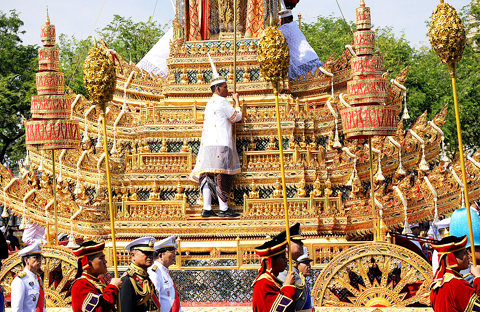
PHOTO: AFP
Fittingly for a nation where the monarchy is regarded with near religious devotion, by dawn yesterday Thais were already competing for space near a gilded crematorium purpose-built for the occasion.
“It’s been very hard, but I had to do it,” said Boonkom Chareeruk, 48, a street vendor who rode a bicycle decorated with a large photograph of Galyani some 350km from the northeastern province of Kalasin.
He said he planned to return for celebrations to mark the king’s 81st birthday on Dec. 5.
Between the cremation and the king’s birthday there is expected to be a lull in the recent political turmoil that has gripped Thailand, but after that the feuding factions are expected to resume their stand-off.
Protesters have occupied the main government offices in Bangkok since August, refusing to leave until the resignation of the government, which they accuse of acting as a front for ousted premier Thaksin Shinawatra.
But as a mark of respect for the princess, a popular former French teacher, the anti-government demonstrators agreed at the last minute to clear a road on the funeral route.
Ancient Thai music wailed as three separate processions involving 2,000 troops accompanied the 14-tonne Royal Great Victory carriage from the royal throne hall to the Sanam Luang parade ground where the cremation takes place.
Crown Prince Maha Vajiralongkorn, representing the aging king, and embattled Prime Minister Somchai Wongsawat wore white ceremonial dress as they took part in the procession.
Thais lining the streets wore black clothes as a sign of mourning, in line with government requests. Officials said they numbered in the tens of thousands. All terrestrial television channels broadcast the ceremony live.
On Friday night the King led a candle-lighting ceremony at the royal palace, where Princess Galyani had lain in state for the past 10 months while craftsmen constructed the pyre.
The pyre is the most spectacular of dozens of temporary funeral buildings at the site, a 39m tower modeled after Mount Meru, a mythical Buddhist site said to be at the center of the universe.
After the cremation, the funeral buildings will be demolished because they are reminders of the death of a beloved royal.
But Thailand’s political convulsions will be more difficult to erase.
The months of protests against the government exploded into violence on Oct. 7, with two demonstrators killed and nearly 500 people injured after clashes with police.
The monarchy officially plays no political role in Thailand. But when the king’s wife Queen Sirikit donated thousands of dollars towards their medical expenses and attended the funeral of one of the people killed, protesters hailed the move as proof of royal support.
Leading the protests are the People’s Alliance for Democracy, which accuses the government now led by Somchai of acting as a corrupt front for his brother-in-law Thaksin.
The victory of Thaksin’s allies in elections in December angered the old power cliques in the palace, military and bureaucracy who loathe the billionaire telecoms tycoon.
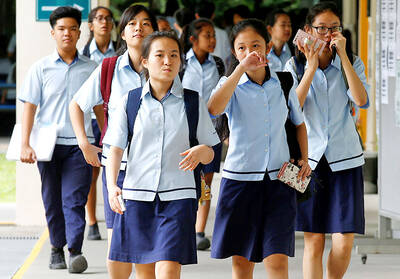
School bullies in Singapore are to face caning under new guidelines, but the education minister on Tuesday said it would be meted out only as a last resort with strict safeguards. Human rights groups regularly criticize Singapore for the use of corporal punishment, which remains part of the school and criminal justice systems, but authorities have defended it as a deterrent to crime and serious misconduct. Caning was discussed in the parliament after legislators asked how it would be used in relation to bullying in schools. The debate followed stricter guidelines on serious student misconduct, including bullying, unveiled by the Singaporean Ministry of

As evening falls in Fiji’s capital, a steady stream of people approaches a makeshift clinic that is a first line of defense against one of the world’s fastest-growing HIV epidemics. In the South Pacific nation — a popular tourist destination of just under a million people — more than 2,000 new HIV cases were recorded last year, a 26 percent increase from 2024. The government has declared an HIV outbreak and described it as a national crisis. “It’s spreading like wildfire,” said Siteri Dinawai, 46, who came to be tested. The Moonlight Clinic, a converted minibus parked in a suburban cul-de-sac in Suva, is
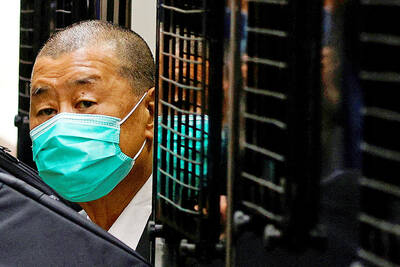
Jailed media entrepreneur Jimmy Lai (黎智英) has been awarded Deutsche Welle’s (DW) freedom of speech award for his contribution to Hong Kong’s pro-democracy movement. The German public broadcaster on Thursday said Lai would be presented in absentia with the 12th iteration of the award on June 23 at the DW Global Media Forum in Bonn. Deutsche Welle director-general Barbara Massing praised the 78-year-old founder of the now-shuttered news outlet Apple Daily for standing “unwaveringly for press freedom in Hong Kong at great personal risk.” “With Apple Daily, he gave journalists a platform for free reporting and a voice to the democracy movement in
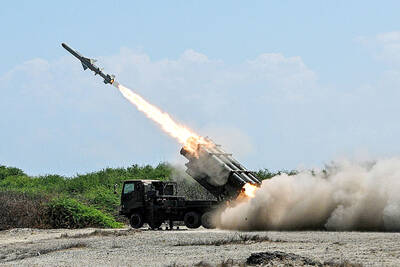
A MESSAGE: Japan’s participation in the Balikatan drills is a clear deterrence signal to China not to attack Taiwan while the US is busy in the Middle East, an analyst said The Japan Self-Defense Forces yesterday fired a Type 88 anti-ship missile during a joint maritime exercise with US, Australian and Philippine forces, hitting a decommissioned Philippine Navy ship in waters facing the disputed South China Sea, in drills that underscore Tokyo’s rising willingness to project military power on China’s doorstep. The drill took place as Manila and Tokyo began talks on a potential defense equipment transfer, made possible by Japan’s decision to scrap restrictions on military exports. The discussions include the possible early transfer of Abukuma-class destroyers and TC-90 aircraft to the Philippines, Japanese Minister of Defense Shinjiro Koizumi said. Philippine Secretary of


 RSS
RSS