


Miriam Makeba, the singer who became the musical symbol of the black struggle against apartheid, has died after collapsing at a concert in Italy. She was 76.
Makeba, nicknamed “Mama Africa” by a worldwide legion of fans and famed for hits such as Pata Pata and The Click Song, died of a heart attack in a Naples hospital after she collapsed as she left the stage at a benefit concert in Castel Volturno on Sunday.
“One of the greatest songstresses of our time Miriam Makeba has ceased to sing,” South African Foreign Minister Nkosazana Dlamini Zuma said in a statement.

PHOTO: AFP
The singer “died performing what she did best — an ability to, communicate a positive message through the art of singing,” the minister said.
Born in Johannesburg on March 4, 1932, Makeba became one of Africa’s best known singers and while Nelson Mandela was in prison took up the battle against apartheid through her music.
The South African government revoked her citizenship in 1960 and even refused to let her return for her mother’s funeral. Makeba spent more than three decades in exile, living in the US, Guinea and Europe.
She saw her music outlawed in her homeland after she appeared in an anti-apartheid film. But she was an international success, winning a Grammy award for Best Folk Recording with US singer Harry Belafonte in 1965 for the album An Evening With Belafonte/Makeba.
“I kept my culture. I kept the music of my roots,” she said in her biography. “Through my music I became this voice and image of Africa, and the people, without even realizing.”
But she also met controversy abroad. Her marriage to civil rights activist and Black Panthers leader Stokely Carmichael in 1968 caused controversy in the US and some of her concerts were canceled.
Makeba performed for half an hour on Sunday at a concert near Naples on behalf of an Italian writer, Roberto Saviano, who has received death threats after writing an expose of the Italian mafia.
“She had been the last one to go on stage, after the performances of other singers,” said Carlo Hermann, an Agence France-Presse photographer who covered the concert and witnessed fellow singers rush to her aid when she collapsed.
“There were calls for an encore and at that moment someone asked if there was a doctor in the house. Miriam Makeba had fainted and was lying on the floor,” he said.
Makeba was the daughter of a Swazi mother and Xhosa father.
She captured international attention as a vocalist for a South African group, The Manhattan Brothers, when they toured the US in 1959. Her citizenship was taken away the following year.
She was briefly married to trumpeter Hugh Masekela, another famous South African artist who also spent long years in exile under apartheid.

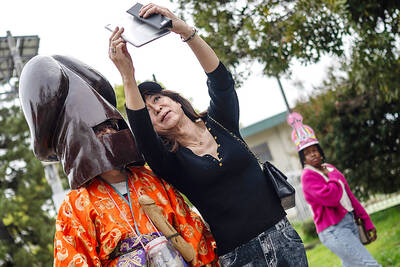
Showcasing phallus-shaped portable shrines and pink penis candies, Japan’s annual fertility festival yesterday teemed with tourists, couples and families elated by its open display of sex. The spring Kanamara Matsuri near Tokyo features colorfully dressed worshipers carrying a trio of giant phallic-shaped objects as they parade through the street with glee. The festival, as legend has it, honors a local blacksmith in the Edo Period (1603-1868) who forged an iron dildo to break the teeth of a sharp-toothed demon inhabiting a woman’s vagina that had been castrating young men on their wedding nights. A 1m black steel phallus sits in the courtyard of

HIGH HOPES: The power source is expected to have a future, as it is not dependent on the weather or light, and could be useful for places with large desalination facilities A Japanese water plant is harnessing the natural process of osmosis to generate renewable energy that could one day become a common power source. The possibility of generating power from osmosis — when water molecules pass from a less salty solution to a more salty one — has long been known. However, actually generating energy from that has proved more complicated, in part due the difficulty of designing the membrane through which the molecules pass. Engineers in Fukuoka, Japan, and their private partners think they might have cracked it, and have opened what is only the world’s second osmotic power plant. It generates

JAN. 1 CLAUSE: As military service is voluntary, applications for permission to stay abroad for over three months for men up to age 45 must, in principle, be granted A little-noticed clause in sweeping changes to Germany’s military service policy has triggered an uproar after it emerged that the law requires men aged up to 45 to get permission from the armed forces before any significant stay abroad, even in peacetime. The legislation, which went into effect on Jan. 1 aims to bolster the military and demands all 18-year-old men fill out a questionnaire to gauge their suitability to serve in the armed forces, but stops short of conscription. If the “modernized” model fails to pull in enough recruits, parliament will be compelled to discuss the reintroduction of compulsory service, German
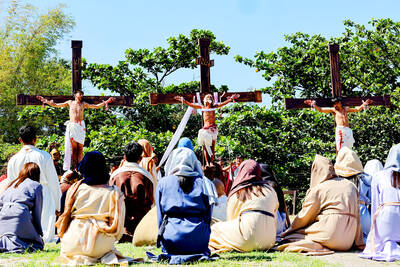
Hundreds of Filipinos and tourists flocked to a sun-bleached field north of Manila yesterday, on Good Friday, to witness one of the country’s most blood-soaked displays of religious fervor, undeterred by rising fuel prices. Scores of bare-chested flagellants with covered faces walked barefoot through the dusty streets of Pampanga Province’s San Fernando as they flogged their backs with bamboo whips in the scorching heat. Agence France-Presse (AFP) journalists said they saw devotees deliberately puncturing their skin with glass shards attached to a small wooden paddle to ensure their bleeding during the ritual, a way to atone for sins and seek miracles from


 RSS
RSS