


A 62-year-old lawmaker held captive eight years by leftist rebels walked to freedom in a western Colombia jungle on Sunday along with the young guerrilla commander who had been his jailer.
Colombian President Alvaro Uribe said the rebel and his girlfriend would be rewarded with cash and asylum in France.
Oscar Tulio Lizcano is the first Revolutionary Armed Forces of Colombia (FARC) hostage to gain freedom since the July 2 rescue of former presidential candidate Ingrid Betancourt and three US military contractors.
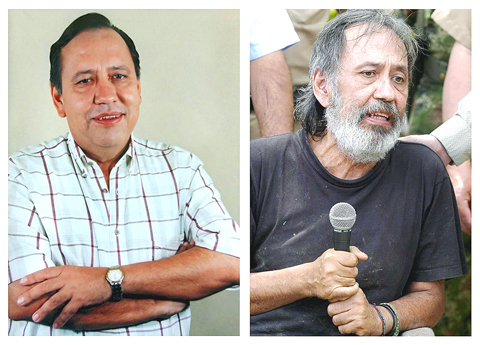
PHOTO: EPA
His escape is yet another blow to Latin America’s last major rebel army, which is battling record desertions under withering pressure from Colombia’s US-backed military.
The white-bearded Lizcano encountered a military road checkpoint three days after escaping with the leader of the unit that held him.
He looked haggard in a grimy black shirt and muddy training pants during a brief news conference at a military base in the western city of Cali. He apologized for his somewhat incoherent speech, saying his captors had forbidden him to speak. He thanked “the person who had the courage, the valor to leave with me.”
“I was really sick,” he said, collapsed in a chair beside a standing Colombian Defense Minister Juan Manuel Santos and police and military commanders.
He said he had eaten little while on the run with his 28-year-old captor, known only by the alias “Isaza.”
Lizcano was taken to a clinic, where doctors said he was dehydrated and had signs of malnutrition.
Santos said the escape followed the Oct. 10 desertion of a second rebel, alias “Moroco,” from the camp where Lizcano was held. He said that guerrilla disclosed Lizcano’s precise whereabouts to authorities, who already had a rough idea of the location and had been strangling rebel supply routes.
Santos put their number at about eight women and six men. Lizcano said food was so scarce in the camp that he ate a lot palm hearts and sugar cane.
Colombia’s military has put withering pressure the FARC since early last year, killing or capturing top commanders and spurring record desertions and betrayals among rebels with lucrative reward offers.
Uribe said “Isaza” would receive a reward — Santos put it at about US$400,000 — and asylum in France along with his girlfriend.
He made the announcement as he prepared to meet in Cali with leaders of some 30,000 Indians who had marched to the city demanding land and justice in the murders of indigenous leaders.
The young rebel, a patch over his left eye covering a four-year-old wound, beamed at the news.
Late last year, France offered asylum to any FARC rebels who demobilized, part of an effort to secure the release of hostages including Betancourt, a dual French national.
“The French government has now told us that it accepts having Isaza in France,” Uribe said.
Lizcano was kidnapped on Aug. 5, 2000, while inaugurating a soccer field in his home province of Caldas ahead of municipal elections.
The government’s peace commissioner, Luis Carlos Restrepo, had said last week without providing details that FARC deserters had reported Lizcano’s health was delicate.
Informed of Lizcano’s freedom, Betancourt told Caracol radio that it should send a message to the FARC that “it should change its attitude, that we should get a peace process going in Colombia.”
Efforts to negotiate a prisoner swap were frozen months before her rescue and the government has said it has made no efforts to contact the rebels and resume them.
The FARC still holds at least 20 high-value politicians, police officers and soldiers — including a provincial governor and a police colonel, some of whom have been held for more than a decade.
It is now down to an estimated 9,000 fighters by government count — half its strength when Uribe first took office in 2002.

‘CROSSING THE LINE’: China’s embassy in Seoul criticized US Forces Korea Commander General Xavier Brunson, asking if his ‘hostile’ remarks were authorized by Washington South Korea and the US are in talks over recent public remarks by the commander of US Forces Korea, Seoul’s presidential office said yesterday, after the comments drew sharp criticism from China. In a recent podcast interview, US Forces Korea Commander General Xavier Brunson described South Korea as “the dagger in the heart of Asia” from China’s east coast, prompting the Chinese embassy in Seoul to say that he had “truly crossed the line.” The interview came amid growing speculation that Washington might seek to expand the role of US Forces Korea in countering the growing regional influence of China, a key

SEEKING ORDER: Rodrigo Paz said that ‘anyone who wants to destroy the nation will have to deal with this president and the full force of the constitution’ Bolivian President Rodrigo Paz on Wednesday said that the nation was at a “breaking point” after nearly a month of protests that have caused shortages of food, fuel and medicine. Paz, who took office six months ago amid the worst economic crisis there in four decades, is battling a groundswell of fury over his policies. The political capital, La Paz, has been besieged by low-income workers and members of the indigenous majority calling for his resignation. “The country needs order and is reaching breaking point,” the 58-year-old said at a public event in La Paz, renewing his appeal for dialogue. On Tuesday, the Bolivian

Australian researchers have trained lab-grown brain cells on a silicon computer chip to play the 1990s shooter game Doom and said they are just scratching the surface of what the neurons could be capable of doing. It is the science-fiction work of biotech boffins at Cortical Labs, who researched and developed the technology that harnesses the workings of the brain’s networking system. Each so-called “biological computer” contains about 200,000 living human brain cells, grown from stem cells that were harvested from blood donations. Having mastered the simple computer game Pong, where a paddle is moved up and down to send a ball

Through the noise of rushing papers and whirring belts at a print factory in Kyoto, two creators watch their photo essay come to life in broadsheet form — part of an effort to win new audiences in the age of artificial intelligence (AI). Despite the decline of the publishing industry, self-publication and handmade “zine” magazines are growing in popularity in Japan, reflecting the nation’s enduring love of paper in the digital era. While speaking to Agence France-Presse at the plant, his hands black with ink, one of the creators, Kazuma Obara, said: “I think [paper] is a medium that engages all five


 RSS
RSS