


A defiant Basque regional parliament narrowly approved plans on Friday for a referendum seen as a veiled push for breaking away from Spain, setting it on a collision course with the central government.
Spain’s government immediately vowed to block the referendum, saying it was unconstitutional.
“The plan will be appealed and suspended,” Deputy Prime Minister Maria Teresa Fernandez de la Vega said.
The government will file a lawsuit with the Constitutional Court, which is Spain’s highest. Once it agrees to consider the motion, this has the effect of automatically suspending plans for the referendum, which Basque authorities want to hold Oct. 25.
The referendum would put two questions to a vote. The first asks Basques if they favor a negotiated solution to the separatist conflict if armed militant group ETA is willing to end violence.
The second asks if they agree that all Basque political parties should work toward an agreement on what it calls Basques’ right to decide their future and that this should be put to a second referendum before the end of 2010.
When Basques talk about such self-determination, critics elsewhere in Spain see this as code for advocating a breakaway from Spain.
“His idea divides and it will not go forward,” Prime Minister Jose Luis Rodriguez Zapatero said of Basque regional president Juan Jose Ibarretxe’s planned referendum.
The Basque regional government, run by a coalition of three moderate nationalist parties that lack a majority, got help on Friday from a pro-independence party that supports ETA.
The Communist Party of the Basque Lands allowed one of its nine lawmakers to vote in favor of the referendum.
The final tally in the 75-seat Basque legislature was 34-33 with seven abstentions. One legislator was absent.
Zapatero’s government says the planned referendum is unconstitutional because only Spain’s government, not a regional administration, can authorize such a vote.
“Democracy is above all a set of rules which have been previously agreed so that things can work,” Zapatero told reporters in the northeastern city of Zaragoza.
Ibarretxe first floated the idea late last year as part of a “road map” peace plan following the collapse of negotiations between the Spanish government and ETA.
In debate before Friday’s vote, Ibarretxe denied the referendum was divisive, and insisted there is nothing wrong with simply asking people what they want.
“Democracy is not about keeping society from having an opinion and expressing it, but rather about consulting, hearing citizens’ desires and respecting them,” he said.
Ibarretxe is also being criticized for reneging on a pledge to hold a referendum only if ETA, which has killed around 825 people since 1968, puts an end to attacks.


Through the noise of rushing papers and whirring belts at a print factory in Kyoto, two creators watch their photo essay come to life in broadsheet form — part of an effort to win new audiences in the age of artificial intelligence (AI). Despite the decline of the publishing industry, self-publication and handmade “zine” magazines are growing in popularity in Japan, reflecting the nation’s enduring love of paper in the digital era. While speaking to Agence France-Presse at the plant, his hands black with ink, one of the creators, Kazuma Obara, said: “I think [paper] is a medium that engages all five
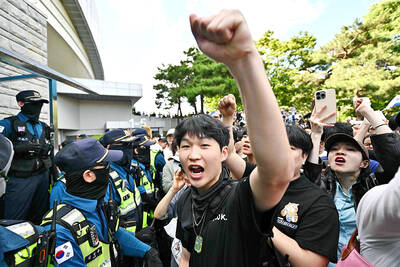
‘ABSURD MISTAKE’: The election commission said that there had been a failure to anticipate turnout after 14 polling stations ran short of ballot papers South Korean riot police yesterday cleared protesters from a Seoul polling station after a 35-hour blockade sparked by a shortage of ballot papers during local elections earlier this week. Wednesday’s election was the first nationwide vote since South Korean President Lee Jae-myung took office following the ouster of Yoon Suk-yeol over his short-lived martial law declaration. Lee’s ruling Democratic Party swept most races, but failed to flip the crucial Seoul mayoral seat. The South Korean National Election Commission apologized, blaming a failure to anticipate turnout after 14 polling stations in Seoul ran short of ballot papers. Some polling stations stayed open until 10pm to

France experienced its hottest spring on record, the French weather service said on Tuesday, after an exceptional early heat wave that also broke highs for the season in England and Wales. Meteo-France said the average nationwide temperature over March to May was 13.8°C — about 1.7°C above the norm, and surpassing records set in 2011 and 2020. “The warmest spring since records began in 1900,” it said in a bulletin. All three months were warmer than average, but the onset of an “unprecedented heatwave” late last month pushed the mercury to highs typically seen at the height of the summer. “Our country had never

A Sherpa guide was found crawling to base camp on Mount Everest a week after he went missing and was reunited with his family, who had given up hope he would return. Dawa Sherpa was last seen on Friday last week descending the mountain, but he did not reach base camp even though his client did. The pair were among the last climbers on the mountain as the climbing season came to an end and the route was dismantled. Dawa was located by a cleaning crew on Thursday morning as he was crawling down the snowy slopes around the Khumbu Icefall, just above


 RSS
RSS