


Taliban militants destroyed bridges and planted mines in several villages they control outside southern Afghanistan's largest city in apparent preparation for battle, residents and officials said yesterday.
More than 700 families — meaning perhaps 4,000 people or more — had fled the Arghandab district 15km northwest of Kandahar city, said Sardar Mohammad, a police officer manning a checkpoint on the east side of the Arghandab River. Police stopped and searched every person passing on the road yesterday.
On the west side of the river, hundreds of Taliban controlled around nine or 10 villages, Mohammad said.
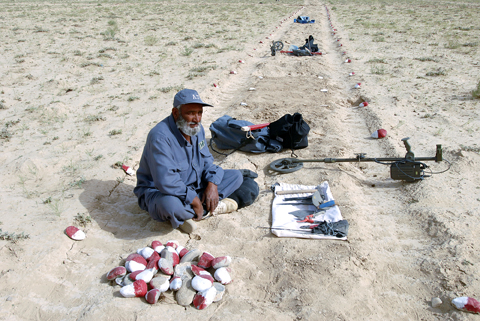
PHOTO: AP
“Last night the people were afraid and families on tractors, trucks and taxis fled the area,” Mohammad said. “Small bridges inside the villages have been destroyed.”
The Afghan army flew four planeloads of soldiers to Kandahar from Kabul yesterday. Canadian forces have also moved in to the region.
“When we get permission from commanders, we will attack the Taliban,” Mohammad said.
The Taliban assault on the outskirts of Kandahar was the latest display of strength by the militants despite a record number of US and NATO troops in the country.
The push into Arghandab district — a lush region filled with grape and pomegranate groves that the Soviet army could never conquer — came three days after a coordinated Taliban attack on Kandahar’s prison that freed 400 insurgent fighters.
Police and army soldiers increased security throughout Kandahar and enforced a 10pm curfew.
A Taliban commander named Mullah Ahmedullah called an Associated Press reporter yesterday and said that around 400 Taliban moved into Arghandab from Khakrez, one district to the north. He said some of the militants released in Friday’s prison break had joined the assault.
“They told us: ‘We want to fight until the death,’” Ahmedullah said. “We’ve occupied most of the area and it’s a good place for fighting. Now we are waiting for the NATO and Afghan forces.”
The hardline Taliban regime ousted from power in a 2001 US-led invasion of Afghanistan regarded Kandahar as its main stronghold and its insurgent supporters are most active in the volatile south of the country.
The US and NATO have pleaded for additional troops over the last year and now have some 65,000 in the country. But the militants are still finding successes that the international alliance can’t counter.
Arghandab lies just northwest of Kandahar and a tribal leader from the region warned that the militants could use the cover from Arghandab’s orchards to mount an attack on Kandahar.
NATO officials dismiss the idea that the Taliban can mount an attack on Kandahar.
One of the thousands of Afghans fleeing Arghandab said yesterday that families were being forced out just as grape groves needed harvesting, meaning financial ruin for thousands.
Haji Ibrahim Khan said Taliban fighters were moving through several Arghandab villages with weapons on their shoulders, planting mines and destroying small bridges.
“They told us to leave the area within 24 hours because they want to fight foreign and Afghan troops,” Khan said. “But within a week we should be harvesting and we were expecting a good one. Now with this fighting we are deeply worried — the grapes are the only source of income we have.”
Two powerful anti-Taliban leaders from Arghandab have died in the last year, weakening the region’s defenses. Mullah Naqib, the district’s former leader, died of a heart attack in October. Taliban fighters moved into Arghandab en masse two weeks after his death but left within days after soldiers moved in.
A second leader, police commander Abdul Hakim Jan, died in a massive suicide bombing in Kandahar in February.
The assault on Monday came one day after Afghan President Hamid Karzai angrily told a news conference that he would send Afghan troops into Pakistan to hunt down Taliban leaders in response to the militants that cross over into Afghanistan from Pakistan.

‘CROSSING THE LINE’: China’s embassy in Seoul criticized US Forces Korea Commander General Xavier Brunson, asking if his ‘hostile’ remarks were authorized by Washington South Korea and the US are in talks over recent public remarks by the commander of US Forces Korea, Seoul’s presidential office said yesterday, after the comments drew sharp criticism from China. In a recent podcast interview, US Forces Korea Commander General Xavier Brunson described South Korea as “the dagger in the heart of Asia” from China’s east coast, prompting the Chinese embassy in Seoul to say that he had “truly crossed the line.” The interview came amid growing speculation that Washington might seek to expand the role of US Forces Korea in countering the growing regional influence of China, a key

SEEKING ORDER: Rodrigo Paz said that ‘anyone who wants to destroy the nation will have to deal with this president and the full force of the constitution’ Bolivian President Rodrigo Paz on Wednesday said that the nation was at a “breaking point” after nearly a month of protests that have caused shortages of food, fuel and medicine. Paz, who took office six months ago amid the worst economic crisis there in four decades, is battling a groundswell of fury over his policies. The political capital, La Paz, has been besieged by low-income workers and members of the indigenous majority calling for his resignation. “The country needs order and is reaching breaking point,” the 58-year-old said at a public event in La Paz, renewing his appeal for dialogue. On Tuesday, the Bolivian

Forecasters in Europe yesterday warned of exceptional heat as record temperatures driven by a “heat dome” push temperatures well above seasonal norms across the continent. The surge follows a record-breaking Monday, with France logging its hottest day in the month of May on record, its weather agency said, and the UK also posting unprecedented highs. A so-called “heat dome” of warm air from northern Africa trapped under a high-pressure system over western Europe is behind the high temperatures not usually seen until high summer. Restrictions on outdoor work were imposed in parts of Italy, beaches in southwest France filled earlier than usual and

Australian researchers have trained lab-grown brain cells on a silicon computer chip to play the 1990s shooter game Doom and said they are just scratching the surface of what the neurons could be capable of doing. It is the science-fiction work of biotech boffins at Cortical Labs, who researched and developed the technology that harnesses the workings of the brain’s networking system. Each so-called “biological computer” contains about 200,000 living human brain cells, grown from stem cells that were harvested from blood donations. Having mastered the simple computer game Pong, where a paddle is moved up and down to send a ball


 RSS
RSS