


Thousands of soldiers scoured China's mountainous earthquake zone yesterday for a military helicopter that was carrying injured quake survivors when it crashed in a fog at the weekend.
There was no clue as to the fate of the five crew members and 14 passengers who were on board the army Mi-171 helicopter when it went down on Saturday in southwestern Sichuan Province, the state-run Xinhua news agency reported.
It said four rescue helicopters had launched missions in the area where the crash was believed to have taken place, assisted by more than 3,000 soldiers on the ground.
But the search had so far been in vain, the Chinese defense ministry said.
“The wreckage of the crashed helicopter has not yet been found,” the ministry said in a statement, adding that a “continuous and all-out air and ground search” had been launched.
Military personnel involved in the effort said they believed the crash took place in the vicinity of Zhaogong Mountain in Sichuan Province, which bore the brunt of the May 12 quake.
The helicopter was on a mission to carry epidemic prevention experts to Li County and was returning with residents too seriously injured to be moved by land, the agency said.
Reflecting the grueling routines forced on military chopper crews in the quake zone, it had completed 63 flights since the earthquake on May 12.
The death toll from the quake, China’s worst for a generation, has risen to 69,016, with 18,830 still missing, the government said on Sunday.
Meanwhile, more than a million people waited anxiously for drainage work to start on a menacing lake — the size of more than 50,000 Olympic-size swimming pools — created when quake-triggered landslides blocked a river.
Regular troops and paramilitary forces toiled for a week to dig a diversion channel for the Tangjiashan “quake lake,” hoping to prevent it overflowing and flooding densely populated areas downstream.
By late Sunday, the last troops had been flown out by helicopter, leaving a handful of experts charged with monitoring the situation, the water resources ministry said on its Web site.
It remained unclear early yesterday if the plan to divert water via the newly dug channel would succeed.
State television said earlier that plans to blast holes in the rubble with dynamite had been abandoned amid fears it could trigger a flood.
The Tangjiashan lake is just one of about three dozen “quake lakes” created by the 7.9 magnitude tremor, and people throughout the region are monitoring as the others swell.
“We have sent our water resource specialists and geologists to check out the quake lakes,” said Wen Miaogui, a spokesman for Hongbai Township, one of several communities devastated by the quake.
“We think they won’t be too dangerous. Downstream we have a lot of good infrastructure, so we think we will be able to avoid disaster,” he said.
While that work goes on, people are still trying to piece together their lives.
Of the dead, more than 11,000 are reported to be children and teachers who were killed when schools collapsed on top of them.
It made Children’s Day, which China marked on Sunday, a particularly poignant occasion as grieving parents mourned their offspring and vented fury over the alleged shoddy construction of many school buildings.
“[The authorities] said we should come and celebrate because the kids here today are the future of Beichuan,” a young mother surnamed Li said.
“But my son should be out there ... my son should be out there,” Li said.
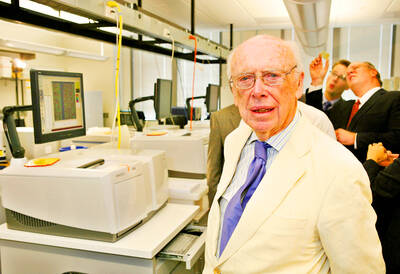
James Watson — the Nobel laureate co-credited with the pivotal discovery of DNA’s double-helix structure, but whose career was later tainted by his repeated racist remarks — has died, his former lab said on Friday. He was 97. The eminent biologist died on Thursday in hospice care on Long Island in New York, announced the Cold Spring Harbor Laboratory, where he was based for much of his career. Watson became among the 20th century’s most storied scientists for his 1953 breakthrough discovery of the double helix with researcher partner Francis Crick. Along with Crick and Maurice Wilkins, he shared the
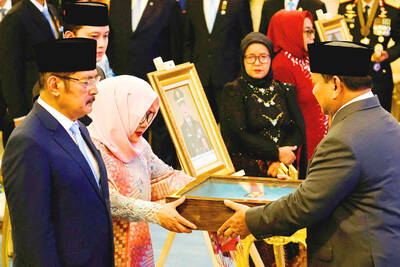
OUTRAGE: The former strongman was accused of corruption and responsibility for the killings of hundreds of thousands of political opponents during his time in office Indonesia yesterday awarded the title of national hero to late president Suharto, provoking outrage from rights groups who said the move was an attempt to whitewash decades of human rights abuses and corruption that took place during his 32 years in power. Suharto was a US ally during the Cold War who presided over decades of authoritarian rule, during which up to 1 million political opponents were killed, until he was toppled by protests in 1998. He was one of 10 people recognized by Indonesian President Prabowo Subianto in a televised ceremony held at the presidential palace in Jakarta to mark National
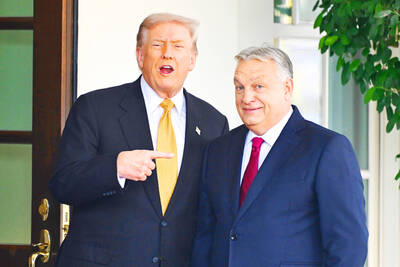
US President Donald Trump handed Hungarian Prime Minister Viktor Orban a one-year exemption from sanctions for buying Russian oil and gas after the close right-wing allies held a chummy White House meeting on Friday. Trump slapped sanctions on Moscow’s two largest oil companies last month after losing patience with Russian President Vladimir Putin over his refusal to end the nearly four-year-old invasion of Ukraine. However, while Trump has pushed other European countries to stop buying oil that he says funds Moscow’s war machine, Orban used his first trip to the White House since Trump’s return to power to push for
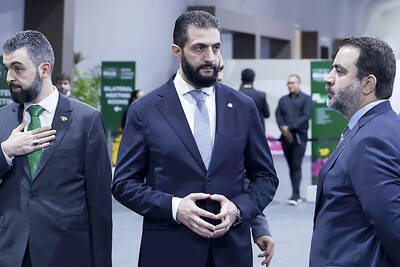
LANDMARK: After first meeting Trump in Riyadh in May, al-Sharaa’s visit to the White House today would be the first by a Syrian leader since the country’s independence Syrian President Ahmed al-Sharaa arrived in the US on Saturday for a landmark official visit, his country’s state news agency SANA reported, a day after Washington removed him from a terrorism blacklist. Sharaa, whose rebel forces ousted long-time former Syrian president Bashar al-Assad late last year, is due to meet US President Donald Trump at the White House today. It is the first such visit by a Syrian president since the country’s independence in 1946, according to analysts. The interim leader met Trump for the first time in Riyadh during the US president’s regional tour in May. US envoy to Syria Tom Barrack earlier


 RSS
RSS