


Police said yesterday they expected to file charges over a Sydney art exhibition that the Australian prime minister called revolting for its portrayal of nude 12- and 13-year-old children.
The exhibit by leading Australian photographer Bill Henson was suspended by police just ahead of its scheduled opening on Thursday night, following public outrage.
It included large photographic prints of naked children, including a frontal image of a teenage girl.
Police removed more than 20 photographs from the Roslyn Oxley9 Gallery yesterday.
“Police are investigating this matter and it is likely that we will proceed to prosecution on the offense of publishing an indecent article under the Crimes Act,” Local Area Commander Allan Sicard said.
He would not specify who was likely to be charged.
Sicard said some of the photos depicted a 13-year-old girl “in a sexual context.”
Henson and the gallery agreed on Thursday to temporarily suspend the show to allow investigators to speak to the children and their parents, police said. Henson’s exhibition consisted of 41 photographs.
The Web site for the gallery went offline to remove the photos.
It was back online yesterday afternoon, with a statement saying the exhibition would reopen without the controversial images.
“Roslyn Oxley9 Gallery will remain closed while the current exhibition is rehung” the statement jointly issued with Henson said. The statement defended Henson’s reputation as an internationally respected contemporary artist.
Australian Prime Minister Kevin Rudd weighed in on the issue during a morning interview on Nine Network television.
“I think they’re revolting. Kids deserve to have the innocence of their childhood protected,” Rudd said. “I have a very deep view of this. For God’s sake let’s just allow kids to be kids, whatever the artistic view or the merits of that sort of stuff. Frankly I don’t think there are any.”
Child protection group Braveheart labeled the photos child pornography and exploitation and called for Henson and the gallery to be prosecuted.
Child protection advocate Hetty Johnston said the photographer and exhibitor should both be prosecuted.
“You can call it anything you want, but at the end of the day, these are images of naked adolescents,” Johnston said.
“We all have a responsibility to look after children. Putting naked photos up there on public display in a gallery ... and even on the Internet is just totally betraying our duty of care to children,” Johnston said.
In media interviews ahead of the exhibition, Henson said he left interpretation of the images to audiences.
“You can’t control the way individuals respond to the work,” he said, saying he photographed adolescents because they reflected a humanity and vulnerability.
Some artists and gallery patrons viewed the shutdown as censorship.
“I think the sexualization of children is an extremely important [issue],” art market analyst Michael Reid said. “The question is: ‘Was there consent?’ which I can’t answer, and ‘Has the image been sexualized?’ In my opinion, it wasn’t.”


PHISHING: The con might appear convincing, as the scam e-mails can coincide with genuine messages from Apple saying you have run out of storage For a while you have been getting messages from Apple saying “your iCloud storage is full.” They say you have exceeded your storage plan, so documents are no longer being backed up, and photos you take are not being uploaded. You have been resisting Apple’s efforts to get you to pay a minimum of £0.99 (US$1.33) a month for more storage, but it seems that you cannot keep putting off the inevitable: You have received an e-mail which says your iCloud account has been blocked, and your photos and videos would be deleted very soon. To keep them you need
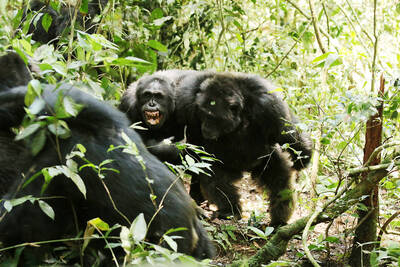
For two decades, researchers observed members of the Ngogo chimpanzee group of Kibale National Park in Uganda spend their days eating fruits and leaves, resting, traveling and grooming in their tropical rainforest abode, but this stable community then fractured and descended into years of deadly violence. The researchers are now describing the first clearly documented example of a group of wild chimpanzees splitting into two separate factions, with one launching a series of coordinated attacks against the other. Adult males and infants were targeted, with 28 deaths. “Biting, pounding the victim with their hands, dragging them, kicking them — mostly adult males,
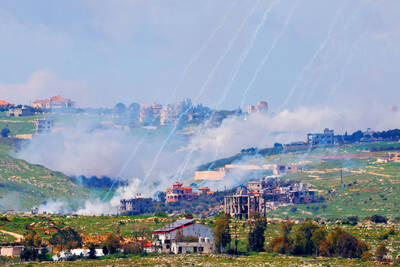
The Israeli military has demolished entire villages as part of its invasion of south Lebanon, rigging homes with explosives and razing them to the ground in massive remote detonations. The Guardian reviewed three videos posted by the Israeli military and on social media, which showed Israel carrying out mass detonations in the villages of Taybeh, Naqoura and Deir Seryan along the Israel-Lebanon border. Lebanese media has reported more mass detonations in other border villages, but satellite imagery was not readily available to verify these claims. The demolitions came after Israeli Minister of Defense Israel Katz called for the destruction of
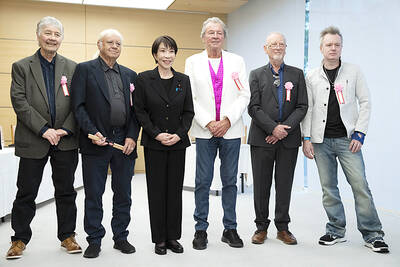
SUPERFAN: The Japanese PM played keyboard in a Deep Purple tribute band in middle school and then switched to drums at university, she told the British rock band Legendary British rock band Deep Purple yesterday made Japanese Prime Minister Sanae Takaichi’s day with a brief visit to their high-profile superfan as they returned to the nation they first toured more than half a century ago. Takaichi’s reputation as an amateur drummer, and a fan of hard rock and heavy metal has been well documented, and she has referred to Deep Purple as one of her favorite bands along with the likes of Black Sabbath and Iron Maiden. “You are my god,” a giddy Takaichi said in English to Deep Purple drummer Ian Paice, presenting him with a set of made-in-Japan


 RSS
RSS