

Haiti’s prime minister was ousted on Saturday in a no confidence vote after more than a week of violent demonstrations over rocketing food and fuel prices.
Just as Haitian President Rene Preval unveiled a plan to cut the price of rice by 15 percent, 16 senators in the upper house of parliament voted unanimously to censure Prime Minister Jacques-Edouard Alexis over the crisis, costing him his job leading the government.
With the 10 senators in Alexis’ own party absent, the legislators reproached the prime minister for failing to respond to the needs of Haiti’s 8.5 million people, 80 percent of whom live on less than US$2 a day.

PHOTO: EPA
The move came amid reports that UN peacekeepers fired tear gas at protesters in central Port-au-Prince and that a UN policeman dressed in civilian clothes was shot dead by unknown assailants near the capital’s cathedral.
“He was a riot policeman from Nigeria,” said Sophie Boutaud de la Combe, spokeswoman for the Minustah force.
Earlier Preval said that he would not block any attempt to remove Alexis. He agreed to work with senate and lower house chiefs to find a replacement.
“If parliament fires the prime minister, I will do what the constitution demands — I will consult the two parliamentary leaders to name a new prime minister, because no party has a parliamentary majority,” Preval said.
Flanked by food importers, Preval announced his plan to bring down rice prices following more than a week of protests and riots that left at least five people dead and 200 injured, an unofficial count showed.
He said the plan would cut the cost of a 50kg bag of rice, which had doubled to US$70 within a week, by US$8 or 15 percent.
“It is a move the government has agreed to thanks to the US$3 million in aid provided by the international community,” Preval said, adding that the government would also work to encourage more food production.
He defended Alexis as having done what he could in the face of global increases in food prices, and said it was “unfair” to place all the blame on him.
Thousands of people took to the streets around Haiti last week after the latest jump in food and fuel prices, in sometimes violent demonstrations that forced UN troops deployed there to intervene.
Blue-helmeted UN peacekeepers were called in to protect the presidential palace, using tear gas and firing into the air to repel demonstrators, radio reports said, while there were also reports of looting.
Preval’s government was formed in 2006 after elections that followed two years of turmoil sparked by the departure of president Jean-Bertrand Aristide. Preval named Alexis as his prime minister and Alexis won a vote of confidence in the lower house of parliament as recently as a month ago.
However, pressure had grown on the government in the current crisis.
Senator Jean Judnel, who backed Saturday’s censure motion, said lawmakers would now “work with the president to chose a new prime minister.”
“We will size up that prime minister to see if he can respond to the needs of the population,” Judnel said.
“He must be able to listen to the cries of the people,” Judnel said.
Meanwhile, Venezuelan President Hugo Chavez announced that Caracas would send Haiti 364 tonnes of emergency food aid, including beef, chicken, milk, cooking oil, lentils and other foods.
Chavez, in Caracas, said the decision was aimed at helping “to ease a crisis that is enormous.”

A cross-party group of Japanese lawmakers, including one from Prime Minister Sanae Takaichi’s governing party, yesterday headed to Beijing to meet with Chinese officials for the first time since ties between the two Asian rivals deteriorated after Takaichi’s comment on Taiwan angered China. The group, which includes Gaku Hashimoto, a lawmaker of Takaichi’s governing Liberal Democratic Party and a former health and welfare vice minister, and a lawmaker each from two opposition parties Komeito and the Centrist Reform Alliance (CRA), is to meet with Chinese Communist Party officials during their visit through Thursday. “Communication has been severed in all areas and we
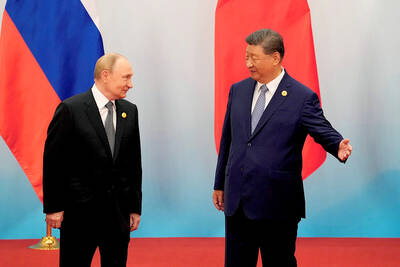
PLENARY SESSION: Although the SCO says it is ‘not an alliance directed against other states,’ Putin and Xi have repeatedly made anti-Western speeches during its summits Russian President Vladimir Putin and Chinese President Xi Jinping (習近平) are expected tomorrow in Kyrgyzstan for a two-day summit, also attended by Iran’s and India’s leaders, of a regional bloc seeking to be a counter-influence to the West. Around a dozen heads of states would head to the Kyrgyz capital, Bishkek, to mark 25 years of the Shanghai Cooperation Group (SCO). The group brings together Russia, China, India, Pakistan, Iran, four Central Asian countries and Moscow-allied Belarus. Putin and Xi have previously used SCO summits to promote their vision of a multipolar world and present a united front against the

A swarm of about 700 artificial intelligence (AI) agents created by OpenAI carried out last month’s hack of the open-source platform Hugging Face and in many cases tried to cover their tracks, a pair of reports into the breach said on Wednesday. The coordinated activity by AI agents — programs that run with minimal human supervision — and their attempts to hide it raise questions about how closely AI companies are monitoring tests of increasingly powerful models, and could add fuel to calls for tighter oversight. While some of the rogue behavior has been disclosed or alluded to previously, the two reports

FLEXIBLE EMPLOYMENT: With gig workers making up about 44% of China’s urban workforce, Zhang Dandan’s comments sparked public outrage The term “flexible employment” has gone viral in China after a prominent economics professor described gig work as a form of “welfare,” drawing widespread public anger and highlighting deep anxieties over job insecurity. Zhang Dandan (張丹丹), a professor of economics and deputy dean at Peking University’s National School of Development, made the remarks during a discussion on social protection for gig workers, on the popular financial show Let’s Talk (張丹丹) last week. She said that from the perspective of labor economics, “flexibility itself is a form of welfare.” While regular employees trade schedule flexibility for pensions and other benefits, flexible workers enjoy greater


 RSS
RSS