


He may have risen to superstardom playing Moses in The Ten Commandments, but US actor Charlton Heston, who died on Saturday at the age of 84, also made a name for himself — and gained a bit of notoriety — preaching about gun rights.
Beginning as a civil rights activist, developing into a staunch defender of the arts and, later in life, growing into an adamant supporter of the right to bear arms, Heston was more than just an epic film hero.
Actor and singer Frank Sinatra once quipped: “That guy Heston has to watch it. If he’s not careful, he’ll get actors a good name.”
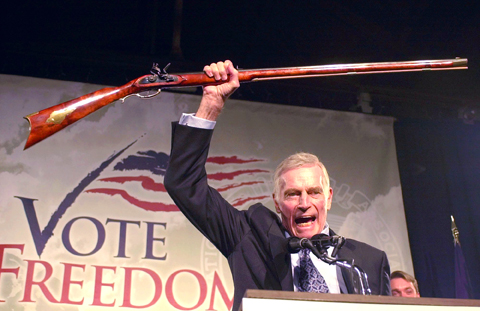
PHOTO: AP
Born John Charlton Carter on Oct. 4, 1923, in Evanston, Illinois, Heston created his pseudonym by combining his mother’s maiden name, Charlton, with his stepfather’s name, Heston.
Growing up in rural Michigan, Heston was one of just 13 students attending a one-room school. He had few friends until his family moved to suburban Chicago and he began playing high school football and acting in plays.
He later attended Northwestern University, served in the air force in World War II and eventually landed on Broadway, making his debut in Antony and Cleopatra.
He was also among the first Broadway actors to make a successful transition to television in the 1950s, when the small screen was on the rise, appearing in Macbeth, Jane Eyre and Wuthering Heights, among other classics.
In a career that spanned half a century, Heston made 62 films, including, more Any Given Sunday in 1999 and Town and Country in 2001.
He also triumphantly returned to television in the 1980s, with a role in the hit series Dynasty.
“I’ve played cardinals and cowboys, kings and quarterbacks, presidents and painters, cops and conmen,” he once said.
Though he was perhaps at his best in epics like Ben-Hur and The Ten Commandments, Heston also mastered science-fiction with roles in films like the 1960s cult classic Planet of the Apes.
Anthony Mann, who directed Heston in El Cid, once said, “Charlton is the ideal actor for the epic. Apart from his physical attributes, he can handle a horse, a sword, a chariot, a lance — anything — as though he were made for it. He’s incredible. Put a toga on him and he looks perfect.”
This versatility and natural talent helped him win the best actor Oscar in 1959 for Ben-Hur, as well as awards from more than 20 other countries.
He also made a lasting impact with 1970s disaster flicks like Earthquake and Airport 1975.
But activism was another key role that Heston played. A six-term president of the Screen Actors Guild, from 1965 to 1971, he also served as chairman of the American Film Institute and was chosen by then US president and one-time actor Ronald Reagan to cochair the White House Task Force on the Arts and Humanities.
He also won the Academy of Motion Picture Arts and Sciences’ Jean Hersholt Award in 1977 for his humanitarian work.
Heston was an avid civil rights activist who marched alongside Martin Luther King Jr during the 1963 March on Washington.
He was also a prominent gun enthusiast, serving as four-term president of the National Rifle Association gun lobbying group, and famously declared that anyone seeking to take away his rifle would have to “pry it from my cold, dead hands!”
Heston visited US troops in Vietnam three times and served as a member of the National Council for the Arts.

‘GROSS NEGLIGENCE?’ Despite a spleen typically being significantly smaller than a liver, the surgeon said he believed Bryan’s spleen was ‘double the size of what is normal’ A Florida surgeon who is facing criminal charges after allegedly removing a patient’s liver instead of his spleen has said he is “forever traumatized” by that person’s death. In a deposition from November last year that was recently obtained by NBC, 44-year-old Thomas Shaknovsky described the death of 70-year-old William Bryan as an “incredibly unfortunate event that I regret deeply.” Bryan died after the botched surgery; and last month, a grand jury in Tallahassee indicted Shaknovsky on a charge of manslaughter. “I’m forever traumatized by it and hurt by it,” Shaknovsky added, also saying that wrong-site surgeries can happen “during

Kouri Richins, a Utah mother who published a children’s book about grief after the death of her husband is to serve a life sentence for his murder without the possibility of parole, a judge ruled on Wednesday. Richins was convicted in March of aggravated murder for lacing a cocktail given to her husband, Eric Richins, with five times the lethal dose of fentanyl at their home near Park City in 2022. A jury also found her guilty of four other felonies, including insurance fraud, forgery and attempted murder for trying to poison her husband weeks earlier on Feb. 14, 2022, with a

Former Chinese ministers of national defense Wei Fenghe(魏鳳和) and Li Shangfu (李尚福) were both sentenced to death with a two-year reprieve over graft charges, state news agency Xinhua reported on Thursday, underscoring the severity of the purge in the military. The armed forces have been one of the main targets of a broad corruption crackdown ordered by Chinese President Xi Jinping (習近平) after coming to power in 2012. The purges reached the elite Rocket Force, which oversees nuclear weapons as well as conventional missiles, in 2023. Earlier this year they escalated further, resulting in the removal of the top general in

‘PERSONAL MISTAKES’: Eileen Wang has agreed to plead guilty to the felony, which comes with a maximum sentence of 10 years in federal prison A southern California mayor has agreed to plead guilty to acting as an illegal agent for the Chinese government and has resigned from her city position, officials said on Monday. Eileen Wang (王愛琳), mayor of Arcadia, was charged last month with one count of acting in the US as an illegal agent of a foreign government. She was accused of doing the bidding of Chinese officials, such as sharing articles favorable to Beijing, without prior notification to the US government as required by law. The 58-year-old was elected in November 2022 to a five-person city council, from which the mayor is selected


 RSS
RSS