


Baba Amte, a follower of Mohandas Gandhi whose dedication to helping the lepers of India brought him the Templeton Prize and many other international awards, died on Feb. 9 at his shelter for leprosy patients in the western Indian state of Maharashtra. He was 93.
The cause was age-related ailments, his eldest son Vikas Amte said.
Baba Amte, who was trained as a lawyer, turned from an early life of hunting, playing sports, driving fancy cars and writing film reviews to working with the poor of his country, but his direction was irrevocably determined by an encounter with a destitute leper.
After that, he gave up his father's huge estate and dedicated himself to the service of lepers. To the end of his life, he worked, marched and protested for better treatment for them and the rest of India's least powerful.
Murlidhar Devidas Amte -- later known by the honorific "baba" -- was born on Dec. 24, 1914, in Hingaighat in Maharashtra, the eldest son of a Brahmin landlord.
Even in his youth, Amte rebeled against injustice and discrimination on the basis of birth, caste and creed.
Despite his parents' disapproval, he often ate with servants and played with lower-caste children.
Amte was inspired by the ideas of philosopher Karl Marx, Chinese leader Mao Zedong (
But he was definitively influenced by Gandhi's ideals of simplicity and truth and his fight against injustice. He spent time at Gandhi's ashram in Sevagram, took part in his movement to get the British to leave India in 1942 and organized lawyers to defend the movement's jailed leaders.
He was also imprisoned.
Seeing grim poverty in and around his father's large estate, he gave up his lucrative law practice in his early 30s and began working with untouchable sweepers and night soil carriers. He let his hair and fingernails grow and took a vow of celibacy.
That vow ended one day when he saw Indu Ghuleshastri quietly slip away from her sister's wedding festivities to help an elderly maid wash clothes.
"I told her parents that I was the suitable groom for her," he said.
The two married in 1946.
Amte and Indu, renamed Sadhna after their marriage, set up a labor ashram near Warora.
One rainy night on his way home, he saw a leper named Tulshiram lying naked by the road.
Horrified by the sight of his fingerless and maggot-ridden body and fearing infection, Amte at first ran home, but he returned when his conscience got the better of him, fed the man with his own hands and gave him shelter for the short remainder of his life.
After that, Amte read voraciously about leprosy and worked at the Warora leprosy clinic.
He took a course on leprosy at the Calcutta School of Tropical Medicine in 1949 and even let his body be used for an unsuccessful experiment in growing leprosy germs.
In 1951, he established his own commune for lepers, called Anandvan, on rocky land in Maharashtra State that was covered with scrubby vegetation and infested with scorpions and snakes.
The nearest well was more than a mile away. With help from his wife, their young sons, six leprosy patients and a lame cow and a dog, he turned the barren place into a thick forest.
Later, 50 young volunteers from dozens of countries would work for three-month stints at Anandvan, which became the nerve center of Amte's relentless crusade.
His goal was to help leprosy patients become self-confident and capable of cooperative and creative leadership.
By the 1950s, with a newly discovered sulfone drug for leprosy available, he began treating patients in more than 60 villages around Warora.
Despite having a back ailment later in his life, Amte took part in long protest marches for causes including environmentalism, religious tolerance, peace and justice.
He was a supporter of India's indigenous tribes and opposed the construction of a "super dam" project on one of India's largest rivers; it eventually destroyed many villages.
To the end of his life, he emulated Gandhi in wearing homespun clothes and living a simple life while working for village industry and the empowerment of ordinary people.
In addition to the Templeton Prize, which he won in 1990, his awards included the 1988 UN Human Rights Prize.

Through the noise of rushing papers and whirring belts at a print factory in Kyoto, two creators watch their photo essay come to life in broadsheet form — part of an effort to win new audiences in the age of artificial intelligence (AI). Despite the decline of the publishing industry, self-publication and handmade “zine” magazines are growing in popularity in Japan, reflecting the nation’s enduring love of paper in the digital era. While speaking to Agence France-Presse at the plant, his hands black with ink, one of the creators, Kazuma Obara, said: “I think [paper] is a medium that engages all five
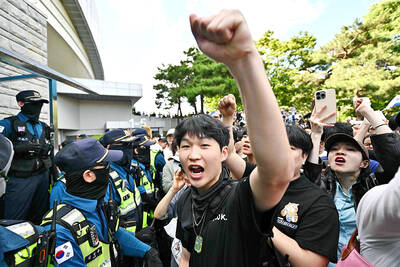
‘ABSURD MISTAKE’: The election commission said that there had been a failure to anticipate turnout after 14 polling stations ran short of ballot papers South Korean riot police yesterday cleared protesters from a Seoul polling station after a 35-hour blockade sparked by a shortage of ballot papers during local elections earlier this week. Wednesday’s election was the first nationwide vote since South Korean President Lee Jae-myung took office following the ouster of Yoon Suk-yeol over his short-lived martial law declaration. Lee’s ruling Democratic Party swept most races, but failed to flip the crucial Seoul mayoral seat. The South Korean National Election Commission apologized, blaming a failure to anticipate turnout after 14 polling stations in Seoul ran short of ballot papers. Some polling stations stayed open until 10pm to

Australian researchers have trained lab-grown brain cells on a silicon computer chip to play the 1990s shooter game Doom and said they are just scratching the surface of what the neurons could be capable of doing. It is the science-fiction work of biotech boffins at Cortical Labs, who researched and developed the technology that harnesses the workings of the brain’s networking system. Each so-called “biological computer” contains about 200,000 living human brain cells, grown from stem cells that were harvested from blood donations. Having mastered the simple computer game Pong, where a paddle is moved up and down to send a ball

France experienced its hottest spring on record, the French weather service said on Tuesday, after an exceptional early heat wave that also broke highs for the season in England and Wales. Meteo-France said the average nationwide temperature over March to May was 13.8°C — about 1.7°C above the norm, and surpassing records set in 2011 and 2020. “The warmest spring since records began in 1900,” it said in a bulletin. All three months were warmer than average, but the onset of an “unprecedented heatwave” late last month pushed the mercury to highs typically seen at the height of the summer. “Our country had never


 RSS
RSS