


Issameldin Mohamed, a native of Egypt, explained that he was not entirely sure that suing the US government was a good idea.
"In [Egypt], if you sue the government, there's something wrong here," he said, pointing to his head to indicate how foolhardy it would be.
But Mohamed, 45, of Owings Mills, Maryland, was out of patience, having waited the better part of 10 years to obtain citizenship. Since 2005, he had passed his citizenship test and was waiting only for his name to be cleared in a government background check.
Finally, after filing a lawsuit in October at US District Court in Baltimore that named Department of Homeland Security Secretary Michael Chertoff, FBI Director Robert Mueller and other top government officials as defendants, his naturalization application was approved. On Dec. 14 he became a citizen.
Mohamed and a rising number of immigrants have decided to sue in federal court to force the government to take action on their citizenship applications.
At the US District Court in Alexandria, roughly 100 lawsuits have been filed this year demanding action on stalled citizenship applications. That represents roughly 8 percent of the entire civil docket at the courthouse, which is among the busiest in the nation.
The lawsuits cite federal law requiring agencies to act on a petition within 120 days after it has been reviewed. Rarely do the lawsuits go before a judge, according to a review of court records. Usually, the plaintiff agrees to drop the case after receiving assurances that it will be resolved quickly and favorably.
Morris Days, an attorney with the Maryland-Virginia chapter of the Council on American-Islamic Relations, has helped Mohamed and 15 others file similar petitions at federal courthouses in the region in recent months.
Days said six already have received citizenship papers or are about to, and he is optimistic that all the applications will be approved.
The holdup invariably is the name check, Days said. Muslims are particularly vulnerable to delays, he said, because names of innocent immigrants get confused with those on terror watch lists.
Delays of two, three or four years are not uncommon, he said.
US Citizenship and Immigration Services (USCIS), the federal agency responsible for processing citizenship applications, has acknowledged that hundreds of thousands of applicants have experienced unacceptable delays because of backlogs in the background checks, which are conducted by the FBI.
Spokesman Chris Bentley said 90 percent of the background checks are completed within six months, but that still leaves a current backlog of 150,000 cases that have been pending six months or longer.
Bentley acknowledged that there has been a big jump nationally in the use of federal lawsuits to prompt action on citizenship applications.
While Bentley said the USCIS had in the past year stopped expediting cases in which lawsuits are filed because of the volume, Days said he was confident that the lawsuits are the only thing that jarred USCIS into action on behalf of his clients.
"If you file the suit and do the right things, they will relent," he said.

In the sweltering streets of Jakarta, buskers carry towering, hollow puppets and pass around a bucket for donations. Now, they fear becoming outlaws. City authorities said they would crack down on use of the sacred ondel-ondel puppets, which can stand as tall as a truck, and they are drafting legislation to remove what they view as a street nuisance. Performances featuring the puppets — originally used by Jakarta’s Betawi people to ward off evil spirits — would be allowed only at set events. The ban could leave many ondel-ondel buskers in Jakarta jobless. “I am confused and anxious. I fear getting raided or even
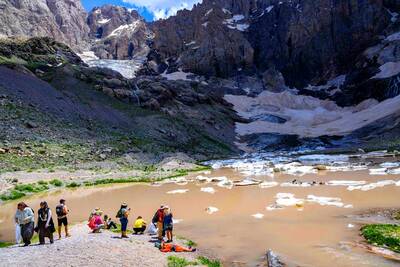
Kemal Ozdemir looked up at the bare peaks of Mount Cilo in Turkey’s Kurdish majority southeast. “There were glaciers 10 years ago,” he recalled under a cloudless sky. A mountain guide for 15 years, Ozdemir then turned toward the torrent carrying dozens of blocks of ice below a slope covered with grass and rocks — a sign of glacier loss being exacerbated by global warming. “You can see that there are quite a few pieces of glacier in the water right now ... the reason why the waterfalls flow lushly actually shows us how fast the ice is melting,” he said.

Eleven people, including a former minister, were arrested in Serbia on Friday over a train station disaster in which 16 people died. The concrete canopy of the newly renovated station in the northern city of Novi Sad collapsed on Nov. 1, 2024 in a disaster widely blamed on corruption and poor oversight. It sparked a wave of student-led protests and led to the resignation of then-Serbian prime minister Milos Vucevic and the fall of his government. The public prosecutor’s office in Novi Sad opened an investigation into the accident and deaths. In February, the public prosecutor’s office for organized crime opened another probe into

RISING RACISM: A Japanese group called on China to assure safety in the country, while the Chinese embassy in Tokyo urged action against a ‘surge in xenophobia’ A Japanese woman living in China was attacked and injured by a man in a subway station in Suzhou, China, Japanese media said, hours after two Chinese men were seriously injured in violence in Tokyo. The attacks on Thursday raised concern about xenophobic sentiment in China and Japan that have been blamed for assaults in both countries. It was the third attack involving Japanese living in China since last year. In the two previous cases in China, Chinese authorities have insisted they were isolated incidents. Japanese broadcaster NHK did not identify the woman injured in Suzhou by name, but, citing the Japanese


 RSS
RSS