


Romanian lawmakers began to debate on Wednesday whether Bran Castle, commonly known as Dracula's Castle, was legally returned to owner Dominic Habsburg and whether he is allowed to sell it.
The Transylvanian castle, which has featured in many movies, was returned to Archduke Dominic Habsburg, the son of Princess Ileana, in May last year. The princess had been given the castle in exchange for good deeds done by the royal family, which ruled Romania from 1866 until the communist era.
The 14th century castle was confiscated by the communists in 1948.
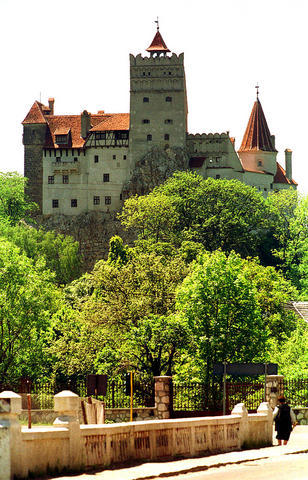
PHOTO:AP
Habsburg, 69, an architect from North Salem, New York, pledged to keep it open as a museum until 2009. He offered to sell the castle last year to local authorities for US$80 million, but the offer was rejected because it was too expensive.
Opposition lawmaker Dumitru Ioan Puchianu said on Wednesday during a parliamentary debate that the return of the castle to Habsburg was illegal due to procedural errors. He said that Habsburg is legally not allowed to sell it. Lawmakers ended the debate without voting on the issue.
In a letter released on Wednesday, Habsburg's lawyers said he would launch a lawsuit for 150 million euros (US$210 million) in damages if Parliament voted that the restitution and sale plans were illegal.
"I live once more with the feeling of dread in which I once lived, as a child, when my family and I were forced out of our home and thrown out into the streets in midwinter," he said in a letter addressed to Parliament and calling on lawmakers not to allow "such a dreadful injustice to happen."
The Bran Castle, perched on a cliff near Brasov in mountainous central Romania, is a major tourist attraction because of its ties to Prince Vlad the Impaler, the warlord whose cruelty inspired Bram Stoker's 1897 novel Dracula.
Legend has it that Vlad, who earned his nickname because of the way he tortured his enemies, spent one night in the 1400s at the castle.

Through the noise of rushing papers and whirring belts at a print factory in Kyoto, two creators watch their photo essay come to life in broadsheet form — part of an effort to win new audiences in the age of artificial intelligence (AI). Despite the decline of the publishing industry, self-publication and handmade “zine” magazines are growing in popularity in Japan, reflecting the nation’s enduring love of paper in the digital era. While speaking to Agence France-Presse at the plant, his hands black with ink, one of the creators, Kazuma Obara, said: “I think [paper] is a medium that engages all five

‘CROSSING THE LINE’: China’s embassy in Seoul criticized US Forces Korea Commander General Xavier Brunson, asking if his ‘hostile’ remarks were authorized by Washington South Korea and the US are in talks over recent public remarks by the commander of US Forces Korea, Seoul’s presidential office said yesterday, after the comments drew sharp criticism from China. In a recent podcast interview, US Forces Korea Commander General Xavier Brunson described South Korea as “the dagger in the heart of Asia” from China’s east coast, prompting the Chinese embassy in Seoul to say that he had “truly crossed the line.” The interview came amid growing speculation that Washington might seek to expand the role of US Forces Korea in countering the growing regional influence of China, a key

Australian researchers have trained lab-grown brain cells on a silicon computer chip to play the 1990s shooter game Doom and said they are just scratching the surface of what the neurons could be capable of doing. It is the science-fiction work of biotech boffins at Cortical Labs, who researched and developed the technology that harnesses the workings of the brain’s networking system. Each so-called “biological computer” contains about 200,000 living human brain cells, grown from stem cells that were harvested from blood donations. Having mastered the simple computer game Pong, where a paddle is moved up and down to send a ball
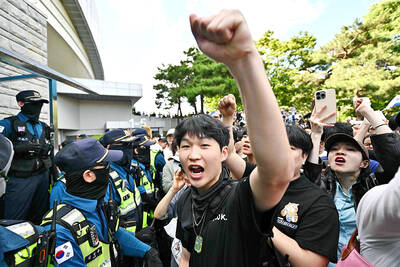
‘ABSURD MISTAKE’: The election commission said that there had been a failure to anticipate turnout after 14 polling stations ran short of ballot papers South Korean riot police yesterday cleared protesters from a Seoul polling station after a 35-hour blockade sparked by a shortage of ballot papers during local elections earlier this week. Wednesday’s election was the first nationwide vote since South Korean President Lee Jae-myung took office following the ouster of Yoon Suk-yeol over his short-lived martial law declaration. Lee’s ruling Democratic Party swept most races, but failed to flip the crucial Seoul mayoral seat. The South Korean National Election Commission apologized, blaming a failure to anticipate turnout after 14 polling stations in Seoul ran short of ballot papers. Some polling stations stayed open until 10pm to


 RSS
RSS