


A US Air Force B-52 bomber flew for more than three hours across several states while carrying six cruise missiles under its wings mistakenly armed with nuclear warheads, Pentagon officials say.
The incident last Thursday triggered an Air Force probe and the firing of a commander, Pentagon officials said on Wednesday.
US President George W. Bush and Secretary of Defense Robert Gates were informed immediately after the mistake came to light, and Gates has asked for daily briefings on the Air Force inquiry, Defense Department press secretary Geoff Morrell said.
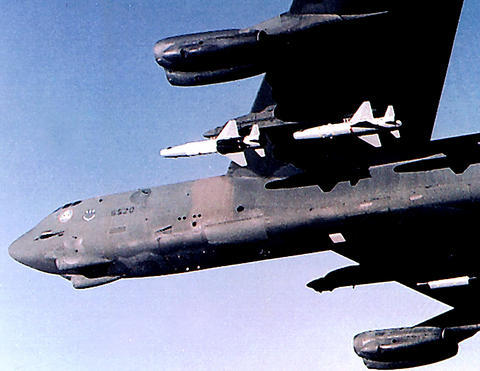
PHOTO: AFP/LOCKHEED MARTIN
The B-52 originated at Minot Air Base in North Dakota and flew to Barksdale Air Force Base in Louisiana, said air force officials, who spoke on condition of anonymity because of a Pentagon policy not to confirm information on nuclear weapons.
The US Air Force has relieved the munition squadron commander at Minot of his duties, and launched an investigation into last Thursday's incident, a Pentagon spokesman said.
"At no time was there a threat to public safety," Lieutenant Colonel Ed Thomas said.
"It is important to note that munitions were safe, secure and under military control at all times," he said.
The Pentagon would not provide details, citing secrecy rules, but an expert said the incident was unprecedented, and pointed to a disturbing lapse in the air force's command and control system.
"It seems so fantastic that so many points, checks can dysfunction," said Hans Kristensen, an expert on US nuclear forces.
"We have so many points and checks specifically so we don't have these kinds of incidents," he said.
"That's perhaps what is most worrisome about this particular incident -- that apparently an individual who had command authority about moving these weapons around decided to do so," he said.
"It's a command and control issue and it's one that calls into question the system, because if one individual can do that who knows what can happen," he said.
Nuclear weapons are normally transferred on cargo planes, never on the wings of bombers, he said.
Bomber flights with live nuclear weapons ended in the late 1960s after accidents in Spain in 1966 and in Greenland in 1968.
US lawmakers expressed outrage at the incident.
Representative Ike Skelton, Democratic chairman of the Armed Services Committee in the House of Representatives, called the mishandling of the weapons "deeply disturbing" and said the committee would press the military for details.
"It is absolutely inexcusable that the Air Force lost track of these five nuclear warheads, even for a short period of time," Representative Edward Markey, a Democrat on the House Homeland Security Committee, said in a statement.
"Nothing like this has ever been reported before and we have been assured for decades that it was impossible," Markey said.
The breach originally was reported by the Military Times newspaper on Wednesday and was later confirmed by the Pentagon.
The missiles, which are being decommissioned, were mounted onto pylons on the bomber's wings, and it was unclear why the warheads had not been removed.
Officials said the weapons are designed with multiple safety features that ensure the warheads do not detonate accidentally. Arming the weapons requires a number of stringent protocols and authentication codes that must be followed for detonation. They are designed to withstand a significant impact, including a crash, without detonating.
The missiles carried W-80 warheads of up to 150 kilotonnes, 10 times the destructive force of the bomb dropped on Hiroshima.

Through the noise of rushing papers and whirring belts at a print factory in Kyoto, two creators watch their photo essay come to life in broadsheet form — part of an effort to win new audiences in the age of artificial intelligence (AI). Despite the decline of the publishing industry, self-publication and handmade “zine” magazines are growing in popularity in Japan, reflecting the nation’s enduring love of paper in the digital era. While speaking to Agence France-Presse at the plant, his hands black with ink, one of the creators, Kazuma Obara, said: “I think [paper] is a medium that engages all five
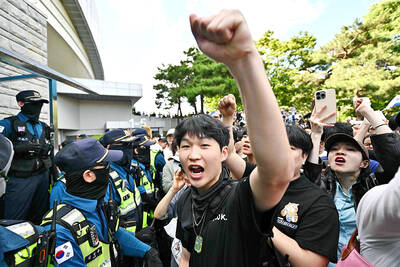
‘ABSURD MISTAKE’: The election commission said that there had been a failure to anticipate turnout after 14 polling stations ran short of ballot papers South Korean riot police yesterday cleared protesters from a Seoul polling station after a 35-hour blockade sparked by a shortage of ballot papers during local elections earlier this week. Wednesday’s election was the first nationwide vote since South Korean President Lee Jae-myung took office following the ouster of Yoon Suk-yeol over his short-lived martial law declaration. Lee’s ruling Democratic Party swept most races, but failed to flip the crucial Seoul mayoral seat. The South Korean National Election Commission apologized, blaming a failure to anticipate turnout after 14 polling stations in Seoul ran short of ballot papers. Some polling stations stayed open until 10pm to

Australian researchers have trained lab-grown brain cells on a silicon computer chip to play the 1990s shooter game Doom and said they are just scratching the surface of what the neurons could be capable of doing. It is the science-fiction work of biotech boffins at Cortical Labs, who researched and developed the technology that harnesses the workings of the brain’s networking system. Each so-called “biological computer” contains about 200,000 living human brain cells, grown from stem cells that were harvested from blood donations. Having mastered the simple computer game Pong, where a paddle is moved up and down to send a ball

France experienced its hottest spring on record, the French weather service said on Tuesday, after an exceptional early heat wave that also broke highs for the season in England and Wales. Meteo-France said the average nationwide temperature over March to May was 13.8°C — about 1.7°C above the norm, and surpassing records set in 2011 and 2020. “The warmest spring since records began in 1900,” it said in a bulletin. All three months were warmer than average, but the onset of an “unprecedented heatwave” late last month pushed the mercury to highs typically seen at the height of the summer. “Our country had never


 RSS
RSS