


Bent over his desk, an Iranian illuminator puts the last touches on a gilded garden of the minuscule intertwined paisleys that have decorated the Koran for hundreds of years.
One of the oldest Iranian art forms, illumination (tazhib) has survived since the pre-Islamic era but now risks extinction if it fails to attract patrons, who prefer modern art to traditional work.
Tazhib is non-figurative illumination whose geometric flourishes, decorations and intricate calligraphy have traditionally adorned the margins of holy books and epic poems, as well as being an art form in its own right.
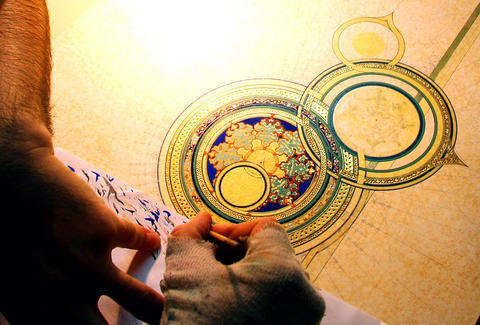
PHOTO: AFP
"The perfection and harmony of this art speaks for itself," said illuminator Fereidoon Joghan, who has spent the past quarter of a century mastering this most rarefied of arts.
"I would like to create something beautiful rather than screaming a message," said the artist, who has won numerous national awards in Islamic decorative arts.
Joghan tries to work using traditional methods, including brushes made from cat's fur, and remaining as faithful as possible to the motifs and techniques created by masters hundreds of years ago.
Ridiculed by peers in Tehran's prestigious school of fine arts for his passion, Joghan said he had to abandon illumination temporarily at college, where he experimented with modern painting.
"The harmony and the intense concentration calm me to an extent that I forget all my problems," he said.
The art dates back to the Sassanid era in pre-Islamic Iran but flourished after the 7th century advent of Islam, which banned human depictions.
Faced with such limitations, Iranian artists poured their creative talent into beautifying the holy script, carpets and mosques.
"After Islam, the Koran was the only outlet of artistic work and it was the sanctity and importance of the book that has kept illumination alive through the ups and down of history," fellow tazhib artist Mehdi Moghiseh said.
The best works of illumination were created in the 15th century under the Timurid dynasty, when Iran's rulers of Mongol origin were great patrons of Persian art and literature.
This heyday of tazhib was sponsored by rulers who commissioned artists to enhance calligraphy in Koran and complement miniatures in the Shahnameh (Book of Kings), a 10th-century poetic chronicle of Iran's myths and ancient history.
Both artists are pessimistic about the future of tazhib, however, as it is almost impossible to market the work in the modern world.
Joghan spends eight hours a day working for four months on a piece no larger than a medium-sized book which is worth 100 million rials (US$11,000). He has not sold a work in years.
The related, figurative, art of miniature painting stands a better chance of survival, experts say, although at a recent exhibition not a single piece could convince visitors to part with their money.
"If the masters cannot make a living out of their work it will fade away. They have to be protected like an endangered species. This is our heritage, our identity," Moghiseh said.
He believes people's lack of interest partly stems from the absence of traditional art forms in modern surroundings.
Moreover, Iran's younger generation also favors art forms which yield immediate results and allow a more liberated expression.
Visiting Tehran's Reza Abbasi museum, which preserves masterpieces of Iranian miniature, ceramic, calligraphy and illumination, Kamran Hamzeloo is unimpressed by the artistic achievements of his ancestors.
"The works are lovable and subtle, but I think if the Iranian artist of the time had more freedom he would have looked at the world differently," he said.
There are still a few young enthusiasts yearning to fill the shoes of the masters, despite the insecurity and uncertainty they know will come with the job.
"I saw Mr Joghan's works in an exhibition. It touched me in a way that I could not sleep a wink until morning," 28-year-old chemist Maryam Labani said.
"I pestered him on the phone for two weeks to take me on as a student," said Labani, looking through a magnifying glass to put a drop of pink on an octagonal illumination -- work which could be ruined by the slightest false move.

An American scientist convicted of lying to US authorities about payments from China while he was at Harvard University has rebuilt his research lab in Shenzhen, China, to pursue technology the Chinese government has identified as a national priority: embedding electronics into the human brain. Charles Lieber, 67, is among the world’s leading researchers in brain-computer interfaces. The technology has shown promise in treating conditions such as amyotrophic lateral sclerosis and restoring movement in paralyzed people. It also has potential military applications: Scientists at the Chinese People’s Liberation Army have investigated brain interfaces as a way to engineer super soldiers by boosting

Jailed media entrepreneur Jimmy Lai (黎智英) has been awarded Deutsche Welle’s (DW) freedom of speech award for his contribution to Hong Kong’s pro-democracy movement. The German public broadcaster on Thursday said Lai would be presented in absentia with the 12th iteration of the award on June 23 at the DW Global Media Forum in Bonn. Deutsche Welle director-general Barbara Massing praised the 78-year-old founder of the now-shuttered news outlet Apple Daily for standing “unwaveringly for press freedom in Hong Kong at great personal risk.” “With Apple Daily, he gave journalists a platform for free reporting and a voice to the democracy movement in

PHILIPPINE COMMITTEE: The head of the committee that made the decision said: ‘If there is nothing to hide, there is no reason to hide, there is no reason to obstruct’ A Philippine congressional committee on Wednesday ruled that there was “probable cause” to impeach Philippine Vice President Sara Duterte after hearing allegations of unexplained wealth, misuse of state funds and threats to have the president assassinated. The unanimous decision of the 53-member committee in the Philippine House of Representatives sends the two impeachment complaints to deliberations and voting by the entire lower chamber, which has more than 300 lawmakers. The complaints centered on Duterte’s alleged illegal use and mishandling of intelligence funds from the vice president’s office, and from her time as education secretary under Philippine President Ferdinand Marcos Jr. Duterte and the

As evening falls in Fiji’s capital, a steady stream of people approaches a makeshift clinic that is a first line of defense against one of the world’s fastest-growing HIV epidemics. In the South Pacific nation — a popular tourist destination of just under a million people — more than 2,000 new HIV cases were recorded last year, a 26 percent increase from 2024. The government has declared an HIV outbreak and described it as a national crisis. “It’s spreading like wildfire,” said Siteri Dinawai, 46, who came to be tested. The Moonlight Clinic, a converted minibus parked in a suburban cul-de-sac in Suva, is


 RSS
RSS