


Jamil el-Banna has been locked up by the US for nearly five years without being charged -- arrested in Africa, allegedly tortured at a CIA "black site" in Afghanistan, then held at Guantanamo Bay -- all because of faulty British intelligence, his defenders charge.
Now his lawyers have a new worry. The British government told them on Friday that el-Banna had been cleared for transfer to his native Jordan, where he says he was tortured before becoming a political refugee in Britain in 1997.
His lawyers decried the move, charging that sending him back amounted to the US outsourcing torture.
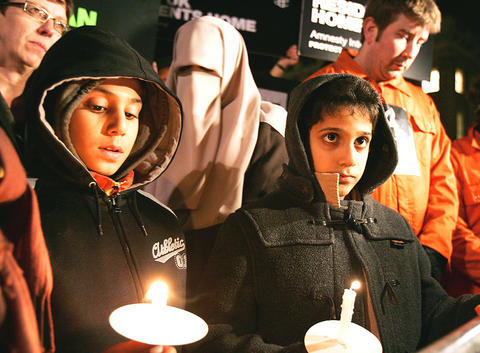
PHOTO: AP
"We are going to block his rendition to Jordan," attorney Clive Stafford Smith said. "To be sure, he would be out of [Guantanamo], but it would be from the frying pan into the fire."
Intelligence documents released by Britain to defense attorneys and a transcript of a Guantanamo hearing trace el-Banna's story.
His troubles started after a British MI5 intelligence officer visited his home near London one overcast morning in October 2002 and tried to get him to become a paid informant.
El-Banna, who is of Palestinian origin, was comfortable in Britain, repairing cars for sale at auction and performing faith healings while raising his family. But after the Sept. 11 attacks on the US, British spies were interested in him because of his associations with radical Muslims.
Abu Qatada, a Muslim cleric described by a Spanish judge as Osama bin Laden's "spiritual ambassador in Europe," had been el-Banna's neighbor in Pakistan, where el-Banna worked in the early 1990s for a Saudi charity helping Afghan refugees.
In Jordan, el-Banna belonged to a radical Palestinian support group linked to Iran and Syria -- which is what got him in trouble with Jordanian authorities.
El-Banna also had spoken with Imad Barakat Yarkas, an alleged al-Qaeda cell leader later jailed in Spain, and he was among hundreds of Muslims who regularly attended sermons in Abu Qatada's London-area mosque.
But the MI5 officer wrote that el-Banna "did not give any hint of willingness to cooperate with us."
His lawyers confirmed he didn't want to become an informant.
"He had nothing to do with Islamic extremism, and he did not want his life to be one of an informant," Stafford Smith said. "He was quite happy living the way he was living; he did not want their money, and he had four [now five] young kids to look after, who did not need to be exposed to that kind of jeopardy."
Unbeknownst to el-Banna, his friend Bisher al-Rawi, an Iraqi living in Britain, was helping MI5 keep tabs on London's Muslim community.
At the time, Abu Qatada was in hiding to avoid arrest under Britain's anti-terrorism laws, and al-Rawi relayed messages between MI5 and the cleric. El-Banna, meanwhile, sometimes drove Abu Qatada's wife and children to the imam's hideout as a favor to al-Rawi, el-Banna's lawyers said.
Al-Rawi also recruited el-Banna on the trip that ended with their arrest in Africa. El-Banna, then on welfare while working under the table, planned to manage a Gambian peanut oil plant, and the MI5 officer assured him he could travel.
El-Banna and al-Rawi were detained at Gatwick Airport the next day, however. According to an MI5 memo written that day -- Nov. 1, 2002 -- "some form of homemade electronic device" found in al-Rawi's bag could have been used in a car bomb.
British authorities released the men three days later and let them go to Africa after deciding the device was simply "a commercially available battery charger that had been modified by al-Rawi in order to make it more powerful."
But their fate was sealed when MI5 sent the Nov. 1 memo to US intelligence and alerted Gambian security, which arrested the two friends and handed them over to the CIA.

‘CROSSING THE LINE’: China’s embassy in Seoul criticized US Forces Korea Commander General Xavier Brunson, asking if his ‘hostile’ remarks were authorized by Washington South Korea and the US are in talks over recent public remarks by the commander of US Forces Korea, Seoul’s presidential office said yesterday, after the comments drew sharp criticism from China. In a recent podcast interview, US Forces Korea Commander General Xavier Brunson described South Korea as “the dagger in the heart of Asia” from China’s east coast, prompting the Chinese embassy in Seoul to say that he had “truly crossed the line.” The interview came amid growing speculation that Washington might seek to expand the role of US Forces Korea in countering the growing regional influence of China, a key

SEEKING ORDER: Rodrigo Paz said that ‘anyone who wants to destroy the nation will have to deal with this president and the full force of the constitution’ Bolivian President Rodrigo Paz on Wednesday said that the nation was at a “breaking point” after nearly a month of protests that have caused shortages of food, fuel and medicine. Paz, who took office six months ago amid the worst economic crisis there in four decades, is battling a groundswell of fury over his policies. The political capital, La Paz, has been besieged by low-income workers and members of the indigenous majority calling for his resignation. “The country needs order and is reaching breaking point,” the 58-year-old said at a public event in La Paz, renewing his appeal for dialogue. On Tuesday, the Bolivian

Through the noise of rushing papers and whirring belts at a print factory in Kyoto, two creators watch their photo essay come to life in broadsheet form — part of an effort to win new audiences in the age of artificial intelligence (AI). Despite the decline of the publishing industry, self-publication and handmade “zine” magazines are growing in popularity in Japan, reflecting the nation’s enduring love of paper in the digital era. While speaking to Agence France-Presse at the plant, his hands black with ink, one of the creators, Kazuma Obara, said: “I think [paper] is a medium that engages all five

Australian researchers have trained lab-grown brain cells on a silicon computer chip to play the 1990s shooter game Doom and said they are just scratching the surface of what the neurons could be capable of doing. It is the science-fiction work of biotech boffins at Cortical Labs, who researched and developed the technology that harnesses the workings of the brain’s networking system. Each so-called “biological computer” contains about 200,000 living human brain cells, grown from stem cells that were harvested from blood donations. Having mastered the simple computer game Pong, where a paddle is moved up and down to send a ball


 RSS
RSS