


The bone-numbing trek to the North Pole is riddled with enough perils to make a seasoned explorer quake with fear: Frostbite threatens, polar bears loom and the ice is constantly shifting beneath frozen feet.
But Barbara Hillary took it all in stride, completing the trek to the world's northernmost point last month at the age of 75. She is one of the oldest people to reach the North Pole, and is believed to be the first black woman on record to accomplish the feat.
Hillary grew up in Harlem and never married, devoting herself instead to a nursing career and community activism. At 67 and during retirement, she battled lung cancer. Five years later, she went dog sledding in Quebec and photographed polar bears in Manitoba.
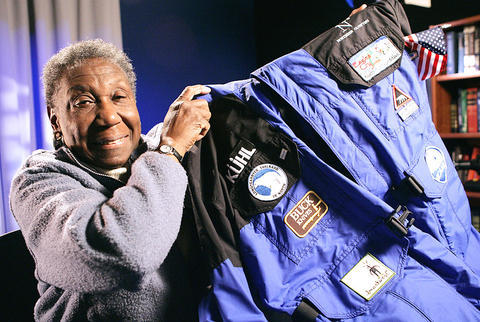
PHOTO: AP
Then she heard that a black woman had never made it to the North Pole.
"I said: `What's wrong with this picture?'" she said. "So I sort of rolled into this, shall we say."
In 1909, Matthew Henson made history as the first black man to reach the Pole, though his accomplishment was not officially recognized for several decades; it was overshadowed by the presence of his white colleague, Robert Peary.
Ann Bancroft, a physical education teacher from Minnesota, was the North Pole's first female visitor in 1986 as a member of the Steger Polar Expedition, which arrived unassisted in a re-creation of the 1909 trip. Various scientific organizations said no record exists of a black woman matching Bancroft's feat, although such record-keeping is not perfect.
"It's not like there's a guest book when you get up there and you sign it," said Robert Russell, founder of Eagles Cry Adventures, Inc, the travel company that leads thrill-seekers like Hillary to the farthest corners of the globe. Russell conducted six months' worth of research, interviewing fellow polar expedition contractors and digging through history books, but failed to find a black woman who completed the trek.
Russell's paying customers can travel to that coveted place in various ways, from 18-day cross-country ski trips to simply being dropped off at the Pole via helicopter.
The trip costs about US$21,000 per person.
Hillary insisted on skiing. Only trouble was, she'd never been on the slopes before.
"It wasn't a popular sport in Harlem," she quipped.
So she enrolled in cross-country skiing lessons and hired a personal trainer, who finally determined she was physically fit for the voyage.
"She's a headstrong woman. You don't tell her `no' about too many things," Russell said.
Her lack of funds didn't stop her, either. Hillary scraped together thousands of dollars and solicited private donors. On April 18, she arrived in Longyearben, Norway, where it is common for people to carry guns due to the presence of hungry polar bears.
"Before I arrived, the word was out that soul food was coming," she joked.
The travelers were then flown to Borneo ice camp -- which is re-built each year due to melting ice -- and pitched their tents. On April 23 Hillary set off on skis with two trained guides. Russell, fearing for her health, had convinced her to take the daylong ski route to the Pole in lieu of the longer trips.
As the sunlight glinted off the ice, distorting her gaze, Hillary struggled beneath a load of gear and pressed on.
In her euphoria at reaching the Pole, she forgot the cold and removed her gloves, causing her fingers to be frostbitten.
Standing at the top of the world, she could have cared less. The enormous expanse of ice and sky left Hillary, for once in her long life, speechless.

‘CROSSING THE LINE’: China’s embassy in Seoul criticized US Forces Korea Commander General Xavier Brunson, asking if his ‘hostile’ remarks were authorized by Washington South Korea and the US are in talks over recent public remarks by the commander of US Forces Korea, Seoul’s presidential office said yesterday, after the comments drew sharp criticism from China. In a recent podcast interview, US Forces Korea Commander General Xavier Brunson described South Korea as “the dagger in the heart of Asia” from China’s east coast, prompting the Chinese embassy in Seoul to say that he had “truly crossed the line.” The interview came amid growing speculation that Washington might seek to expand the role of US Forces Korea in countering the growing regional influence of China, a key

SEEKING ORDER: Rodrigo Paz said that ‘anyone who wants to destroy the nation will have to deal with this president and the full force of the constitution’ Bolivian President Rodrigo Paz on Wednesday said that the nation was at a “breaking point” after nearly a month of protests that have caused shortages of food, fuel and medicine. Paz, who took office six months ago amid the worst economic crisis there in four decades, is battling a groundswell of fury over his policies. The political capital, La Paz, has been besieged by low-income workers and members of the indigenous majority calling for his resignation. “The country needs order and is reaching breaking point,” the 58-year-old said at a public event in La Paz, renewing his appeal for dialogue. On Tuesday, the Bolivian

Through the noise of rushing papers and whirring belts at a print factory in Kyoto, two creators watch their photo essay come to life in broadsheet form — part of an effort to win new audiences in the age of artificial intelligence (AI). Despite the decline of the publishing industry, self-publication and handmade “zine” magazines are growing in popularity in Japan, reflecting the nation’s enduring love of paper in the digital era. While speaking to Agence France-Presse at the plant, his hands black with ink, one of the creators, Kazuma Obara, said: “I think [paper] is a medium that engages all five

Australian researchers have trained lab-grown brain cells on a silicon computer chip to play the 1990s shooter game Doom and said they are just scratching the surface of what the neurons could be capable of doing. It is the science-fiction work of biotech boffins at Cortical Labs, who researched and developed the technology that harnesses the workings of the brain’s networking system. Each so-called “biological computer” contains about 200,000 living human brain cells, grown from stem cells that were harvested from blood donations. Having mastered the simple computer game Pong, where a paddle is moved up and down to send a ball


 RSS
RSS