


An Australian journalist lashed out at the Japanese government yesterday, likening it to North Korea, after a publisher backed down on releasing his biography of Crown Princess Masako.
Ben Hills said the publisher bowed to government pressure in canceling the translation of his book, which blames overbearing palace minders for plunging the career woman-turned-princess into depression.
But Hills said he was talking to other Japanese publishers to print his book and that the controversy was boosting interest in the English-language edition, released last December by Random House Australia.
Hill called the decision by Japanese publishing house Kodansha a "blatant attack on freedom of speech."
Late on Friday Kodansha said it had canceled plans to publish the Japanese translation of Princess Masako: Prisoner of the Chrysanthemum Throne.
The tartly worded biography is billed on the cover as "tragic, true story" of the 43-year-old princess, a Harvard graduate who abandoned a diplomatic career to marry royalty. The book describes her as a virtual captive of the imperial palace who has been bullied by bureaucrats into depression.
Hills said in an e-mail yesterday that he was "disappointed" by Kodansha's decision, adding "We regard this as a blatant attack on freedom of speech."
He also condemned Japan's government for exercising "censorship that would be totally unacceptable in any other advanced country" and pressuring Kodansha to surrender.
"I do not worry whether people love my book or hate my book, but they should be given the chance to read it for themselves and make up their own minds," Hills said.
Japan's Imperial Household Agency and its Foreign Ministry had demanded an apology from the author for "disrespectful descriptions, distortions of facts and judgmental assertions with audacious conjectures and coarse logic." But government officials declined to cite most of the passages they found problematic. The government also protested to Random House in Sydney.
Kazunobu Kakishima, editor at Kodansha, denied the company was scrapping the translation because of the government's protest. The decision, he said, came after Hills refused to acknowledge making factual errors during an interview with a Japanese TV on Friday. Kakishima said Hills had acknowledged the errors in discussions with Kodansha.
But Hills said that he and his Australian publisher did not apologize for the errors "because we felt -- and feel -- that there is nothing to apologize for."

Through the noise of rushing papers and whirring belts at a print factory in Kyoto, two creators watch their photo essay come to life in broadsheet form — part of an effort to win new audiences in the age of artificial intelligence (AI). Despite the decline of the publishing industry, self-publication and handmade “zine” magazines are growing in popularity in Japan, reflecting the nation’s enduring love of paper in the digital era. While speaking to Agence France-Presse at the plant, his hands black with ink, one of the creators, Kazuma Obara, said: “I think [paper] is a medium that engages all five
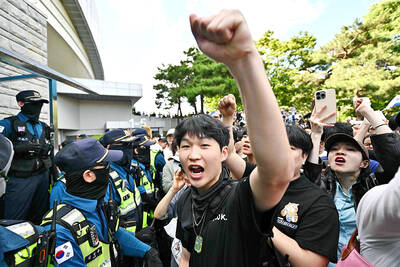
‘ABSURD MISTAKE’: The election commission said that there had been a failure to anticipate turnout after 14 polling stations ran short of ballot papers South Korean riot police yesterday cleared protesters from a Seoul polling station after a 35-hour blockade sparked by a shortage of ballot papers during local elections earlier this week. Wednesday’s election was the first nationwide vote since South Korean President Lee Jae-myung took office following the ouster of Yoon Suk-yeol over his short-lived martial law declaration. Lee’s ruling Democratic Party swept most races, but failed to flip the crucial Seoul mayoral seat. The South Korean National Election Commission apologized, blaming a failure to anticipate turnout after 14 polling stations in Seoul ran short of ballot papers. Some polling stations stayed open until 10pm to

Australian researchers have trained lab-grown brain cells on a silicon computer chip to play the 1990s shooter game Doom and said they are just scratching the surface of what the neurons could be capable of doing. It is the science-fiction work of biotech boffins at Cortical Labs, who researched and developed the technology that harnesses the workings of the brain’s networking system. Each so-called “biological computer” contains about 200,000 living human brain cells, grown from stem cells that were harvested from blood donations. Having mastered the simple computer game Pong, where a paddle is moved up and down to send a ball

France experienced its hottest spring on record, the French weather service said on Tuesday, after an exceptional early heat wave that also broke highs for the season in England and Wales. Meteo-France said the average nationwide temperature over March to May was 13.8°C — about 1.7°C above the norm, and surpassing records set in 2011 and 2020. “The warmest spring since records began in 1900,” it said in a bulletin. All three months were warmer than average, but the onset of an “unprecedented heatwave” late last month pushed the mercury to highs typically seen at the height of the summer. “Our country had never


 RSS
RSS