


The UK's biggest arms supplier secretly paid a US$12 million commission into a Swiss account in a deal which led to Tanzania, one of the world's poorest countries, buying a controversial military radar system.
A Tanzanian middleman, who has a long-standing relationship with military and government figures, has admitted that the sum was covertly moved to a Swiss account by BAE Systems, which is under investigation by the UK's Serious Fraud Office (SFO).
The secret payment represented 30 percent of the contract value. The east African state had to borrow to finance the deal, which critics said was unnecessary and overpriced.
British Prime Minister Tony Blair supported the 2002 sale but his former Cabinet colleague, Clare Short, says she and Chancellor (UK finance minister) Gordon Brown opposed it.
Saudi Arabia
The SFO, which was recently forced to abandon its investigation into commissions paid on a massive arms contract with Saudi Arabia, is now focusing its attention on Tanzania.
Sunday's admissions by the Tanzanian middleman, Sailesh Vithlani, led Short to call for BAE's prosecution if the allegations were proved. She said the prime minister had been personally responsible for forcing the license for the Tanzania deal through the Cabinet.
"No. 10 [the prime minister's residence] insisted on letting this go ahead, when it stank," she said. "It was always obvious that this useless project was corrupt."
In Dar es Salaam, Vithlani's business partner, Tanil Somaiya, said that British police had already flown out to trace and interview both men as potential witnesses.
He said BAE had made two parallel arrangements with the middlemen. In the first, a conventional agency agreement was signed. Under this, a 1 percent commission was to be paid if the US$40m radar deal went through, to a Tanzania-registered firm, Merlin International Ltd.
Vithlani was the majority shareholder in Merlin, Somaiya said, while he had a small token interest himself. BAE paid US$400,000 down this route in stage payments, Somaiya said, as the radar equipment was delivered.
But under a second, more unusual agreement, BAE's secretly owned offshore company Red Diamond deposited another US$12 million, representing 30 percent of the contract price, in Switzerland. That money was under the personal control of Vithlani, Somaiya said, and this had been admitted to UK police.
Vague
When asked about the BAE money, Vithlani said he had made no disbursements from the Swiss cash to public officials "in Tanzania." Asked if he had disbursed any of the US$12 million to third parties outside of Tanzania, he declined to comment.
"When the UK police traveled to Tanzania, we met them at their request and answered all their questions," he said.
Vithlani acted as agent not only on the radar deal but also in the 2002 purchase from the US of a top-of-the-range Gulfstream official jet for the then Tanzanian president, Benjamin Mkapa, at a cost of more than US$40 million.
When asked if he would allow British police to inspect all the transactions on his Swiss account, he declined to comment.
Police sources in Tanzania said the agreement to use Vithlani as an agent had been signed off by the then chairman of BAE Dick Evans.
Evans, who has been at the center of many of the arms deals under investigation, has already been interviewed by the SFO during their two-year inquiry.
On Sunday, BAE Systems were asked why they had made a 30 percent payment to Vithlani's Swiss account. The company refused to answer, saying: "We will not be commenting on any point of substance. This cannot of course be taken as any kind of admission."

Through the noise of rushing papers and whirring belts at a print factory in Kyoto, two creators watch their photo essay come to life in broadsheet form — part of an effort to win new audiences in the age of artificial intelligence (AI). Despite the decline of the publishing industry, self-publication and handmade “zine” magazines are growing in popularity in Japan, reflecting the nation’s enduring love of paper in the digital era. While speaking to Agence France-Presse at the plant, his hands black with ink, one of the creators, Kazuma Obara, said: “I think [paper] is a medium that engages all five
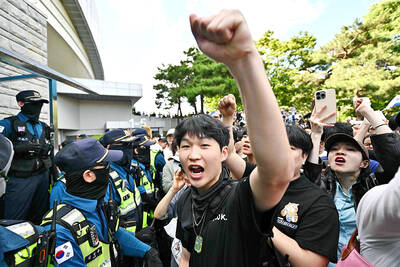
‘ABSURD MISTAKE’: The election commission said that there had been a failure to anticipate turnout after 14 polling stations ran short of ballot papers South Korean riot police yesterday cleared protesters from a Seoul polling station after a 35-hour blockade sparked by a shortage of ballot papers during local elections earlier this week. Wednesday’s election was the first nationwide vote since South Korean President Lee Jae-myung took office following the ouster of Yoon Suk-yeol over his short-lived martial law declaration. Lee’s ruling Democratic Party swept most races, but failed to flip the crucial Seoul mayoral seat. The South Korean National Election Commission apologized, blaming a failure to anticipate turnout after 14 polling stations in Seoul ran short of ballot papers. Some polling stations stayed open until 10pm to

Australian researchers have trained lab-grown brain cells on a silicon computer chip to play the 1990s shooter game Doom and said they are just scratching the surface of what the neurons could be capable of doing. It is the science-fiction work of biotech boffins at Cortical Labs, who researched and developed the technology that harnesses the workings of the brain’s networking system. Each so-called “biological computer” contains about 200,000 living human brain cells, grown from stem cells that were harvested from blood donations. Having mastered the simple computer game Pong, where a paddle is moved up and down to send a ball

France experienced its hottest spring on record, the French weather service said on Tuesday, after an exceptional early heat wave that also broke highs for the season in England and Wales. Meteo-France said the average nationwide temperature over March to May was 13.8°C — about 1.7°C above the norm, and surpassing records set in 2011 and 2020. “The warmest spring since records began in 1900,” it said in a bulletin. All three months were warmer than average, but the onset of an “unprecedented heatwave” late last month pushed the mercury to highs typically seen at the height of the summer. “Our country had never


 RSS
RSS