


Troops fanned out into India's remote northeastern jungles yesterday to crack down on separatist rebels blamed for a wave of ethnic killings that have taken 69 lives since the weekend.
The counter-insurgency operation in Assam came as authorities confirmed ethnic minority Hindi-speaking migrant workers from the eastern Indian state of Bihar -- the main target of the attacks -- were fleeing the state.
The outlawed United Liberation Front of Asom (ULFA), a rebel group fighting for an independent homeland in the oil, tea and timber-rich state since 1979, has been blamed for the killings.
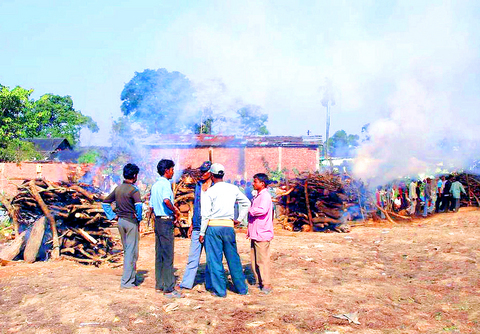
PHOTO: EPA
"We have reports of Hindi-speaking people leaving the state out of fear. But nobody is sure as to the number of people who have fled Assam in the wake of the recent violence," Assam government spokesman and Health Minister Himanta Biswa Sarma said.
Army Chief General J.J. Singh and Defense Minister A.K. Antony were due in the state yesterday to oversee the crackdown on the ULFA rebels in Assam and a neighboring state.
The defense officials are scheduled to review security at an army base in the northern town of Tezpur in Assam.
"The joint offensive by security forces of both Assam and Arunachal Pradesh will track down ULFA rebels believed to be taking shelter here," Arunachal Pradesh Police Chief Amod Kanth said.
The initial operation was focused on the hostile and thickly-wooded terrain in Tirap, Changlang and Lohit districts of Arunachal Pradesh, which borders eastern Assam, intelligence sources said.
Officials said the guerrillas use the state of Arunachal Pradesh as a transit point to reach their training bases in the military-ruled nation of Myanmar, which has a porous border with northeast India.
Myanmar has repeatedly assured New Delhi that it would not let Indian rebels operate from its soil and has often launched offensives against them.
In 2000, ULFA militants killed at least 100 Hindi-speaking people in Assam in a series of well-planned attacks after the rebel group vowed to free the state of all "non-Assamese migrant workers."
Hundreds of migrants started fleeing their homes and headed out of Assam, witnesses and officials said yesterday.
"I came with 30 more people from Bihar and was working at a brick kiln. Life was pretty good until Saturday, when militants attacked us with guns," recounted Sukhi Ram Yadav, a middle-aged migrant from the eastern state of Bihar who arrived in Assam in search of work two months ago.
He said he had literally escaped death by crouching behind a tree as hooded gunmen rained bullets on a group of workers sheltered in a mud-and-thatch hut in Tinsukia District, about 520km from Assam's main city of Guwahati.
"It was past midnight and we all were taken out of the hut and forced to line up outside and soon there was staccato gunfire. I somehow managed to hide behind a tree," Yadav said as he awaited a train at Guwahati railway station to leave for Bihar.
But many of those who were settled in Assam for generations have decided to stay put as local Assamese reached out to help the victims.
"The way our Assamese friends helped us to carry the injured to the hospital and even volunteering to donate blood and offering money for treatment is in itself heartening," said Bina Devi, a mother of three whose husband was injured in one of the attacks.


Through the noise of rushing papers and whirring belts at a print factory in Kyoto, two creators watch their photo essay come to life in broadsheet form — part of an effort to win new audiences in the age of artificial intelligence (AI). Despite the decline of the publishing industry, self-publication and handmade “zine” magazines are growing in popularity in Japan, reflecting the nation’s enduring love of paper in the digital era. While speaking to Agence France-Presse at the plant, his hands black with ink, one of the creators, Kazuma Obara, said: “I think [paper] is a medium that engages all five
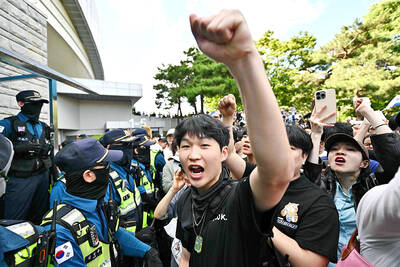
‘ABSURD MISTAKE’: The election commission said that there had been a failure to anticipate turnout after 14 polling stations ran short of ballot papers South Korean riot police yesterday cleared protesters from a Seoul polling station after a 35-hour blockade sparked by a shortage of ballot papers during local elections earlier this week. Wednesday’s election was the first nationwide vote since South Korean President Lee Jae-myung took office following the ouster of Yoon Suk-yeol over his short-lived martial law declaration. Lee’s ruling Democratic Party swept most races, but failed to flip the crucial Seoul mayoral seat. The South Korean National Election Commission apologized, blaming a failure to anticipate turnout after 14 polling stations in Seoul ran short of ballot papers. Some polling stations stayed open until 10pm to

France experienced its hottest spring on record, the French weather service said on Tuesday, after an exceptional early heat wave that also broke highs for the season in England and Wales. Meteo-France said the average nationwide temperature over March to May was 13.8°C — about 1.7°C above the norm, and surpassing records set in 2011 and 2020. “The warmest spring since records began in 1900,” it said in a bulletin. All three months were warmer than average, but the onset of an “unprecedented heatwave” late last month pushed the mercury to highs typically seen at the height of the summer. “Our country had never

A Sherpa guide was found crawling to base camp on Mount Everest a week after he went missing and was reunited with his family, who had given up hope he would return. Dawa Sherpa was last seen on Friday last week descending the mountain, but he did not reach base camp even though his client did. The pair were among the last climbers on the mountain as the climbing season came to an end and the route was dismantled. Dawa was located by a cleaning crew on Thursday morning as he was crawling down the snowy slopes around the Khumbu Icefall, just above


 RSS
RSS