


Sun, sand, kidnap and organ removal. If you believe the latest horror movie to come out of Hollywood, this is what to expect from a holiday in Brazil.
After US film executives launched Turistas -- billed as a tropical Blair Witch Project -- Brazilian tourist chiefs are weeping into their caipirinhas a Brazilian cocktail, fearful that it will scare off visitors.
The film, by a Fox Films subsidiary, follows a group of American backpackers whose holiday at a Brazilian resort turns into a nightmare when they are drugged with caipirinha, kidnapped and set upon by a gang of organ traffickers.
`Sabotage'
Brazilians accuse the filmmakers of sensationalism and of trying to sabotage their already fragile overseas reputation. Particularly irksome has been the publicity drive, which includes a spoof online travel guide describing itself as "a cautionary expose of Brazil."
Mixing historical facts and a heavy dose of fiction, the guide offers a spine-chilling portrait of Brazil -- a place where "organ harvesting," sadistic sex rituals, kidnapping and murder lurk around each corner.
The site carries grisly photographs of organ transplants set against a backdrop of palm-dotted beaches and includes the catchphrase: "In a country where you can do anything, anything is possible."
Fighting back
Tourist chiefs, who say they have invested some US$39.6 million promoting Brazil this year, have hired a US public relations firm to counter the gory interpretation.
"The film is horrible," said Jeanine Pires, the president of Brazil's tourist board. "The things it says are terrible. But it is a work of fiction ... one hopes that cinemagoers will be able to differentiate between what is fiction and what is real."
Fox has incurred the wrath of Brazilians before.
In 2002 Brazil's president, Fernando Henrique Cardoso, demanded an apology after The Simpsons satirized Rio as a city of monkey attacks, bisexual men and women who dance the penetrada.
Stephanie Dennison, a specialist in Latin American cinema from the University of Leeds, said Turistas was a consequence of Brazil opening its doors to more foreign film crews.
"Brazil is promoting itself as a place to film, and this is what happens," Dennison said.
Pires said the government blundered; it could have stopped the production of "this tasteless film" in Brazil.
She said she had "no knowledge" of recent cases of caipirinha poisonings.
Josh Duhamel, one of the lead actors, told a US chat show last week: "I guess there's a bit of a stink about the way the movie portrays Brazil, but our intention was not to deter people to go to Brazil ... It's a beautiful country."
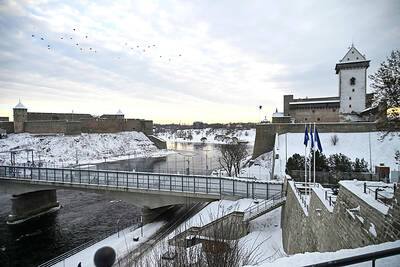
Two medieval fortresses face each other across the Narva River separating Estonia from Russia on Europe’s eastern edge. Once a symbol of cooperation, the “Friendship Bridge” connecting the two snow-covered banks has been reinforced with rows of razor wire and “dragon’s teeth” anti-tank obstacles on the Estonian side. “The name is kind of ironic,” regional border chief Eerik Purgel said. Some fear the border town of more than 50,0000 people — a mixture of Estonians, Russians and people left stateless after the fall of the Soviet Union — could be Russian President Vladimir Putin’s next target. On the Estonian side of the bridge,

DIPLOMATIC THAW: The Canadian prime minister’s China visit and improved Beijing-Ottawa ties raised lawyer Zhang Dongshuo’s hopes for a positive outcome in the retrial China has overturned the death sentence of Canadian Robert Schellenberg, a Canadian official said on Friday, in a possible sign of a diplomatic thaw as Canadian Prime Minister Mark Carney seeks to boost trade ties with Beijing. Schellenberg’s lawyer, Zhang Dongshuo (張東碩), yesterday confirmed China’s Supreme People’s Court struck down the sentence. Schellenberg was detained on drug charges in 2014 before China-Canada ties nosedived following the 2018 arrest in Vancouver of Huawei chief financial officer Meng Wanzhou (孟晚舟). That arrest infuriated Beijing, which detained two Canadians — Michael Spavor and Michael Kovrig — on espionage charges that Ottawa condemned as retaliatory. In January

Jeremiah Kithinji had never touched a computer before he finished high school. A decade later, he is teaching robotics, and even took a team of rural Kenyans to the World Robotics Olympiad in Singapore. In a classroom in Laikipia County — a sparsely populated grasslands region of northern Kenya known for its rhinos and cheetahs — pupils are busy snapping together wheels, motors and sensors to assemble a robot. Guiding them is Kithinji, 27, who runs a string of robotics clubs in the area that have taken some of his pupils far beyond the rural landscapes outside. In November, he took a team

SHOW OF SUPPORT: The move showed that aggression toward Greenland is a question for Europe and Canada, and the consequences are global, not just Danish, experts said Canada and France, which adamantly oppose US President Donald Trump’s wish to control Greenland, were to open consulates in the Danish autonomous territory’s capital yesterday, in a strong show of support for the local government. Since returning to the White House last year, Trump has repeatedly insisted that Washington needs to control the strategic, mineral-rich Arctic island for security reasons. Trump last month backed off his threats to seize Greenland after saying he had struck a “framework” deal with NATO chief Mark Rutte to ensure greater US influence. A US-Denmark-Greenland working group has been established to discuss ways to meet Washington’s security concerns


 RSS
RSS