


The head of Cambodia's royalist party, Prince Norodom Ranariddh, was ousted this past week in favor of his less regal brother-in-law, but the dispute's real winner was the country's now undisputed strongman, Prime Minister Hun Sen.
Hun Sen, who has held or shared the prime minister's post since 1985, was the main force behind moves by the Funcinpec Party to dump Ranariddh, using his well-honed political savvy to have his way with the fractured and demoralized royalists.
In addition to sending Ranariddh on the way to what may well be political obscurity, Hun Sen has also boosted the chances of his ruling Cambodian People's Party (CPP) in upcoming elections, said Hang Puthea, executive director of independent Cambodian election monitoring group Nicfec.
"The CPP already commanded the political advantage even without Funcinpec splitting. So, it is going to remain ahead after Funcinpec is broken into pieces," he said.
In a remarkable political career, Hun Sen rose from a peasant background to a Khmer Rouge military commander and then defected to join a Vietnamese-installed communist government which had ousted the ultra-revolutionaries.
He reinvented himself as a brilliant tactician -- critics would say ruthless manipulator -- in Cambodia's fledgling democratic arena.
On Wednesday, Funcinpec voted to remove Ranariddh as its leader, saying his long absences from the country left him unable to lead the party, which is the junior partner in Hun Sen's government.
The decision, which was made at a special party congress came after Hun Sen, well known for his divide-and-conquer tactics, called on Funcinpec to toss out Ranariddh for alleged incompetence.
Ranariddh, speaking by telephone from France on Thursday, stopped short of accusing Hun Sen of being behind his ouster but said it was "very crystal clear" that his removal was the direct result of Hun Sen's Sept. 17 suggestion.
The prince accused the top officials in the new party leadership of betrayal and claimed that many Funcinpec members were forced to attend the congress that ousted him.
Although considering a legal challenge of his ouster, Ranariddh has acknowledged that he will never regain control of Funcinpec, whose leadership he inherited from his father, retired king Norodom Sihanouk.
He said he plans to set up a new party named the Norodom Ranariddh Party.
Having two parties with royalist identities would split the votes of royalist citizens, said Kek Galabru, president of Licadho, a local human rights group.
"Right now they are playing the game of the ruling party. It's really bad for them," he said. "The big winner is the CPP. But of course, Hun Sen is the bigger winner."
Cambodia is to hold local elections next April and general elections in 2008.
Funcinpec was founded as a resistance group against the Vietnamese-installed government more than two decades ago by Sihanouk, whose prestige helped the prince and his party win a 1993 UN-sponsored general election held as part of a peacekeeping mission aimed at establishing democracy.
But under Ranariddh, who many believe is more comfortable as a pampered royal than a rough and tumble politician, the party has seen its popularity gradually wane. It lost to the CPP in the last two general elections in 1998 and 2003.
Royalist officials have put the blame on the prince, who has spent at least as much time traveling overseas -- he teaches law part-time in France -- as he has working to strengthen the royalist party.
It's not the first time Hun Sen has pulled Funcinpec's strings.
In 1993, he used the threat of force -- and the unraveling of a hard-won peace -- to bully Ranariddh's party, which had won the election, into taking his party into the government as an equal partner.
When he became tired of being co-prime minister with Ranariddh, he engineered a bloody coup in 1997, which -- in addition to making him the country's sole top leader -- physically eliminated some of Funcinpec's more able political operators.
On Wednesday, his party sent its warmest congratulations to Keo Puth Rasmey, Funcinpec's freshly chosen leader.
With Hun Sen's will accomplished yet again, said Kek Galabru, "People see how powerful he is -- he said something, then it's done."
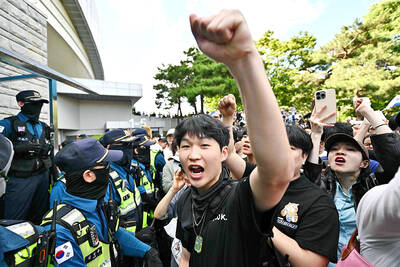
‘ABSURD MISTAKE’: The election commission said that there had been a failure to anticipate turnout after 14 polling stations ran short of ballot papers South Korean riot police yesterday cleared protesters from a Seoul polling station after a 35-hour blockade sparked by a shortage of ballot papers during local elections earlier this week. Wednesday’s election was the first nationwide vote since South Korean President Lee Jae-myung took office following the ouster of Yoon Suk-yeol over his short-lived martial law declaration. Lee’s ruling Democratic Party swept most races, but failed to flip the crucial Seoul mayoral seat. The South Korean National Election Commission apologized, blaming a failure to anticipate turnout after 14 polling stations in Seoul ran short of ballot papers. Some polling stations stayed open until 10pm to

France experienced its hottest spring on record, the French weather service said on Tuesday, after an exceptional early heat wave that also broke highs for the season in England and Wales. Meteo-France said the average nationwide temperature over March to May was 13.8°C — about 1.7°C above the norm, and surpassing records set in 2011 and 2020. “The warmest spring since records began in 1900,” it said in a bulletin. All three months were warmer than average, but the onset of an “unprecedented heatwave” late last month pushed the mercury to highs typically seen at the height of the summer. “Our country had never

A Sherpa guide was found crawling to base camp on Mount Everest a week after he went missing and was reunited with his family, who had given up hope he would return. Dawa Sherpa was last seen on Friday last week descending the mountain, but he did not reach base camp even though his client did. The pair were among the last climbers on the mountain as the climbing season came to an end and the route was dismantled. Dawa was located by a cleaning crew on Thursday morning as he was crawling down the snowy slopes around the Khumbu Icefall, just above
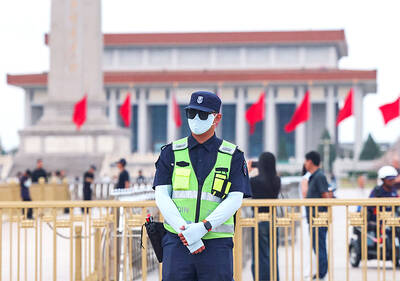
Chinese authorities are snuffing out any remembrance of the deadly 1989 military crackdown on student-led pro-democracy protests in Tiananmen Square, which happened 37 years ago yesterday, in a further tightening of a years-long campaign to erase what happened from public memory. Police told relatives of the victims they would not be allowed to visit a cemetery in Beijing on the anniversary of the crackdown, a person with knowledge of the matter said. Relatives of the victims visited the cemetery on the anniversary for more than 30 years to read memorial statements with police keeping watch, Amnesty International said. Hundreds of people,


 RSS
RSS