


Deposed prime minister Thaksin Shinawatra resigned from his once all-powerful party in a letter from London yesterday after more than 200 colleagues quit as the organization crumbled following a military coup, a party leader said.
The mass exodus and Thaksin's resignation marked the death knell for the party that had controlled Thai politics since 2001.
"I am resigning from the party," said the letter from Thaksin, which was read aloud by party spokesman Jatuporn Promphan.
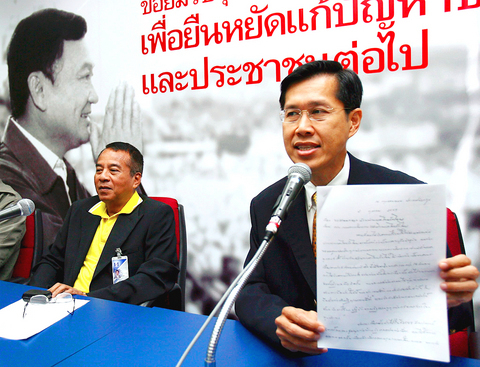
PHOTO: EPA
"As the party leader I have to show my responsibility by resigning from the position of party leader and deeply [apologize] to supporters who do not want me to resign," the letter said.
Thaksin assigned deputy party leader Sudarat Keyuraphan to serve as the acting head of the party.
But the move was largely seen as ceremonial since the party is unable to engage in politics under the martial law imposed by coup leaders who ousted Thaksin on Sept. 19.
Another party leader pronounced the departures as the end of Thai Rak Thai, which means "Thais love Thais."
"The legacy of the Thai Rak Thai party is over. The Thai Rak Thai has died along with Thaksin Shinawatra," said another deputy leader, Pongpol Adireksan.
He said that an executive order issued by the ruling military council on Saturday "clearly showed that it aims to dissolve the Thai Rak Thai and shut the door for Thaksin to return to politics."
He added that more than 200 party members had resigned since Saturday.
Among them was Deputy Prime Minister Somkid Jatsuripitak, regarded as Thaksin's right-hand man and his top economic adviser, who submitted his letter of resignation yesterday morning, said Jatuporn.
Somkid was a co-founder of Thai Rak Thai and a former finance and commerce minister.
The order will ban members of a political party from politics for five years if courts find the party had breached election laws and is dissolved.
Thaksin's party, which held a parliamentary majority after sweeping several elections, is under legal scrutiny for alleged violations during a snap election called by Thaksin in April.
Thaksin was overthrown by senior military officers in a bloodless coup on Sept. 19 while he was abroad on official business in New York. After the coup, he flew to London, where he has an apartment.
Surayud Chulanont, a former army commander, was named to replace him as interim prime minister.
The coup leaders have assured investors that the interim government will support local and foreign investment and give the private sector a leading economic role.
Western nations and human rights groups have nevertheless criticized the coup as a setback for democracy, and the appointment of Surayud as interim prime minister has done little to ease that disapproval.
An interim Constitution to replace the 1997 one scrapped by the military empowers the coup leaders to remove the prime minister and Cabinet, and to select a committee to draft a permanent Constitution.
It maintains martial law and other restrictions imposed by the military, including curbs on press freedoms and limits on public gatherings.
The US has urged the new prime minister to protect basic civil liberties, expressing hope that the former army commander's appointment would spur a quick return to democracy.
Tom Casey, the US State Department's spokesman, also said that the meeting that was held on Monday in Bangkok between US Ambassador Ralph Boyce and Surayud was "appropriate and important."
He shrugged off suggestions that the meeting conveyed tacit approval for the coup.
The meeting gave the US a chance to "reiterate our concerns about the coup itself," Casey told reporters.

‘CROSSING THE LINE’: China’s embassy in Seoul criticized US Forces Korea Commander General Xavier Brunson, asking if his ‘hostile’ remarks were authorized by Washington South Korea and the US are in talks over recent public remarks by the commander of US Forces Korea, Seoul’s presidential office said yesterday, after the comments drew sharp criticism from China. In a recent podcast interview, US Forces Korea Commander General Xavier Brunson described South Korea as “the dagger in the heart of Asia” from China’s east coast, prompting the Chinese embassy in Seoul to say that he had “truly crossed the line.” The interview came amid growing speculation that Washington might seek to expand the role of US Forces Korea in countering the growing regional influence of China, a key

SEEKING ORDER: Rodrigo Paz said that ‘anyone who wants to destroy the nation will have to deal with this president and the full force of the constitution’ Bolivian President Rodrigo Paz on Wednesday said that the nation was at a “breaking point” after nearly a month of protests that have caused shortages of food, fuel and medicine. Paz, who took office six months ago amid the worst economic crisis there in four decades, is battling a groundswell of fury over his policies. The political capital, La Paz, has been besieged by low-income workers and members of the indigenous majority calling for his resignation. “The country needs order and is reaching breaking point,” the 58-year-old said at a public event in La Paz, renewing his appeal for dialogue. On Tuesday, the Bolivian

Forecasters in Europe yesterday warned of exceptional heat as record temperatures driven by a “heat dome” push temperatures well above seasonal norms across the continent. The surge follows a record-breaking Monday, with France logging its hottest day in the month of May on record, its weather agency said, and the UK also posting unprecedented highs. A so-called “heat dome” of warm air from northern Africa trapped under a high-pressure system over western Europe is behind the high temperatures not usually seen until high summer. Restrictions on outdoor work were imposed in parts of Italy, beaches in southwest France filled earlier than usual and

Australian researchers have trained lab-grown brain cells on a silicon computer chip to play the 1990s shooter game Doom and said they are just scratching the surface of what the neurons could be capable of doing. It is the science-fiction work of biotech boffins at Cortical Labs, who researched and developed the technology that harnesses the workings of the brain’s networking system. Each so-called “biological computer” contains about 200,000 living human brain cells, grown from stem cells that were harvested from blood donations. Having mastered the simple computer game Pong, where a paddle is moved up and down to send a ball


 RSS
RSS