


Hundreds of people have fallen sick and one man has died in the central Philippines following the country's worst-ever oil spill, health officials said yesterday.
The health department has deployed medical teams to Guimaras Island, which bore the brunt of the disaster, where 329 people have complained of a range of health problems including skin irritation and respiratory problems.
Health Secretary Francisco Duque arrived in the nearby city of Iloilo yesterday to see first hand the conditions following the sinking of an oil tanker off Guimaras on Aug. 11 which has discharged more than 189,270 liters of industrial oil into the pristine seas.
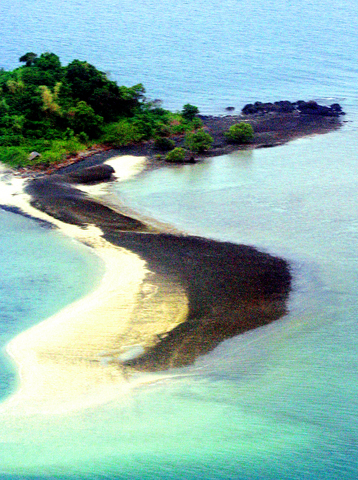
PHOTO: AFP
The tanker, said to be resting on the seabed with 1.7 million liters still in its hold has been described as an ecological time bomb by environmentalists.
Four US coastguard and the National Oceanic and Atmospheric Agency experts also arrived in Iloilo yesterday to assess the damage and see how they could help.
They join Japanese experts who have already been sent to assist in the disaster.
Duque said the department would look into the case of Rogelio Dalida, a fisherman from Nueva Valencia town in Guimaras who reportedly died of a heart attack after inhaling oil fumes.
He had been suffering from asthma and the fumes could have aggravated his condition, Duque said.
Nueva Valencia mayor Diosdado Gonzaga confirmed one man in his town died last week but said more tests were needed to determine if his heart attack was really brought on by the oil spill or not.
Duque said the health department would also look into hundreds of complaints by Guimaras residents of health problems possibly arising from the oil slick.
These problems range from skin irritation and respiratory problems to stomach aches and nausea, Duque said.
Two toxicologists have been sent to Guimaras by the health department to look into the possibility of relocating some coastal residents away from the shore.
Duque has warned residents exposure to the oil could lead to illnesses and advised them not to eat any marine products taken from the polluted waters.
Residents have been forced to use improvised spill booms, made of bamboo and dried grass to try to prevent black sludge washing up onto beaches.
They were also using buckets and shovels to scoop the sludge from the beaches.
Oil has contaminated more than 300km of coastline on Guimaras Island and is now threatening Negros, the country's fourth-largest island, as well as Panay Island.
Oil has also destroyed 454 hectares of mangroves and 58 hectares of seaweed farms.
Defense Secretary Avelino Cruz, who heads a task force on the oil spill said 3,700 families were affected by the disaster and that tourism to the island, once known for its pristine beaches, had also been hit hard.
The government set up a commission of inquiry into the disaster on Wednesday and has given it three days to submit an initial report.
The spill is already regarded as the worst environmental disaster in the history of the Philippines, stretching more than 18.5km and putting the livelihoods of thousands of poor fishermen at risk.

‘CROSSING THE LINE’: China’s embassy in Seoul criticized US Forces Korea Commander General Xavier Brunson, asking if his ‘hostile’ remarks were authorized by Washington South Korea and the US are in talks over recent public remarks by the commander of US Forces Korea, Seoul’s presidential office said yesterday, after the comments drew sharp criticism from China. In a recent podcast interview, US Forces Korea Commander General Xavier Brunson described South Korea as “the dagger in the heart of Asia” from China’s east coast, prompting the Chinese embassy in Seoul to say that he had “truly crossed the line.” The interview came amid growing speculation that Washington might seek to expand the role of US Forces Korea in countering the growing regional influence of China, a key

SEEKING ORDER: Rodrigo Paz said that ‘anyone who wants to destroy the nation will have to deal with this president and the full force of the constitution’ Bolivian President Rodrigo Paz on Wednesday said that the nation was at a “breaking point” after nearly a month of protests that have caused shortages of food, fuel and medicine. Paz, who took office six months ago amid the worst economic crisis there in four decades, is battling a groundswell of fury over his policies. The political capital, La Paz, has been besieged by low-income workers and members of the indigenous majority calling for his resignation. “The country needs order and is reaching breaking point,” the 58-year-old said at a public event in La Paz, renewing his appeal for dialogue. On Tuesday, the Bolivian

Through the noise of rushing papers and whirring belts at a print factory in Kyoto, two creators watch their photo essay come to life in broadsheet form — part of an effort to win new audiences in the age of artificial intelligence (AI). Despite the decline of the publishing industry, self-publication and handmade “zine” magazines are growing in popularity in Japan, reflecting the nation’s enduring love of paper in the digital era. While speaking to Agence France-Presse at the plant, his hands black with ink, one of the creators, Kazuma Obara, said: “I think [paper] is a medium that engages all five

Australian researchers have trained lab-grown brain cells on a silicon computer chip to play the 1990s shooter game Doom and said they are just scratching the surface of what the neurons could be capable of doing. It is the science-fiction work of biotech boffins at Cortical Labs, who researched and developed the technology that harnesses the workings of the brain’s networking system. Each so-called “biological computer” contains about 200,000 living human brain cells, grown from stem cells that were harvested from blood donations. Having mastered the simple computer game Pong, where a paddle is moved up and down to send a ball


 RSS
RSS