


Australian Foreign Minister Alexander Downer held crisis talks yesterday with the leaders of East Timor, trying to end the worst violence in the tiny nation since it split from Indonesia seven years ago.
Downer met East Timorese President Xanana Gusmao, Foreign and Defense Minister Jose Ramos Horta and Prime Minister Mari Alkatiri -- who is blamed by many for the crisis, which led the government to call in 2,250 Australian and other foreign troops.
A heavy show of force for Downer's visit kept order in the streets of the capital Dili, which has been wracked by two weeks of mayhem, arson and gang violence that has left at least 20 people dead.
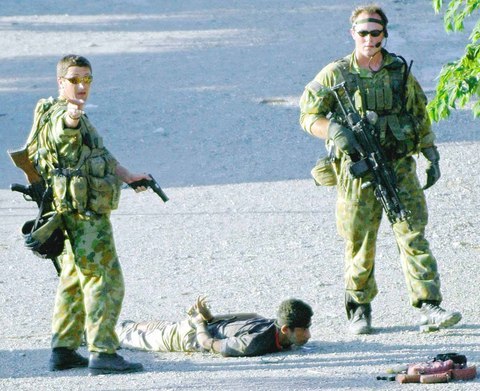
PHOTO: AFP
But plumes of smoke again appeared in the sky after Downer departed following a four-hour visit, underlining the simmering unrest that has led tens of thousands of frightened people to leave their homes and take refuge in churches and elsewhere.
The Australian foreign minister rejected suggestions from Alkatiri in recent days that the unrest was being engineered by Indonesia, which invaded East Timor in 1975 and held it for nearly a quarter-century.
"We have no evidence at all that any of the violence here in recent times has been coordinated by anybody in Indonesia, or that there has been any Indonesian involvement in it," Downer told reporters.
"Indonesia doesn't want to destabilize East Timor," he said. "I think East Timor can do without [such] canards."
Downer said that he told the Timorese leadership about the need for reconciliation between the country's bickering factions, and called for a new multinational police force in the country to be run by the UN.
"I think it would be appropriate for that police presence, which would obviously include quite a few Australians, to operate under the auspices of the UN," he said.
The violence began after Alkatiri sacked 600 of the country's 1,400-strong army after they went on strike to protest what they said was discrimination against those from the west of the country.
Westerners are generally seen as more pro-Indonesia, a sensitive issue in a country that fought a long and bloody guerrilla campaign, led by Gusmao, to win independence.
Battles between the military and the sacked breakaway troops, under the command of Major Alfredo Reinado, descended into fighting between rival gangs from the east and west of the country.
Gusmao made an emotional plea for national unity on Thursday, two days after he announced he was assuming emergency powers including control over the army -- a move that Alkatiri publicly challenged.
But the president declined to sack the unpopular prime minister, despite calls from the rebels and protesters who have taken to the streets, chanting for Alkatiri to go.
Downer played down those calls and said he had experience of many countries with unpopular politicians.
East Timor opted for independence from Indonesia in 1999, but the referendum was accompanied by an orgy of violence carried out by Indonesian forces and Jakarta-backed militias. Around 1,400 people were killed.
The UN then administered East Timor until full independence in 2002, when guerrilla leader Gusmao became the president. The latest outbreak of violence has been the worst since the days of the bloody independence vote.
"The Australian defense force has been doing an outstanding job here," Downer said. "They've been operating in a difficult environment and they are clearly getting the security situation back together."

‘CROSSING THE LINE’: China’s embassy in Seoul criticized US Forces Korea Commander General Xavier Brunson, asking if his ‘hostile’ remarks were authorized by Washington South Korea and the US are in talks over recent public remarks by the commander of US Forces Korea, Seoul’s presidential office said yesterday, after the comments drew sharp criticism from China. In a recent podcast interview, US Forces Korea Commander General Xavier Brunson described South Korea as “the dagger in the heart of Asia” from China’s east coast, prompting the Chinese embassy in Seoul to say that he had “truly crossed the line.” The interview came amid growing speculation that Washington might seek to expand the role of US Forces Korea in countering the growing regional influence of China, a key

Through the noise of rushing papers and whirring belts at a print factory in Kyoto, two creators watch their photo essay come to life in broadsheet form — part of an effort to win new audiences in the age of artificial intelligence (AI). Despite the decline of the publishing industry, self-publication and handmade “zine” magazines are growing in popularity in Japan, reflecting the nation’s enduring love of paper in the digital era. While speaking to Agence France-Presse at the plant, his hands black with ink, one of the creators, Kazuma Obara, said: “I think [paper] is a medium that engages all five

Australian researchers have trained lab-grown brain cells on a silicon computer chip to play the 1990s shooter game Doom and said they are just scratching the surface of what the neurons could be capable of doing. It is the science-fiction work of biotech boffins at Cortical Labs, who researched and developed the technology that harnesses the workings of the brain’s networking system. Each so-called “biological computer” contains about 200,000 living human brain cells, grown from stem cells that were harvested from blood donations. Having mastered the simple computer game Pong, where a paddle is moved up and down to send a ball

France experienced its hottest spring on record, the French weather service said on Tuesday, after an exceptional early heat wave that also broke highs for the season in England and Wales. Meteo-France said the average nationwide temperature over March to May was 13.8°C — about 1.7°C above the norm, and surpassing records set in 2011 and 2020. “The warmest spring since records began in 1900,” it said in a bulletin. All three months were warmer than average, but the onset of an “unprecedented heatwave” late last month pushed the mercury to highs typically seen at the height of the summer. “Our country had never


 RSS
RSS