


Sri Lanka's military and the island's Tamil Tiger rebels are locked in a low intensity war despite a ceasefire that still technically holds on paper, the head of Nordic truce monitors said yesterday.
"You could in some definition say we already have a war. We don't have a peace agreement, we have a ceasefire agreement. So there is a war ongoing. It is a low intensity war. You can say that," Major General Ulf Henricsson, head of the Sri Lanka Monitoring Mission said.
Henricsson dismissed a threat by the Tigers that warned his monitors to stay off navy vessels -- just days after the rebels sank a Sri Lankan navy boat in a sea battle that killed dozens of people -- or face the consequences in any future attacks, saying his 60-strong team would continue to do their job.
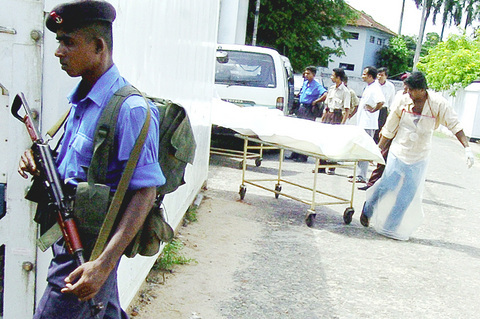
PHOTO: AFP
"I make my own decision on this matter, and I think their warning, as they call it, is more or less a threat and [the naval attack was] a clear violation of the ceasefire agreement," he added.
Tamil rebels yesterday said they would resume war if denied access to the sea.
"We move with complete freedom in these waters to transport our cadres and to distribute material needs to our movement," Colonel Soosai, who heads the Sea Tigers, the rebels' naval wing, was quoted as saying by the pro-rebel Web site TamilNet.
"We will not hesitate to wage war with anyone who attempts to prevent us from exercising our freedom," said Soosai, who like many rebels use only one name.
Meanwhile a suspected Tamil Tiger rebel gunman killed a soldier and wounded three others yesterday, the military said, as the EU warned that the rebel attack on the navy convoy may jeopardize peace talks.
The soldier was among several guarding a checkpoint when the gunman approached and opened fire, the Media Unit of the Defense Ministry said. Three other soldiers were wounded in the attack.
The EU's warnings followed the sea battle on Thursday, when rebel suicide boats rammed and sank a navy patrol craft. The apparent main target, a troop carrier with 710 soldiers, escaped unharmed.
The transporter was carrying a truce monitor and flying the monitors' flag when the military says suicide rebels attacked it.
The Tigers say their fighters were conducting a naval exercise when they were fired on by the navy.
The government said about 50 insurgents were killed and 17 sailors left dead or missing following the engagement at sea -- the largest such battle since a 2002 ceasefire was signed.
"The reckless behavior of the [Tamil Tigers] ... can only contribute to a dangerous escalation that results in growing hostilities and jeopardizes any possibility for future peace talks," said an EU statement seen yesterday.
"The attack on a troop carrier and the reported sinking of an accompanying navy vessel is the latest and most severe [truce] violation," the EU said. It said it backs an observation by cease-fire monitors that the Sri Lankan government had rightful control of the sea.
The US on Friday condemned the attack on the naval vessel warning that growing violence risked plunging Sri Lanka into civil war again.
"We are deeply concerned about the escalating violence by the Tamil Tigers, which has put Sri Lanka at risk of a return to war," said a statement by Richard Boucher, assistant secretary of state for South and Central Asian Affairs.
Boucher called the attacks "a clear violation of the ceasefire agreement between the government of Sri Lanka and the Tamil Tigers."

‘CROSSING THE LINE’: China’s embassy in Seoul criticized US Forces Korea Commander General Xavier Brunson, asking if his ‘hostile’ remarks were authorized by Washington South Korea and the US are in talks over recent public remarks by the commander of US Forces Korea, Seoul’s presidential office said yesterday, after the comments drew sharp criticism from China. In a recent podcast interview, US Forces Korea Commander General Xavier Brunson described South Korea as “the dagger in the heart of Asia” from China’s east coast, prompting the Chinese embassy in Seoul to say that he had “truly crossed the line.” The interview came amid growing speculation that Washington might seek to expand the role of US Forces Korea in countering the growing regional influence of China, a key

Through the noise of rushing papers and whirring belts at a print factory in Kyoto, two creators watch their photo essay come to life in broadsheet form — part of an effort to win new audiences in the age of artificial intelligence (AI). Despite the decline of the publishing industry, self-publication and handmade “zine” magazines are growing in popularity in Japan, reflecting the nation’s enduring love of paper in the digital era. While speaking to Agence France-Presse at the plant, his hands black with ink, one of the creators, Kazuma Obara, said: “I think [paper] is a medium that engages all five

Australian researchers have trained lab-grown brain cells on a silicon computer chip to play the 1990s shooter game Doom and said they are just scratching the surface of what the neurons could be capable of doing. It is the science-fiction work of biotech boffins at Cortical Labs, who researched and developed the technology that harnesses the workings of the brain’s networking system. Each so-called “biological computer” contains about 200,000 living human brain cells, grown from stem cells that were harvested from blood donations. Having mastered the simple computer game Pong, where a paddle is moved up and down to send a ball

France experienced its hottest spring on record, the French weather service said on Tuesday, after an exceptional early heat wave that also broke highs for the season in England and Wales. Meteo-France said the average nationwide temperature over March to May was 13.8°C — about 1.7°C above the norm, and surpassing records set in 2011 and 2020. “The warmest spring since records began in 1900,” it said in a bulletin. All three months were warmer than average, but the onset of an “unprecedented heatwave” late last month pushed the mercury to highs typically seen at the height of the summer. “Our country had never


 RSS
RSS