


UN Secretary-General Kofi Annan warned on Monday that fighting in Chad, where rebels are trying to unseat the government, could have a domino effect in the region.
"If you have another escalation in Chad you risk destabilizing the whole region, not just Chad but also the Central African Republic, a sort of domino effect that we have seen in the Great Lakes region," Annan said of the conflicts in central Africa.
"We really should do everything to prevent it here," he told reporters after his monthly lunch with the 15 Security Council ambassadors.
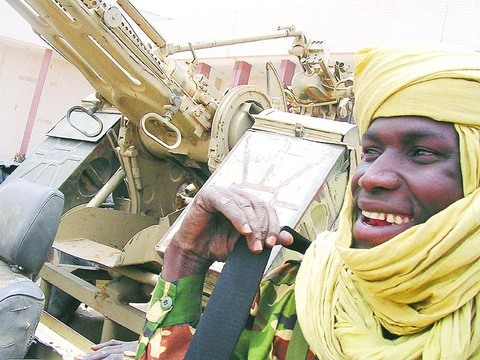
PHOTO: AFP
Chadian President Idriss Deby is seeking help in stopping rebels that he says are backed by neighboring Sudan.
Chad on Monday accused Sudan of forming a new rebel army to attack the country, but withdrew a threat to expel 200,000 refugees from the strife-torn Sudanese region of Darfur.
It also gained tacit support from the US as one source suggested the Khartoum regime might have been involved in an attack on Chad and the US State Department issued a pointed warning to Sudan against any such move in the future.
Chadian Foreign Minister Ahmat Allami claimed the Sudanese government was "reforming a new army" to attack Chad, after the failure of an assault by insurgents on the capital N'Djamena last week which left around 400 people dead.
"Preparations are under way on the other side of the border. The Sudanese are reforming a new army... The Sudanese are preparing a new massacre," Allami said by telephone.
Deby's office later released a statement accusing Khartoum of conscripting young people in Darfur to join the Chadian rebels and of sending them weapons to use in a new attack.
"According to corroborating sources, the Sudanese government is carrying out a forced recruitment of young people in Darfur to replace those who died during the latest combats," his office said in a statement.
Chad broke off diplomatic relations with Sudan last Friday, a day after the attack on N'Djamena by the rebel United Front for Change (FUC), which is seeking to topple Deby.
Washington stopped short of officially endorsing Chad's allegations on Monday but a senior State Department official, who asked not to be named, told reporters, "I'm not going to wave you off that there was some involvement" by the regime of President Omar al-Beshir in Khartoum.
Chad initially threatened to retaliate by expelling the 200,000 refugees from the civil war in Sudan's western Darfur region now living in camps in Chad.
But on Monday, the UN's refugee chief Antonio Guterres said Deby had assured him that "refugees will not be refouled [forcibly returned]."
However, UN spokesman Stephane Dujarric said that UN food deliveries had been disrupted in five Chadian camps but completed in five others.
Annan said he raised at the Security Council lunch reports of Sudan's involvement.
"If indeed the evidence is there that troops came from across the border of another country to attack one, the council cannot remain silent," he said.
He said he had spoken by telephone over the weekend to Deby, Congo Republic President and African Union Chairman Denis Sassou Nguesso, as well as US Secretary of State Condoleezza Rice and others "to see what can be done."
"I think it is important that the African Union, and all the countries in the region, and the international community, maintain the pressure on the two countries not to escalate," Annan said.
He said he still hoped for a peace agreement this month at talks in Abuja, Nigeria, between the Sudan government and Darfur rebels opposing it. But he acknowledged: "I have no certainty that there will be an agreement by the end of April."
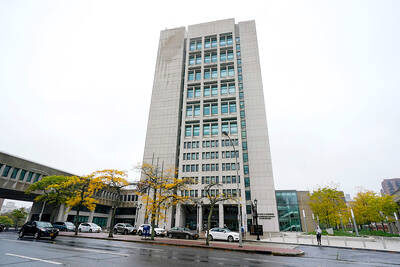
A coalition of civil rights groups on Tuesday asked a New York State judge to order one of its largest suburban counties to stop its deployment of nearly 600 license plate readers, calling it a warrantless and “indiscriminate surveillance system” that violates the state constitution. The class action lawsuit also alleged that Westchester County never got proper authorization to launch the program, which has amassed a database of 1.6 billion plate scans that has been shared with more than 50 outside law enforcement agencies. The complaint said the network “records the long-term travel patterns, daily habits, and intimate information of millions of

Pope Leo XIV on Wednesday blessed a giant new tower at Barcelona’s famed Sagrada Familia Basilica after celebrating mass inside what is now the world’s tallest church. A fireworks and light show illuminated the exterior of the temple at the end of the ceremony, bathing the unfinished basilica in shifting colours that highlighted its towering spires. A choir of 600 singers performed at the service which lasted around 90 minutes and was attended by Spanish Prime Minister Pedro Sanchez as well as King Felipe VI and Queen Letizia. The stained-glass windows in various colours shone brightly in between the tree-like
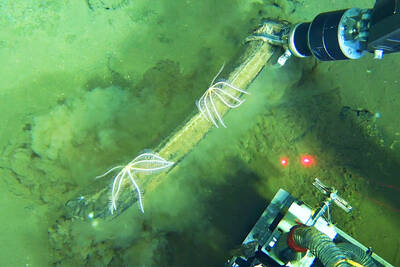
Scientists have discovered communities of marine life — including jellyfish, tubeworms and brittle stars — thriving on a whale graveyard. The graveyards form when whale carcasses fall to the sea floor, becoming a sustaining snack for nearby critters. This one, which is up to 7km below the surface of the southeastern Indian Ocean, spans the largest area, and is so far the deepest found. A whale’s sheer size and the unique chemistry of its bones are the keys to forming these unique underwater neighborhoods, said Song Xikun (宋希坤), a biologist with the Chinese Academy of Sciences’ Institute of Deep-sea Science and Engineering

Voters in Switzerland yesterday cast their ballots on an initiative championed by the top right-wing party to cap the Alpine country’s population at 10 million. As of press time last night, early results showed that Swiss voters were leaning against it. The populist Swiss People’s Party, which has the most seats in parliament, has stirred up and fostered anti-migration sentiment over the years, notably about an influx of workers from the neighboring EU. Critics called the bid a self-inflicted wound, saying the boom in migration over the past generation has brought foreign labor and skills to sectors such as healthcare, finance, pharmaceuticals


 RSS
RSS