


It was not the grandiloquent send-off he might have hoped for. Instead of a triumphal state funeral, former Yugoslavian president Slobodan Milosevic was ignominiously buried on Saturday in his back garden.
Milosevic's body was taken to Pozarevac, the small provincial town where he grew up. It was, by any standards, a bizarre final journey, more suited to a beloved family pet than a former head of state.
The garden where he was buried is supposed to be the place where Milosevic first kissed his teenage future wife Mira -- a woman known in Serbia as "Lady Macbeth" for her murderous intentions towards her husband's enemies.
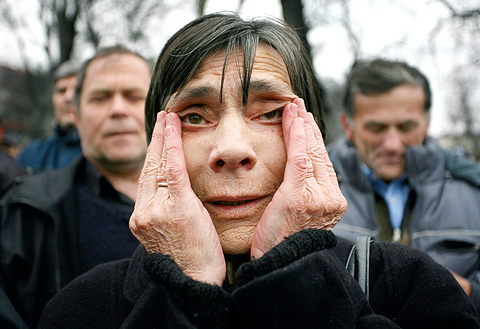
PHOTO: AFP
On Saturday however, it became clear that Mira had failed to turn up to Milosevic's funeral. His son Marko did not make it either. Mira Milosevic had stayed in self-imposed exile in Moscow, officials from Milosevic's Socialist party said, rather than return to Serbia, where she faces corruption charges.
In the absence of the former president's family, it was left to thousands of elderly Milosevic supporters to pay their last respects.
The West may regard him as a monster, but to Serbia's nationalist minority he is still a hero.
"I run a business. Today things are catastrophic," said Milodrag Antic, 54, mourning Serbia's economic decline.
"Things were much better under Tito and under Milosevic. We used to go on holiday and go skiing. Now we are broke," he said.
Serbia's weak pro-Western government refused Milosevic a state funeral but allowed the Socialist Party of Serbia, which holds the balance of power, to display his coffin in Belgrade's shabby museum. Over the past three days lines of supporters queued for up to seven hours to say goodbye.
Then at 10.30am on Saturday the coffin set off on its strange last trip. It stopped outside Serbia's parliament building, where thousands of supporters gathered, chanting "Slobo," before it was whisked away. After two hours' drive, past muddy fields and pine-covered hills, it arrived in Pozarevac.
Here -- as elsewhere in Serbia -- Milosevic is a figure of division. In the central square mourners clapped and threw flowers when his silver hearse arrived.
In a first-floor flat overlooking them, however, Slavicia Galena opened a giant bottle of Serbian slivovitz.
"We are celebrating," she said, handing out large shots. "My husband was a member of the resistance. Milosevic's son Marko had him beaten up and dragged off to his private prison underground."
After more speeches, the coffin was transported to Mira's suburban villa. A second plot has already been dug for Mira next to her husband, neighbors said.
"Nobody cares much for Milosevic," cafe owner Sala Njegic, 43, said.
"He's the past. He's history. I'm not interested in his funeral, to be honest. His big problem was his wife," he said.
Last week the town's municipal assembly voted to allow Milosevic to be buried in his garden, an unusual arrangement requiring special permission.
But the biggest reaction in Pozarevac was apathy. A minority on both sides have passionate views about the former Yugoslav president. But most people, it became clear on Saturday, don't really care.
Milosevic's legacy, it would appear, is not just a fragmented country, but a fractured society, in which pessimism, indifference, and even boredom rule.
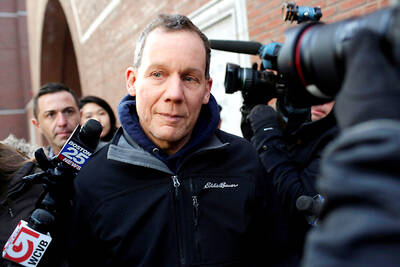
An American scientist convicted of lying to US authorities about payments from China while he was at Harvard University has rebuilt his research lab in Shenzhen, China, to pursue technology the Chinese government has identified as a national priority: embedding electronics into the human brain. Charles Lieber, 67, is among the world’s leading researchers in brain-computer interfaces. The technology has shown promise in treating conditions such as amyotrophic lateral sclerosis and restoring movement in paralyzed people. It also has potential military applications: Scientists at the Chinese People’s Liberation Army have investigated brain interfaces as a way to engineer super soldiers by boosting
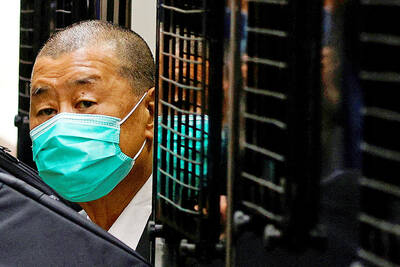
Jailed media entrepreneur Jimmy Lai (黎智英) has been awarded Deutsche Welle’s (DW) freedom of speech award for his contribution to Hong Kong’s pro-democracy movement. The German public broadcaster on Thursday said Lai would be presented in absentia with the 12th iteration of the award on June 23 at the DW Global Media Forum in Bonn. Deutsche Welle director-general Barbara Massing praised the 78-year-old founder of the now-shuttered news outlet Apple Daily for standing “unwaveringly for press freedom in Hong Kong at great personal risk.” “With Apple Daily, he gave journalists a platform for free reporting and a voice to the democracy movement in
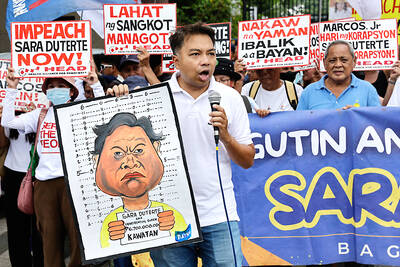
PHILIPPINE COMMITTEE: The head of the committee that made the decision said: ‘If there is nothing to hide, there is no reason to hide, there is no reason to obstruct’ A Philippine congressional committee on Wednesday ruled that there was “probable cause” to impeach Philippine Vice President Sara Duterte after hearing allegations of unexplained wealth, misuse of state funds and threats to have the president assassinated. The unanimous decision of the 53-member committee in the Philippine House of Representatives sends the two impeachment complaints to deliberations and voting by the entire lower chamber, which has more than 300 lawmakers. The complaints centered on Duterte’s alleged illegal use and mishandling of intelligence funds from the vice president’s office, and from her time as education secretary under Philippine President Ferdinand Marcos Jr. Duterte and the
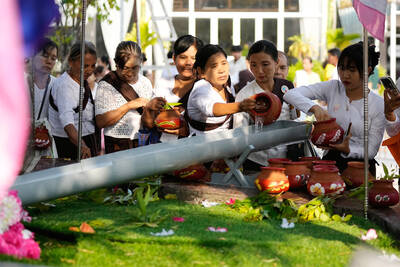
Burmese President Min Aung Hlaing yesterday cut all prisoners’ sentences by one-sixth, a blanket measure that a source close to deposed leader Aung San Suu Kyi said would further shorten her detention. Aung San Suu Kyi has been sequestered since a 2021 military coup, but the senior member of her dissolved National League for Democracy (NLD) party said that while her term had been reduced, her remaining sentence is still unclear. “We also don’t know exactly how many years she has left,” the source told reporters, speaking on condition of anonymity for security reasons. The military toppled Aung San Suu Kyi’s elected government


 RSS
RSS