


Steve Fossett, this era's Phileas Fogg, wants to do something not even the Around the World in 80 Days hero could contemplate: Fly around the globe -- and then some -- for more than three days without stopping.
His goal is to break a 20-year-old record for longest flight. He plans to travel 43,462km in a spindly experimental airplane that helped him break a different record last year.
During his 80 hours in the air, Fossett will take power naps no longer than five minutes each. He'll drink a steady diet of nutritious milkshakes. And he'll relieve himself using "pee bottles" and a plastic bag.
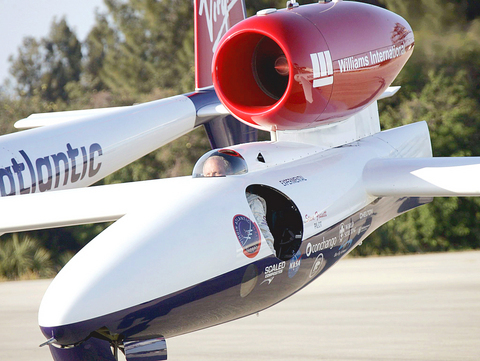
PHOTO: EPA
His flight is tentatively set for dawn today. He will take off at a runway used to land space shuttles, head east, circumnavigate the world and continue over the Atlantic Ocean for a second time before landing outside London.
"Except for takeoff and landing, it's a slow pace," he said. "That's a good thing. It gives me time to think about every step that I'm making because if I make an error ... it will be devastating to the flight."
If successful, Fossett's trip would surpass the previous airplane record of 40,204km set in 1986 by the Voyager aircraft piloted by Dick Rutan and Jeanna Yeager, as well as the balloon record of 40,805km set by the Breitling Orbiter 3 in 1999.
When Fossett actually leaves the ground depends on the weather. Temperature at takeoff must be less than 12?C to achieve maximum thrust, and right now the earliest time that criteria will be met is today.
Fossett already has faced delays unrelated to weather or engineering. The takeoff was pushed back a few days because Chinese authorities were unable to issue the proper overflight permits during the Lunar New Year, and the plane's movement to the Kennedy Space Center last month was delayed because of a mishap that damaged a wing.
Fossett, 61, a former Chicago investment tycoon, has a wellspring of patience. He had failed five times before successfully circumnavigating the globe solo in a balloon in 2002.
This time the aviator plans to use the same plane, the Virgin Atlantic Global Flyer, that he used last March when he became the first person to fly solo nonstop, without refueling, around the globe in 67 hours.
As the plane's name suggests, the venture is being financed by Virgin Atlantic Airways founder Richard Branson.
The glider-like aircraft with a 34.2m wing span has two external booms, holding 2,454kg of fuel, on either side of the 2.1m long cockpit, which supports the engine.
At takeoff, fuel is expected to account for almost 85 percent of the graphite-made aircraft's weight. Drag parachutes are used to help it descend from its average flying height of about 13,500m or slow it down from a top speed of 458.6kph.
"When you have an aircraft like that, everything except the cockpit and the engine are basically a part of the fuel tank," said Dick Knapinski, a spokesman for the Experimental Aircraft Association in Oshkosh, Wisconsin
"The engine can't be too large because then it would add extra weight, which would need extra fuel, which means you need a bigger airplane. It's a fine line for the person doing the engineering," he said.
That person is Burt Rutan, who designed the Voyager airplane that his brother, Dick, and Yeager used to set the record almost two decades ago. Rutan has popularized "canard" designs in which small wings are placed near the nose of the aircraft.

‘CROSSING THE LINE’: China’s embassy in Seoul criticized US Forces Korea Commander General Xavier Brunson, asking if his ‘hostile’ remarks were authorized by Washington South Korea and the US are in talks over recent public remarks by the commander of US Forces Korea, Seoul’s presidential office said yesterday, after the comments drew sharp criticism from China. In a recent podcast interview, US Forces Korea Commander General Xavier Brunson described South Korea as “the dagger in the heart of Asia” from China’s east coast, prompting the Chinese embassy in Seoul to say that he had “truly crossed the line.” The interview came amid growing speculation that Washington might seek to expand the role of US Forces Korea in countering the growing regional influence of China, a key

Through the noise of rushing papers and whirring belts at a print factory in Kyoto, two creators watch their photo essay come to life in broadsheet form — part of an effort to win new audiences in the age of artificial intelligence (AI). Despite the decline of the publishing industry, self-publication and handmade “zine” magazines are growing in popularity in Japan, reflecting the nation’s enduring love of paper in the digital era. While speaking to Agence France-Presse at the plant, his hands black with ink, one of the creators, Kazuma Obara, said: “I think [paper] is a medium that engages all five

Australian researchers have trained lab-grown brain cells on a silicon computer chip to play the 1990s shooter game Doom and said they are just scratching the surface of what the neurons could be capable of doing. It is the science-fiction work of biotech boffins at Cortical Labs, who researched and developed the technology that harnesses the workings of the brain’s networking system. Each so-called “biological computer” contains about 200,000 living human brain cells, grown from stem cells that were harvested from blood donations. Having mastered the simple computer game Pong, where a paddle is moved up and down to send a ball
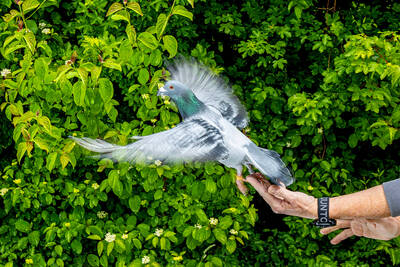
A surprising gut feeling may help pigeons find their way home. Animals use various techniques to navigate, including following the stars and remembering key landmarks. Birds, fish and turtles orient themselves using Earth’s magnetic field as a compass, but it is not yet clear how exactly they do this. Pigeons are a well-known group of frequent flyers that can traverse hundreds of kilometers in a single day. For thousands of years, humans have used them to carry news, notes and military messages. Scientists have long tried to untangle how pigeons travel without getting lost. Some think the birds detect magnetic cues using light-sensitive


 RSS
RSS