


■ Hong Kong
Arsonist receives life
A 68-year-old man began a life sentence on Thursday after being found guilty of setting fire to a commuter train during rush hour, the South China Morning Post said. The man, Yim Kam-chung, ignited a bottle of solvent in a train carriage in February as it left a busy station in Tsim Sha Tsui, the daily said. The fire was extinguished by a passenger who stamped on the bottle and alerted fellow passengers. Yim later told police he had set out to "cause a tragedy" because the government has confiscated six of his vehicles.
■ Hong Kong
Old food seller arrested
A street hawker has been arrested for selling tins of food out-of-date by up to six years scavenged from trash cans, officials said yesterday. The 47-year-old woman was buying foodstuffs and other items collected from rubbish collection points by scavengers for around a US$1 a bag. She was then selling them on at prices well below the normal market value. They included tea, dried noodles, soy sauce and potato chips. The Food and Environmental Hygiene Department was alerted to the case when a woman became ill after eating soup she bought from the hawker that had an expiry date three years earlier.
■ South Korea
Agent Orange makers lose
The Seoul High Court yesterday ordered two US manufacturers of the defoliant Agent Orange to pay US$62 million in medical compensation to South Korean veterans of the Vietnam War and their families. The court ordered Dow Chemical in Midland, Michigan, and Monsanto Company in St. Louis, Missouri, to pay the compensation to about 6,800 people. The herbicide was widely used to destroy jungle cover used by communist troops during the war, but South Koreans, Vietnamese and many US veterans later blamed their exposure to the chemical for a variety of illnesses and reproductive disorders, including miscarriages, birth defects, cancers and nervous disorders.
■ Philippines
Rebels battle each other
Fighting broke out between rival factions of the largest Muslim separatist group on Mindanao island on Thursday, highlighting what analysts have said could be a split in the rebels. Hundreds of people have fled a remote village in Maguindanao province after some 200 members of the Moro Islamic Liberation Front (MILF) occupied the area following two days of fighting, a rebel spokesman and army officials said. An army spokesman said the fighting was between MILF's radical faction.
■ Egypt
Farmer dumps chicks
A farmer abandoned 10,000 newly hatched chicks to their fate on a desert road east of Cairo fearing they might be infected with the deadly bird flu virus, a police official said on Wednesday. Shocked motorists traveling on the road about 130km east of Cairo contacted police after seeing the chicks running loose on the tarmac on Tuesday, the official added. Health officials gathered the chicks and confirmed after testing that they were not carrying the virus. The farmer has taken back the birds and would not be facing legal proceedings, the official said.
■ Russia
Alleged spies urged to stay
The Russian President, Vladimir Putin, on Wednesday said that four British diplomats accused of espionage in Moscow should not be expelled, as their replacements might be cleverer than they were and harder to catch. Putin said he wanted the Russian security services and the foreign ministry to suggest a line of approach to the Kremlin, but questioned the wisdom of expelling the four men. The diplomats were shown on Russian state television on Sunday allegedly retrieving data from a Russian agent, by palmtop computer, via a transmitter hidden in a fake rock. The program claimed that Britain was using spies to fund and communicate with Russian non-governmental organizations.
■ Colombia
Hiccups lead to two deaths
A man accidentally shot his nephew to death while trying to cure his hiccups by pointing a revolver at him to scare him, police in the Caribbean port city of Barranquilla said on Tuesday. After shooting 21-year-old university student David Galvan in the neck, his uncle, Rafael Vargas, 35, was so distraught he turned the gun on himself and committed suicide, police said. The incident took place on Sunday night while the two were having drinks with neighbors. Galvan started to hiccup and Vargas, who worked as a security guard, said he would use the home remedy for hiccups of scaring him. He pulled out his gun, pointed it at Galvan and it accidentally went off, witnesses told local TV.
■ Libya
Rights record praised
Tripoli won praise on Wednesday for taking "important steps" to improve human rights but was warned it will have to do more to meet international standards. Despite improvements, including the release of 14 political prisoners, Libya continues to hold other political prisoners, conducts unfair trials and restricts free speech, Human Rights Watch said. Monitors from the New York-based body were allowed to visit Libya for the first time last year, a move it welcomed as a step towards greater transparency. Libyan authorities provided access to top officials as well as police stations, an immigrant detention centre and five prisons, where 32 prisoners were interviewed in private, the report said.
■ Bolivia
Sister appointed first lady
Bolivian President Evo Morales' sister will give up her butcher shop to become Bolivia's first lady, filling the role because the new leader is single, his office said on Wednesday. Esther Morales, 54, is married with three children and owns a grocery shop that sells beef and llama meat in the small town of Oruro. Esther Morales, who raised her younger brother after their mother died, has refused to be referred to as first lady, saying it was contrary to her humble social class.


Through the noise of rushing papers and whirring belts at a print factory in Kyoto, two creators watch their photo essay come to life in broadsheet form — part of an effort to win new audiences in the age of artificial intelligence (AI). Despite the decline of the publishing industry, self-publication and handmade “zine” magazines are growing in popularity in Japan, reflecting the nation’s enduring love of paper in the digital era. While speaking to Agence France-Presse at the plant, his hands black with ink, one of the creators, Kazuma Obara, said: “I think [paper] is a medium that engages all five
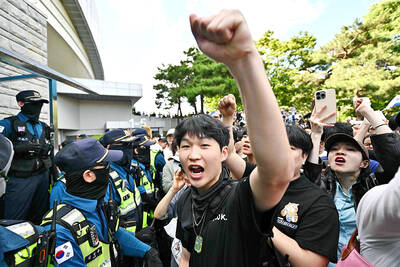
‘ABSURD MISTAKE’: The election commission said that there had been a failure to anticipate turnout after 14 polling stations ran short of ballot papers South Korean riot police yesterday cleared protesters from a Seoul polling station after a 35-hour blockade sparked by a shortage of ballot papers during local elections earlier this week. Wednesday’s election was the first nationwide vote since South Korean President Lee Jae-myung took office following the ouster of Yoon Suk-yeol over his short-lived martial law declaration. Lee’s ruling Democratic Party swept most races, but failed to flip the crucial Seoul mayoral seat. The South Korean National Election Commission apologized, blaming a failure to anticipate turnout after 14 polling stations in Seoul ran short of ballot papers. Some polling stations stayed open until 10pm to

France experienced its hottest spring on record, the French weather service said on Tuesday, after an exceptional early heat wave that also broke highs for the season in England and Wales. Meteo-France said the average nationwide temperature over March to May was 13.8°C — about 1.7°C above the norm, and surpassing records set in 2011 and 2020. “The warmest spring since records began in 1900,” it said in a bulletin. All three months were warmer than average, but the onset of an “unprecedented heatwave” late last month pushed the mercury to highs typically seen at the height of the summer. “Our country had never

A Sherpa guide was found crawling to base camp on Mount Everest a week after he went missing and was reunited with his family, who had given up hope he would return. Dawa Sherpa was last seen on Friday last week descending the mountain, but he did not reach base camp even though his client did. The pair were among the last climbers on the mountain as the climbing season came to an end and the route was dismantled. Dawa was located by a cleaning crew on Thursday morning as he was crawling down the snowy slopes around the Khumbu Icefall, just above


 RSS
RSS