


Bolivia's socialist president-elect, Evo Morales, won a hero's welcome and a cooperation deal in Havana, with Cuban President Fidel Castro promising the world "the [political] map is changing."
Alluding to numerous shifts to the left in Latin America, the latest in Bolivia, Castro said: "It appears the [political] map is changing, and we need to be reflective, to watch closely and stay informed."
A military band played and an honor guard stood at attention after Morales arrived on Friday at Jose Marti International airport for his first visit abroad since winning Bolivia's Dec. 18 presidential vote.
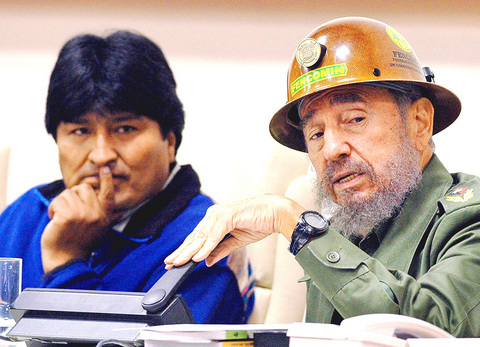
PHOTO: EPA
Castro, 79, had sent his private plane to bring Morales to Havana and after the president-elect stepped off the plane onto a red carpet, the two leaders embraced.
Morales, who has never hidden his admiration for Cuba's revolution, said he felt "joy, great emotion to be here." Wearing a red sweater, Morales referred to Castro as el comandante and said his trip was a gesture of "friendship with the Cuban people."
Morales' choice of Cuba as his first visit abroad after his electoral victory underlines the political loyalties of the leftist leader, who pledged to join Castro's "anti-imperialist struggle" in a message to the Cuban people the day after his election.
As Bolivia's first indigenous president, Morales' election was "something extraordinary" that had "rocked the world," Castro said.
"We invited him before the elections because we knew that he would win," said Castro, wearing his customary military fatigues.
Despite US efforts to isolate Cuba, Castro enjoys very close ties to Venezuela's leftist President Hugo Chavez, whose international profile has risen steadily as Venezuelan oil earnings have mounted. Meanwhile left-of-center governments have come to power elsewhere in the region, from Argentina to Uruguay to Chile and Brazil.
Castro said "during our discussion we were in touch with Chavez," but he did not offer further details on the kind of three-way alliance that has Washington increasingly concerned.
A week ago, Chavez warned, referring to Morales' win, that "the [US] threats have already begun. From here on in, we are demanding that the immoral imperialist US government respect the holy sovereignty of Bolivia and the government elected by Bolivia."
As an activist for coca farmers in Bolivia, Morales cultivated friendly ties with Castro for years and has pledged to support Chavez's effort to defeat a US-proposed free trade area.
Morales has vowed to nationalize Bolivia's large natural gas industry in South America's poorest nation, and end the US-sponsored coca eradication program that he says has hurt farmers and failed to curb drug trafficking.

‘CROSSING THE LINE’: China’s embassy in Seoul criticized US Forces Korea Commander General Xavier Brunson, asking if his ‘hostile’ remarks were authorized by Washington South Korea and the US are in talks over recent public remarks by the commander of US Forces Korea, Seoul’s presidential office said yesterday, after the comments drew sharp criticism from China. In a recent podcast interview, US Forces Korea Commander General Xavier Brunson described South Korea as “the dagger in the heart of Asia” from China’s east coast, prompting the Chinese embassy in Seoul to say that he had “truly crossed the line.” The interview came amid growing speculation that Washington might seek to expand the role of US Forces Korea in countering the growing regional influence of China, a key

Through the noise of rushing papers and whirring belts at a print factory in Kyoto, two creators watch their photo essay come to life in broadsheet form — part of an effort to win new audiences in the age of artificial intelligence (AI). Despite the decline of the publishing industry, self-publication and handmade “zine” magazines are growing in popularity in Japan, reflecting the nation’s enduring love of paper in the digital era. While speaking to Agence France-Presse at the plant, his hands black with ink, one of the creators, Kazuma Obara, said: “I think [paper] is a medium that engages all five

Australian researchers have trained lab-grown brain cells on a silicon computer chip to play the 1990s shooter game Doom and said they are just scratching the surface of what the neurons could be capable of doing. It is the science-fiction work of biotech boffins at Cortical Labs, who researched and developed the technology that harnesses the workings of the brain’s networking system. Each so-called “biological computer” contains about 200,000 living human brain cells, grown from stem cells that were harvested from blood donations. Having mastered the simple computer game Pong, where a paddle is moved up and down to send a ball

France experienced its hottest spring on record, the French weather service said on Tuesday, after an exceptional early heat wave that also broke highs for the season in England and Wales. Meteo-France said the average nationwide temperature over March to May was 13.8°C — about 1.7°C above the norm, and surpassing records set in 2011 and 2020. “The warmest spring since records began in 1900,” it said in a bulletin. All three months were warmer than average, but the onset of an “unprecedented heatwave” late last month pushed the mercury to highs typically seen at the height of the summer. “Our country had never


 RSS
RSS