


Detectives investigating race riots that rocked Sydney last week seized a pistol, ammunition, knives and smoke bombs in a series of raids yesterday, police said in a statement.
The weapons haul came after police questioned five men arrested on Sunday night with a drum of petrol and objects for putting together makeshift fuel bombs in their car, New South Wales Police said in a statement.
Police Commissioner Ken Moroney said that material in the car suggested the men had links to white supremacist groups.
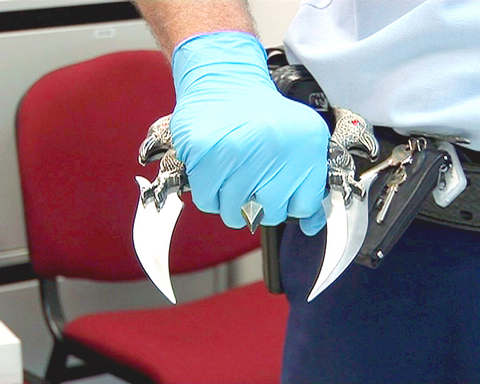
PHOTO: EPA
Four of the men were released without charge after questioning and the fifth was ordered to appear in court on Jan. 17 on charges of being armed with intent to commit an indictable offense.
State Police Commissioner Ken Moroney said police raided five homes in Sydney and the nearby city of Wollongong and arrested one man. He was not immediately charged.
News of the raids came the same day that New South Wales state's top political leader, Premier Morris Iemma, said police believe the threat of racial violence at Sydney's southern beaches has passed for now and urged people to return to the seaside.
"The intelligence and the security assessments are such that people are encouraged to return to normal business," Iemma told reporters. "This can change, but at the moment the assessments are that we want a return to normal."
He said there were no immediate plans to cancel celebrations by backpackers on Sydney's Bondi Beach on Christmas day.
Meanwhile, federal authorities have said they will begin trying to trace mobile phone text messages blamed for inciting race riots that rocked this city last week.
"The Commonwealth law enforcement authorities have advised New South Wales Police that they think they can start tracing all of these texts," New South Wales Police Minister Carl Scully told Macquarie Radio. "If that is the case and we do nab a few of them, that will be a very sobering message because they face the risk of being put in jail for a long time."
Police confiscated several mobile phones carrying such messages over the weekend, along with weapons including fuel bombs, swords, knives, baseball bats and a homemade club made from a stick studded with nails.
About 2,000 police took part in a major operation to maintain public order, stopping, checking and sometimes confiscating cars.
"We feel that the police have been involved to the point where we have stopped potential disasters from happening in and around our beachside suburbs, so we are confident we averted potentially major tragedies," New South Wales state Assistant Police Commissioner Andrew Scipione told television's Nine Network.
Iemma said police had charged 163 people with 283 offenses since their unprecedented crackdown on racially motivated rioting began on Dec. 12, the day after riots erupted at the southern beach of Cronulla.
Despite Iemma saying life should return to normal at beachside suburbs -- where cafes and bars have seen profits plunge since the rioting broke out -- there is no end in sight to the heavy police presence at Sydney's beaches.
He said earlier yesterday that police will remain at the troubled beaches for as long as necessary -- as the city gears up for summer vacations when the beaches are at their busiest.
"This is a fight for order and control of our streets," he told Australian Broadcasting Corp radio.
"There are hooligans out there who believe they have the right to determine who goes to beaches and streets and who will control parts of our parks and our streets," Iemma added. "That is not something we can tolerate."
Amir Ali Osmanagic, 18, from southern Victoria state appeared in Waverley Local Court yesterday charged with affray and possessing an offensive implement with intent to commit an indictable offense after police said he was found Sunday on a bus heading to Sydney's Bondi Beach carrying two bottles full of petrol.
Osmanagic, who did not enter a plea, was ordered jailed until a court hearing tomorrow. Lawmakers in New South Wales state, of which Sydney is the capital, last week doubled the maximum sentence for affray from five to 10 years in response to the rioting.

‘CROSSING THE LINE’: China’s embassy in Seoul criticized US Forces Korea Commander General Xavier Brunson, asking if his ‘hostile’ remarks were authorized by Washington South Korea and the US are in talks over recent public remarks by the commander of US Forces Korea, Seoul’s presidential office said yesterday, after the comments drew sharp criticism from China. In a recent podcast interview, US Forces Korea Commander General Xavier Brunson described South Korea as “the dagger in the heart of Asia” from China’s east coast, prompting the Chinese embassy in Seoul to say that he had “truly crossed the line.” The interview came amid growing speculation that Washington might seek to expand the role of US Forces Korea in countering the growing regional influence of China, a key

Through the noise of rushing papers and whirring belts at a print factory in Kyoto, two creators watch their photo essay come to life in broadsheet form — part of an effort to win new audiences in the age of artificial intelligence (AI). Despite the decline of the publishing industry, self-publication and handmade “zine” magazines are growing in popularity in Japan, reflecting the nation’s enduring love of paper in the digital era. While speaking to Agence France-Presse at the plant, his hands black with ink, one of the creators, Kazuma Obara, said: “I think [paper] is a medium that engages all five

Australian researchers have trained lab-grown brain cells on a silicon computer chip to play the 1990s shooter game Doom and said they are just scratching the surface of what the neurons could be capable of doing. It is the science-fiction work of biotech boffins at Cortical Labs, who researched and developed the technology that harnesses the workings of the brain’s networking system. Each so-called “biological computer” contains about 200,000 living human brain cells, grown from stem cells that were harvested from blood donations. Having mastered the simple computer game Pong, where a paddle is moved up and down to send a ball

France experienced its hottest spring on record, the French weather service said on Tuesday, after an exceptional early heat wave that also broke highs for the season in England and Wales. Meteo-France said the average nationwide temperature over March to May was 13.8°C — about 1.7°C above the norm, and surpassing records set in 2011 and 2020. “The warmest spring since records began in 1900,” it said in a bulletin. All three months were warmer than average, but the onset of an “unprecedented heatwave” late last month pushed the mercury to highs typically seen at the height of the summer. “Our country had never


 RSS
RSS