


A Sydney magistrate yesterday refused to grant bail to one of eight men arrested this week and charged with conspiring to make explosives in preparation for a terrorist attack, saying the evidence appeared to link him to a plot that could "create great disturbance inside this country."
Shackled and wearing an orange prison jumpsuit, short hair and a beard, the 29-year-old suspected terrorist, Mirsad Mulahalilovic, appeared for the brief bail hearing via a video link from a top security jail outside Sydney.
Prosecutors accused him of buying acid that could be used to make bombs and alleged Mulahalilovic is part of a Sydney-based terror cell that been meeting secretly over recent months and had bomb-making instructions stored on a computer memory card.
Mulahalilovic was the only one of eight suspects arrested in a string of dramatic pre-dawn raids on Tuesday in Sydney to apply for bail at the city's Central Local Court yesterday.
He and the other seven suspects are due to appear again in court on Dec. 5.
Defense attorney Phillip Boulten argued that the prosecution case, built over an 18-month investigation leading up to the mass arrests, consisted only of evidence that Mulahalilovic bought a 1m length of PVC piping and some plastic caps, and that police found hydrochloric acid in his house.
But Prosecutor Wendy Abraham argued that Mulahalilovic's case needed to be looked at in terms of his relationship with other suspects picked up in the raids, who are accused of being a terror cell led by a radical Islamic cleric based in Melbourne.
Abraham said that hydrochloric acid was one of the ingredients for explosives police found on the computer memory card.
Boulten argued that there was a "completely innocent explanation" for the acid, which could be used as a cleaner by Mulahalilovic, who is a painter and handyman. There is "no evidence that it was to be used for an illicit purpose," he said.
"This is a most marginal basis upon which to charge someone with a conspiracy to [carry out] a terrorist attack," Boulten said.
He accused authorities of keeping Mulahalilovic locked up for more than 20 hours each day since his arrest and preventing him from coming into contact with other prisoners or phoning his pregnant wife and other family members.
He said Mulahalilovic was kept shackled at the hands and feet during his brief exercise period at the prison, and was subject to near constant video surveillance.
Magistrate Allan Moore said that the preliminary evidence indicated Mulahalilovic was involved with others in activities ``which have the potential to create great disturbance inside this country.''
He refused to grant Mulahalilovic bail despite his family and friends' offer to put up three houses worth A$1 million (US$730,000) as a bond.
In a related terror case, Moore ordered 25-year-old Izzydeen Atik extradited to Victoria state where he was to be charged with membership in a terrorist group.
He was ordered to appear in court in Melbourne on Monday.
This week's raids also netted nine men in Melbourne accused of being in a terror group, including firebrand cleric Abu Bakr, who is accused of leading terror cells in both Sydney and Melbourne.
Police said the men were plotting a catastrophic terror attack on Australian soil, but were arrested before settling on a specific target.

Through the noise of rushing papers and whirring belts at a print factory in Kyoto, two creators watch their photo essay come to life in broadsheet form — part of an effort to win new audiences in the age of artificial intelligence (AI). Despite the decline of the publishing industry, self-publication and handmade “zine” magazines are growing in popularity in Japan, reflecting the nation’s enduring love of paper in the digital era. While speaking to Agence France-Presse at the plant, his hands black with ink, one of the creators, Kazuma Obara, said: “I think [paper] is a medium that engages all five
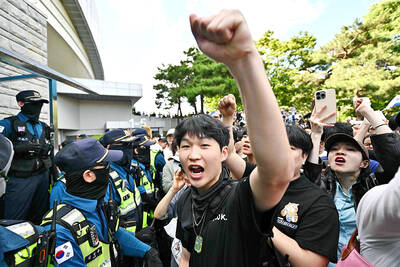
‘ABSURD MISTAKE’: The election commission said that there had been a failure to anticipate turnout after 14 polling stations ran short of ballot papers South Korean riot police yesterday cleared protesters from a Seoul polling station after a 35-hour blockade sparked by a shortage of ballot papers during local elections earlier this week. Wednesday’s election was the first nationwide vote since South Korean President Lee Jae-myung took office following the ouster of Yoon Suk-yeol over his short-lived martial law declaration. Lee’s ruling Democratic Party swept most races, but failed to flip the crucial Seoul mayoral seat. The South Korean National Election Commission apologized, blaming a failure to anticipate turnout after 14 polling stations in Seoul ran short of ballot papers. Some polling stations stayed open until 10pm to

Australian researchers have trained lab-grown brain cells on a silicon computer chip to play the 1990s shooter game Doom and said they are just scratching the surface of what the neurons could be capable of doing. It is the science-fiction work of biotech boffins at Cortical Labs, who researched and developed the technology that harnesses the workings of the brain’s networking system. Each so-called “biological computer” contains about 200,000 living human brain cells, grown from stem cells that were harvested from blood donations. Having mastered the simple computer game Pong, where a paddle is moved up and down to send a ball
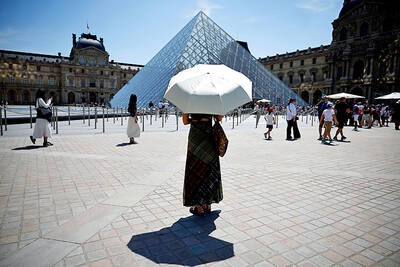
France experienced its hottest spring on record, the French weather service said on Tuesday, after an exceptional early heat wave that also broke highs for the season in England and Wales. Meteo-France said the average nationwide temperature over March to May was 13.8°C — about 1.7°C above the norm, and surpassing records set in 2011 and 2020. “The warmest spring since records began in 1900,” it said in a bulletin. All three months were warmer than average, but the onset of an “unprecedented heatwave” late last month pushed the mercury to highs typically seen at the height of the summer. “Our country had never


 RSS
RSS