


Prosecutors in Sicily opened a criminal investigation on Friday following the publication of a horrific account by a journalist who disguised himself as an illegal immigrant and spent a week in detention.
Fabrizio Gatti, of the center-left news magazine L'Espresso, said he had seen immigrant detainees being humiliated and physically and verbally abused by paramilitary carabinieri officers.
His account, published yesterday, has disturbing echoes of the scandal involving the mistreatment of prisoners by American soldiers at the Abu Ghraib prison in Iraq.
After enduring seven days of dire conditions in a detention center, he was simply let go. Despite the conservative government's tough policy on immigration, the reporter's alter ego, Bilal Ibrahim el Habib, was set free, "to go and work in any city in Europe as an illegal alien."
His journey began when he jumped into the Mediterranean off the Italian island of Lampedusa and floated back ashore on a raft.
Lampedusa, midway between Malta and Tunisia, is a favorite destination for would-be immigrants from north Africa.
Gatti was picked up by a passing motorist and handed over to the carabinieri. One officer, he said, amused himself by showing a pornographic video on his mobile telephone to the mainly Muslim detainees in the reception center.
"A 30-year-old man covers his eyes with his hands," Gatti recorded in his diary. "He is one of those who led the prayers yesterday in the open-air `mosque.' The carabiniere tears his hands from his eyes and pushes the screen in front of his nose saying, `Look -- that way you'll learn.'"
The reporter said that officers had forced him to sit in liquid sewage and kept him for hours in the burning sun. He also records fascist-style straight-arm salutes being exchanged between carabinieri.
The most violent incident is said to have taken place after the arrival of about 180 migrants at the center. Gatti said several were made to strip naked and, later, the carabinieri forced them and others to run a gauntlet into a protected area he describes as "the cage." The carabinieri formed into two lines.
"A line of six foreigners to be moved into the cage passes between them and each one gets his ration of slaps. Four carabinieri each deal out four slaps apiece. Finally, [a] sergeant who at noon was imitating Mussolini turns up. But he does not reprove anyone."
One of the immigrants had earlier failed to understand an order to strip. Gatti said the sergeant turned to a colleague, saying: "This the one giving you problems?" He then punched the immigrant just below the chest.
The reporter said: "The slapping filled the air for half an hour. Then a woman police officer intervened, telling a carabinieri NCO to "see what your lads are up to because I'm hearing too much hand movement."
He said that although the government claimed that all detainees were brought before a magistrate, his own detention was entirely arbitrary. In the end, he was transferred to Agrigento, Sicily, where police gave him some documents, two bread rolls and a bottle of water, before driving him to a railway station.
There, he and the other migrants with him were told: "You've got five days to get out of Italy. You're free."

Through the noise of rushing papers and whirring belts at a print factory in Kyoto, two creators watch their photo essay come to life in broadsheet form — part of an effort to win new audiences in the age of artificial intelligence (AI). Despite the decline of the publishing industry, self-publication and handmade “zine” magazines are growing in popularity in Japan, reflecting the nation’s enduring love of paper in the digital era. While speaking to Agence France-Presse at the plant, his hands black with ink, one of the creators, Kazuma Obara, said: “I think [paper] is a medium that engages all five
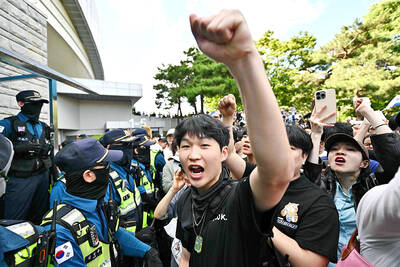
‘ABSURD MISTAKE’: The election commission said that there had been a failure to anticipate turnout after 14 polling stations ran short of ballot papers South Korean riot police yesterday cleared protesters from a Seoul polling station after a 35-hour blockade sparked by a shortage of ballot papers during local elections earlier this week. Wednesday’s election was the first nationwide vote since South Korean President Lee Jae-myung took office following the ouster of Yoon Suk-yeol over his short-lived martial law declaration. Lee’s ruling Democratic Party swept most races, but failed to flip the crucial Seoul mayoral seat. The South Korean National Election Commission apologized, blaming a failure to anticipate turnout after 14 polling stations in Seoul ran short of ballot papers. Some polling stations stayed open until 10pm to

Australian researchers have trained lab-grown brain cells on a silicon computer chip to play the 1990s shooter game Doom and said they are just scratching the surface of what the neurons could be capable of doing. It is the science-fiction work of biotech boffins at Cortical Labs, who researched and developed the technology that harnesses the workings of the brain’s networking system. Each so-called “biological computer” contains about 200,000 living human brain cells, grown from stem cells that were harvested from blood donations. Having mastered the simple computer game Pong, where a paddle is moved up and down to send a ball

France experienced its hottest spring on record, the French weather service said on Tuesday, after an exceptional early heat wave that also broke highs for the season in England and Wales. Meteo-France said the average nationwide temperature over March to May was 13.8°C — about 1.7°C above the norm, and surpassing records set in 2011 and 2020. “The warmest spring since records began in 1900,” it said in a bulletin. All three months were warmer than average, but the onset of an “unprecedented heatwave” late last month pushed the mercury to highs typically seen at the height of the summer. “Our country had never


 RSS
RSS