


Authorities tore down a house-sized teapot, umbrella and boat that gained nationwide notoriety after a banned Malaysian religious sect built them in its commune, the sect's followers said yesterday.
The structures, built by the Sky Kingdom sect to represent interfaith harmony, were reduced to rubble by bulldozers sent by the state government on Sunday in northeastern Terengganu, where the sect has been accused of spreading teachings that run contrary to Islam.
Newspapers published photos of the structures in ruins, with unidentified officials quoted as saying the sect built them illegally earlier this year on land meant for agriculture.

PHOTO: REUTERS
Sulaiman Takrib, who has lived at the commune since 1998, said the residents' houses remain intact despite the destruction of the other architecture. Some 50 people still live there, but officials have ordered most of them to vacate their homes within three weeks, he said.
"We'll have to refer this issue to our lawyers," Sulaiman said by telephone from Terengganu. "We have no wish to fight the authorities using force."
Police and officials in Terengganu refused to comment.
The move comes amid an ongoing crackdown on the Sky Kingdom sect, which is believed to have hundreds of mostly ethnic Malay Muslim members in northeastern Malaysia, though its followers say they come from all religions.
A mob of about 30 people who were allegedly upset with the sect's teachings attacked its commune last month, setting fire to some of the structures. The sect's leader, Ariffin Mohammed, has disappeared since the incident.
Authorities subsequently raided the commune, and detained and charged 49 followers for flouting an edict issued by Islamic state officials that declared their beliefs contrary to Islam. If found guilty, they could be fined and jailed for up to two years.
Three of Ariffin's four wives were detained by police over the weekend and are expected to be charged for helping him spread what authorities have called deviationist teachings.

Through the noise of rushing papers and whirring belts at a print factory in Kyoto, two creators watch their photo essay come to life in broadsheet form — part of an effort to win new audiences in the age of artificial intelligence (AI). Despite the decline of the publishing industry, self-publication and handmade “zine” magazines are growing in popularity in Japan, reflecting the nation’s enduring love of paper in the digital era. While speaking to Agence France-Presse at the plant, his hands black with ink, one of the creators, Kazuma Obara, said: “I think [paper] is a medium that engages all five
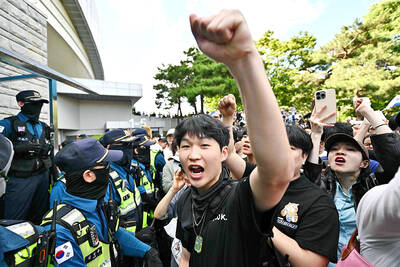
‘ABSURD MISTAKE’: The election commission said that there had been a failure to anticipate turnout after 14 polling stations ran short of ballot papers South Korean riot police yesterday cleared protesters from a Seoul polling station after a 35-hour blockade sparked by a shortage of ballot papers during local elections earlier this week. Wednesday’s election was the first nationwide vote since South Korean President Lee Jae-myung took office following the ouster of Yoon Suk-yeol over his short-lived martial law declaration. Lee’s ruling Democratic Party swept most races, but failed to flip the crucial Seoul mayoral seat. The South Korean National Election Commission apologized, blaming a failure to anticipate turnout after 14 polling stations in Seoul ran short of ballot papers. Some polling stations stayed open until 10pm to

Australian researchers have trained lab-grown brain cells on a silicon computer chip to play the 1990s shooter game Doom and said they are just scratching the surface of what the neurons could be capable of doing. It is the science-fiction work of biotech boffins at Cortical Labs, who researched and developed the technology that harnesses the workings of the brain’s networking system. Each so-called “biological computer” contains about 200,000 living human brain cells, grown from stem cells that were harvested from blood donations. Having mastered the simple computer game Pong, where a paddle is moved up and down to send a ball

France experienced its hottest spring on record, the French weather service said on Tuesday, after an exceptional early heat wave that also broke highs for the season in England and Wales. Meteo-France said the average nationwide temperature over March to May was 13.8°C — about 1.7°C above the norm, and surpassing records set in 2011 and 2020. “The warmest spring since records began in 1900,” it said in a bulletin. All three months were warmer than average, but the onset of an “unprecedented heatwave” late last month pushed the mercury to highs typically seen at the height of the summer. “Our country had never


 RSS
RSS