


Why are toads puffing up and spontaneously exploding in northern Europe?
It began in a posh German neighborhood and has spread across the border into Denmark. It has left onlookers baffled, but one German scientist studying the splattered amphibian remains now has a theory: Hungry crows may be pecking out their livers.
"The crows are clever," said Frank Mutschmann, a Berlin veterinarian who collected and tested specimens at the Hamburg pond. "They learn quickly from watching other crows how to get the livers."
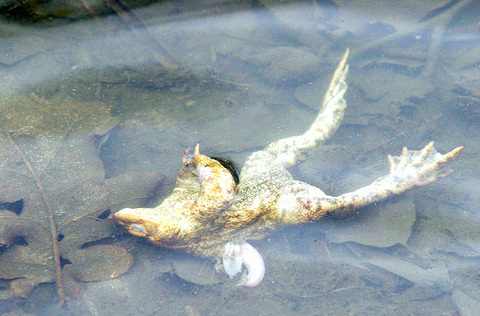
PHOTO: AFP
So far, more than 1,000 toad corpses have been found at a pond in Hamburg and in Denmark. But the pond water in Hamburg has been tested, and its quality is no better or worse than elsewhere in the city. The remains have been checked for a virus or bacteria, but none has been found.
Based on the wounds, Mutschmann said, it appears that a bird pecks into the toad with its beak between the amphibian's chest and abdominal cavity, and the toad puffs itself up as a natural defense mechanism.
But, because the liver is missing and there's a hole in the toad's body, the blood vessels and lungs burst and the organs ooze out.
As gruesome as it sounds, it isn't actually that unusual, he said.
"It's not unique -- it's in a city area, and that makes it spectacular," he said. "Of course, it's something very dramatic."
There have also been reports of exploded toads in a pond near Laasby in Denmark.
Local environmental workers in Hamburg have described it as a scene out of a horror or science fiction movie, with the bloated frogs agonizing and twitching for several minutes, inflating like a balloon before suddenly bursting.
"It's horrible," biologist Heidi Mayerhoefer was quoted as telling the Hamburger Morgenpost daily. "The toads burst, the entrails slide out. But the animal isn't immediately dead -- they keep struggling for several minutes."
Hamburg's Institute for Hygiene and the Environment regularly tests water quality in the city, and found no evidence that the toads were diseased. The institute even ruled out that the toads were suffering because of a fungus brought in from South America.
Other theories have been that horses on a nearby track infected them with a virus, or even that the toads are taking the selfless way out -- sacrificing themselves by suicide to save others from overpopulation.
Could hungry crows be a reasonable answer?
"We haven't seen that. It might be, it might not be," institute spokeswoman Janne Kloepper said.
Local officials in Hamburg were advising residents to stay away from the pond dubbed "the death pool" by German tabloids.

‘CROSSING THE LINE’: China’s embassy in Seoul criticized US Forces Korea Commander General Xavier Brunson, asking if his ‘hostile’ remarks were authorized by Washington South Korea and the US are in talks over recent public remarks by the commander of US Forces Korea, Seoul’s presidential office said yesterday, after the comments drew sharp criticism from China. In a recent podcast interview, US Forces Korea Commander General Xavier Brunson described South Korea as “the dagger in the heart of Asia” from China’s east coast, prompting the Chinese embassy in Seoul to say that he had “truly crossed the line.” The interview came amid growing speculation that Washington might seek to expand the role of US Forces Korea in countering the growing regional influence of China, a key

Through the noise of rushing papers and whirring belts at a print factory in Kyoto, two creators watch their photo essay come to life in broadsheet form — part of an effort to win new audiences in the age of artificial intelligence (AI). Despite the decline of the publishing industry, self-publication and handmade “zine” magazines are growing in popularity in Japan, reflecting the nation’s enduring love of paper in the digital era. While speaking to Agence France-Presse at the plant, his hands black with ink, one of the creators, Kazuma Obara, said: “I think [paper] is a medium that engages all five

Australian researchers have trained lab-grown brain cells on a silicon computer chip to play the 1990s shooter game Doom and said they are just scratching the surface of what the neurons could be capable of doing. It is the science-fiction work of biotech boffins at Cortical Labs, who researched and developed the technology that harnesses the workings of the brain’s networking system. Each so-called “biological computer” contains about 200,000 living human brain cells, grown from stem cells that were harvested from blood donations. Having mastered the simple computer game Pong, where a paddle is moved up and down to send a ball
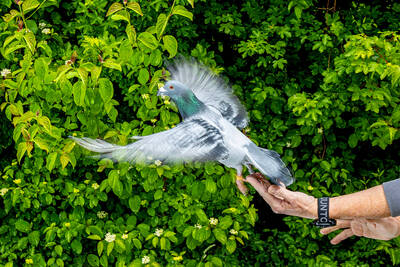
A surprising gut feeling may help pigeons find their way home. Animals use various techniques to navigate, including following the stars and remembering key landmarks. Birds, fish and turtles orient themselves using Earth’s magnetic field as a compass, but it is not yet clear how exactly they do this. Pigeons are a well-known group of frequent flyers that can traverse hundreds of kilometers in a single day. For thousands of years, humans have used them to carry news, notes and military messages. Scientists have long tried to untangle how pigeons travel without getting lost. Some think the birds detect magnetic cues using light-sensitive


 RSS
RSS