


Legendary US author and sharp-witted icon of the 1960s counterculture, Hunter S. Thompson, died on Sunday after apparently shooting himself in the head, police and his family said.
The 67-year-old writer and journalist, best-known for his 1972 book Fear and Loathing in Las Vegas, apparently shot himself at his rural home in Woody Creek, in the western US state of Colorado.
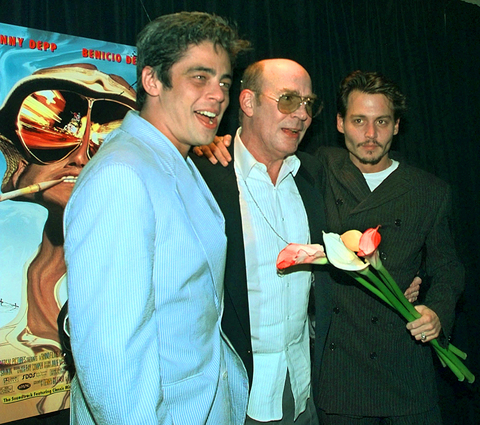
PHOTO: AP
"The sheriff's department can confirm the apparent death by a self-inflicted gunshot wound of Hunter S. Thompson at his home," Tricia Louthis, a spokeswoman for Colorado's Pitkin County government, told reporters.
Authorities declined to give any further details of the death of Thompson, considered one of the most important American authors of the 20th century.
But local news reports said his son, Juan Thompson, had found his body at his home in Woody Creek, near the ski resort of Aspen, about 256km southwest of Denver, on Sunday evening.
"On Feb. 20, Dr. Hunter S. Thompson took his life with a gunshot to the head at his fortified compound in Woody Creek, Colorado," Juan Thompson said in a statement released to the Aspen Daily News.
"Hunter prized his privacy and we ask that his friends and admirers respect that privacy as well as that of his family," he said, adding that arrangements for a memorial service would be made public soon.
Born in July 1937, Thompson, was known for his explosive and comically cutting writing style with which he spun outlandish tales that provided a unique viewpoint to accurately describe his experiences.
Almost always writing in the first person, Thompson flirted with the border between fiction and journalism, creating a genre that became known as "gonzo" journalism, in which the writer engages himself and his personal views in the story. It made him a cult figure.
Thompson shot to fame in 1966 after the publication of his book Hell's Angels, the story of his infiltration of the then-feared Hell's Angels motorcycle gang, an experience during which he was savagely beaten.
Fear and Loathing in Las Vegas is the apocryphal tale of a wild, drug-fuelled weekend spent in the desert gambling hub of Las Vegas by the protagonist Raoul Duke, a thinly-disguised version of Thompson.
Thompson claimed at the time that the book and its tales of LSD use were accurate examples of gonzo journalism, but later admitted that some of the events in it never took place.
But the stories of his heady experiences earned him a popular reputation as a wild-living, hard-drinking, LSD-crazed writer bent on self-destruction.
His other works include Fear and Loathing on the Campaign Trail `72, a collection of articles he wrote for Rolling Stone magazine while covering the re-election campaign of then-president Richard Nixon.
The ever-rebellious Thompson was born in the southern state of Kentucky and frequently got into trouble with the law in his early years for drinking and vandalism, spending 60 days in jail on one occasion.
He was enlisted in the US Air Force in 1956 and managed to get assigned as a sports writer for the air base newspaper at Eglin Air Proving Ground in Florida.
But the unsettled youngster quickly became dissatisfied with the rigors of military routine and his high-jinks led to an honorable discharge after only a year in 1957.
He spent several years in Puerto Rico and South America working for various newspapers, mostly as a sports reporter.
In 1963, Thompson wed Sandy Conklin, a union that would last 18 years and produce one child, Juan. He also moved to Woody Creek, where he would spend most of the rest of his life.
In 1970 Thompson ran for the office of Sheriff in Pitkin, Colorado, campaigning on the Freak Power Party ticket. He lost by a handful of votes.
His later works included The Rum Diary and Screwjack and Other Stories.
Thompson became such an icon that cartoonist Garry Trudeau based the wild character of Duke in his Doonesbury comic strip on him.
Thompson is survived to his second wife, Anita Beymunk, whom he married two years ago, his son Juan and a grandson.

‘CROSSING THE LINE’: China’s embassy in Seoul criticized US Forces Korea Commander General Xavier Brunson, asking if his ‘hostile’ remarks were authorized by Washington South Korea and the US are in talks over recent public remarks by the commander of US Forces Korea, Seoul’s presidential office said yesterday, after the comments drew sharp criticism from China. In a recent podcast interview, US Forces Korea Commander General Xavier Brunson described South Korea as “the dagger in the heart of Asia” from China’s east coast, prompting the Chinese embassy in Seoul to say that he had “truly crossed the line.” The interview came amid growing speculation that Washington might seek to expand the role of US Forces Korea in countering the growing regional influence of China, a key

SEEKING ORDER: Rodrigo Paz said that ‘anyone who wants to destroy the nation will have to deal with this president and the full force of the constitution’ Bolivian President Rodrigo Paz on Wednesday said that the nation was at a “breaking point” after nearly a month of protests that have caused shortages of food, fuel and medicine. Paz, who took office six months ago amid the worst economic crisis there in four decades, is battling a groundswell of fury over his policies. The political capital, La Paz, has been besieged by low-income workers and members of the indigenous majority calling for his resignation. “The country needs order and is reaching breaking point,” the 58-year-old said at a public event in La Paz, renewing his appeal for dialogue. On Tuesday, the Bolivian
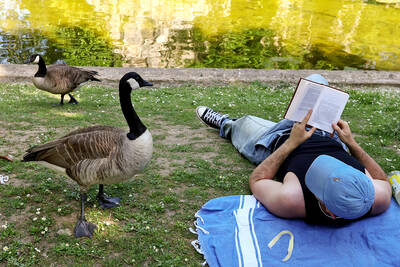
Forecasters in Europe yesterday warned of exceptional heat as record temperatures driven by a “heat dome” push temperatures well above seasonal norms across the continent. The surge follows a record-breaking Monday, with France logging its hottest day in the month of May on record, its weather agency said, and the UK also posting unprecedented highs. A so-called “heat dome” of warm air from northern Africa trapped under a high-pressure system over western Europe is behind the high temperatures not usually seen until high summer. Restrictions on outdoor work were imposed in parts of Italy, beaches in southwest France filled earlier than usual and

Australian researchers have trained lab-grown brain cells on a silicon computer chip to play the 1990s shooter game Doom and said they are just scratching the surface of what the neurons could be capable of doing. It is the science-fiction work of biotech boffins at Cortical Labs, who researched and developed the technology that harnesses the workings of the brain’s networking system. Each so-called “biological computer” contains about 200,000 living human brain cells, grown from stem cells that were harvested from blood donations. Having mastered the simple computer game Pong, where a paddle is moved up and down to send a ball


 RSS
RSS