


The tidal waves that swept across the Indian Ocean did more than take a heavy toll of lives and property in the Maldives -- it confronted the tiny island nation with a threat to its survival.
The archipelago of 1,190 low-lying coral islands, dotted across hundreds of kilometers of ocean, has for years begged bigger, more powerful nations for action against global warming, fearing higher sea levels could literally make much of its territory disappear.
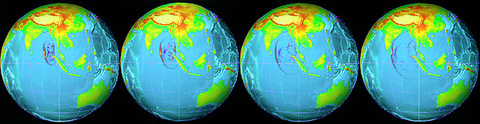
PHOTO: AFP
The speeding walls of water that slammed into 11 nations in Asia and Africa on Sunday, killing tens of thousands of people, marked a brutal demonstration of vulnerability.
"We are the world's lowest-lying country," said Mohammed Zahir, one of the country's leading environmentalists. "The average height of our islands is one meter."
At a schoolyard converted into a disaster area on the main island of Male, sobbing people waited on Tuesday for news of relatives from outlying islands. At least 52 people were confirmed dead, among them two British tourists, and 66 were listed as missing.
Ahmed Shaheed, the chief government spokesman, expected the figures to rise after authorities make contact with distant atolls. Although the number of casualties is small compared to huge tallies in Indonesia, Sri Lanka, India and Thailand, they are comparable in proportion to Maldives' tiny population of 280,000.
"Our nation is in peril here," Shaheed said. "Life as we know it in this country is in some parts gone. Thailand, Sri Lanka, India -- these are big countries with a lot of land area. They can bounce back from disasters like this. For us, it's not so easy."
Parliamentary elections sche-duled for tomorrow may have to be postponed, although the government has made no announcement yet.
Shaheed estimated the economic cost of the disaster at hundreds of millions of US dollars. The Maldives's annual gross domestic product is US$660 million.
"It won't be surprising if the cost exceeds our GDP," Shaheed said. "In the last few years, we made great progress in our standard of living -- the United Nations recognized this. Now we see this can disappear in a few days, a few minutes."
Shaheed noted that investment in a single tourist resort -- the economic mainstay -- could run to US$40 million. Between 10 and 12 of the 80-odd resorts have been severely damaged, and a similar number have suffered significant damage.
Waves a meter or more high swept completely across many islands. They extended over as much as half of Male, a relatively large island of 1.75km2 pouring down the narrow, sandy streets and dashing against buildings, including the president's office.
Kandolhudhoo, an island of 3,500 people in the northern atoll of Raa which had spent millions of dollars on land reclamation over the past five years, was "uninhabitable" after being completely covered by water, Assistant Island Chief Mohammed Ali Fulhu told the Haveeru newspaper.
Residents were evacuated. Rather than trying to rebuild their island, the people would probably have to start new lives elsewhere, Fulhu said.
Relief efforts are focusing on contacting outlying atolls and providing basic supplies to thousands of people who lack drinking water, food and electric power.
Ten thousand people have been evacuated to other islands, where authorities are working to prevent outbreaks of disease.
Shaheed said the Maldives was receiving disaster relief from around the world.

‘CROSSING THE LINE’: China’s embassy in Seoul criticized US Forces Korea Commander General Xavier Brunson, asking if his ‘hostile’ remarks were authorized by Washington South Korea and the US are in talks over recent public remarks by the commander of US Forces Korea, Seoul’s presidential office said yesterday, after the comments drew sharp criticism from China. In a recent podcast interview, US Forces Korea Commander General Xavier Brunson described South Korea as “the dagger in the heart of Asia” from China’s east coast, prompting the Chinese embassy in Seoul to say that he had “truly crossed the line.” The interview came amid growing speculation that Washington might seek to expand the role of US Forces Korea in countering the growing regional influence of China, a key

SEEKING ORDER: Rodrigo Paz said that ‘anyone who wants to destroy the nation will have to deal with this president and the full force of the constitution’ Bolivian President Rodrigo Paz on Wednesday said that the nation was at a “breaking point” after nearly a month of protests that have caused shortages of food, fuel and medicine. Paz, who took office six months ago amid the worst economic crisis there in four decades, is battling a groundswell of fury over his policies. The political capital, La Paz, has been besieged by low-income workers and members of the indigenous majority calling for his resignation. “The country needs order and is reaching breaking point,” the 58-year-old said at a public event in La Paz, renewing his appeal for dialogue. On Tuesday, the Bolivian

Forecasters in Europe yesterday warned of exceptional heat as record temperatures driven by a “heat dome” push temperatures well above seasonal norms across the continent. The surge follows a record-breaking Monday, with France logging its hottest day in the month of May on record, its weather agency said, and the UK also posting unprecedented highs. A so-called “heat dome” of warm air from northern Africa trapped under a high-pressure system over western Europe is behind the high temperatures not usually seen until high summer. Restrictions on outdoor work were imposed in parts of Italy, beaches in southwest France filled earlier than usual and

Australian researchers have trained lab-grown brain cells on a silicon computer chip to play the 1990s shooter game Doom and said they are just scratching the surface of what the neurons could be capable of doing. It is the science-fiction work of biotech boffins at Cortical Labs, who researched and developed the technology that harnesses the workings of the brain’s networking system. Each so-called “biological computer” contains about 200,000 living human brain cells, grown from stem cells that were harvested from blood donations. Having mastered the simple computer game Pong, where a paddle is moved up and down to send a ball


 RSS
RSS