


Many were initially skeptical, but penny-pinching Filipinos are now lining up to have their cars fitted with a device invented by a Filipino auto mechanic that cuts gasoline consumption by as much as half.
Amid soaring oil prices, the "Khaos super turbo charger" has become an instant hit as drivers find ways to beat the almost monthly increases in fuel pump rates.
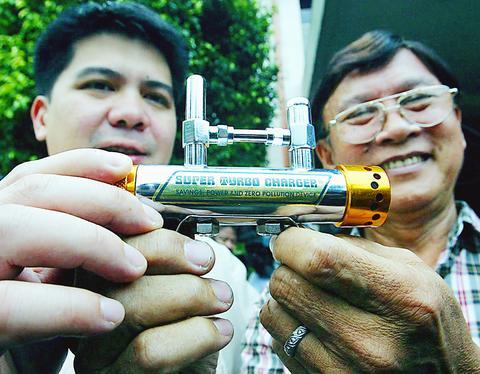
PHOTO: EPA
At least 100 people go to Pablo Planas' shops everyday to have their cars fitted with the Khaos.
"All of my customers have been satisfied with the performance of my device," the 67-year-old auto mechanic said. "And I assure them that they will remain happy for as long as my invention is fitted in their engines."
The Khaos is a small air-regulating cylindrical device made of stainless steel that feeds the correct mixture of fuel and air into the engine while it runs on idle, resulting in better combustion and minimizing emissions, Planas said.
Planas said that with his device, the engine always runs on an efficient air-fuel ratio of 15 to one, lowering fuel consumption by as much as 50 percent.
The apparatus has already passed fuel consumption tests by the Philippine Department of Energy, which has endorsed its usage. It has also passed emissions tests by the Automotive Research and Testing Center in Taiwan.
The device, which costs 6,500 pesos (US$116 dollars), is installed on the engine's intake manifold. It currently only works on cars running on gasoline but Planas is working on a diesel model and one for motorcycles.
It has minimum maintenance requirements, and car owners only need to wash the mechanism's filter every three months with water and soap to keep it in tiptop shape.
Planas, who used to operate six passenger mini-buses in the Manila suburban town of San Juan, invented the device at the height of the oil crisis in 1973.
In 1977, the invention was cited by the government of then president Ferdinand Marcos as an effective tool in controlling emissions. But Planas had a hard time attracting investors to fund his invention and had to sell his buses to raise money for more research and development.
For the next 26 years, he regularly produced up to 20 units and sold them to friends and interested motorists for a minimum amount to cover production costs.
Things perked up last year when Gerry Acuzar, a real-estate and construction magnate, agreed to bankroll mass production of his device.
"At present, we have a small factory that produces 5,000 Khaos every month," said Isko Catibayan, spokesman for Inventionhaus International Corp which markets the device. "By next year, we are targeting to increase production to 20,000 pieces a month."
Catibayan said Planas was holding talks with Ford Philippines for the possible fitting of Khaos on all its vehicles sold in the country.
Planas has already turned down a US$10 million offer from an US businessman who wanted to buy the rights to his invention. Businessmen from Spain, China and Taiwan have also made offers.
"We are not in a rush," Catibayan said. "We want to first focus on the Philippine market. Eventually we want to go into joint ventures ... to sell Khaos overseas."

When a hiker fell from a 55m waterfall in wild New Zealand bush, rescuers were forced to evacuate the badly hurt woman without her dog, which could not be found. After strangers raised thousands of dollars for a search, border collie Molly was flown to safety by a helicopter pilot who was determined to reunite the pet and the owner. A week earlier, an emergency rescue helicopter found the woman with bruises and lacerations after a fall at a rocky spot at the waterfall on the South Island’s West Coast. She was airlifted on March 24, but they were forced to

CONFIDENCE BOOSTER: ’After parkour ... you dare to do a lot of things that you think only young people can do,’ a 67-year-old parkour enthusiast said In a corner of suburban Singapore, Betty Boon vaults a guardrail, crawls underneath a slide, executes forward shoulder rolls and scales a steep slope, finishing the course to applause. “Good job,” the 69-year-old’s coach cheers. This is “geriatric parkour,” where about 20 retirees learned to tackle a series of relatively demanding exercises, building their agility and enjoying a sense of camaraderie. Boon, an upbeat grandmother, said learning parkour has aided her confidence and independence as she ages. “When you’re weak, you will be dependent on someone,” she said after sweating it out with her parkour classmates in suburban Toa Payoh,

Chinese dissident artist Gao Zhen (高兟), famous for making provocative satirical sculptures of former Chinese leader Mao Zedong (毛澤東), was tried on Monday over accusations of “defaming national heroes and martyrs,” his wife and a rights group said. Gao, 69, who was detained in 2024 during a visit from the US, faces a maximum three-year prison sentence, said his wife, Zhao Yaliang (趙雅良), and Shane Yi, a researcher at the Chinese Human Rights Defenders group which operates outside the nation. The closed-door, one-day trial took place at Sanhe City People’s Court in Hebei Province neighboring the capital, Beijing, and ended without a

‘TOXIC CLIMATE’: ‘I don’t really recognize Labour anymore... The idea that you can implement far-right ideas in order to stop the far right is nonsense,’ a protester said Tens of thousands of people on Saturday marched through central London to protest against the far right, weeks ahead of local elections and six months after Britain saw one of its largest far-right demonstrations. Organized by hundreds of civic groups, including trade unions, anti-racism campaigners and Muslim representative bodies, Saturday’s Together Alliance event was billed as the biggest in UK history to counter right-wing extremism. A separate pro-Palestinian march had also converged with the main rally. While organizers claimed 500,000 had turned out in total, the police gave a figure of about 50,000. Protesters carrying placards with slogans such as


 RSS
RSS