


Chinese state media yesterday said it was crucial the ruling communist party adapt to social changes but gave few clues about an apparent power struggle as a secretive party plenum convened for a second day.
"China's economic and social transition has reached a crucial point, setting an unprecedented test for the Party's competence to govern the country," the English-language China Daily said in an editorial.
"By making the party's governance an open topic, the ongoing plenum has sent an encouraging signal that the leadership has to acknowledge the pitfalls and is willing to change with the times."
Some 198 top party officials are meeting in Beijing with hundreds of "leading cadres" for four days of closed-door talks aimed at bolstering the party's fading image.
The official Xinhua news agency said the meeting's emphasis on "strengthening the party's ruling capabilities" would "lay a solid foundation for China's long-term stability and prosperity".
It said "many deep-rooted problems" were starting to emerge and were "threatening to undermine social stability" as the country's economic development continued apace.
The solution lay in the promotion of democracy and the rule of law, as well as making the party and the government more accountable to the people, it said.
China has a different interpretation of the concept of democracy from the West and its leaders have ruled out multi-party elections.
The term is more generally used to refer to a more consultative role played by the public.
Overshadowing the talks were concerns that the leadership remained divided between two generations of politicians.
Speculation has been rife that former party leader Jiang Zemin (江澤民), 78, is refusing to stand down from his position as commander-in-chief of the military, preventing current party leader and President Hu Jintao (胡錦濤), 61, from exercising effective power.
China's state media made no mention of this yesterday although Taiwan's United Daily News claimed Jiang had made a "request" to resign in a letter to the plenary.

FRAUD ALLEGED: The leader of an opposition alliance made allegations of electoral irregularities and called for a protest in Tirana as European leaders are to meet Albanian Prime Minister Edi Rama’s Socialist Party scored a large victory in parliamentary elections, securing him his fourth term, official results showed late on Tuesday. The Socialist Party won 52.1 percent of the vote on Sunday compared with 34.2 percent for an alliance of opposition parties led by his main rival Sali Berisha, according to results released by the Albanian Central Election Commission. Diaspora votes have yet to be counted, but according to initial results, Rama was also leading there. According to projections, the Socialist Party could have more lawmakers than in 2021 elections. At the time, it won 74 seats in the

EUROPEAN FUTURE? Albanian Prime Minister Edi Rama says only he could secure EU membership, but challenges remain in dealing with corruption and a brain drain Albanian Prime Minister Edi Rama seeks to win an unprecedented fourth term, pledging to finally take the country into the EU and turn it into a hot tourist destination with some help from the Trump family. The artist-turned-politician has been pitching Albania as a trendy coastal destination, which has helped to drive up tourism arrivals to a record 11 million last year. US President Donald Trump’s son-in-law, Jared Kushner, also joined in the rush, pledging to invest US$1.4 billion to turn a largely deserted island into a luxurious getaway. Rama is expected to win another term after yesterday’s vote. The vote would

CANCER: Jose Mujica earned the moniker ‘world’s poorest president’ for giving away much of his salary and living a simple life on his farm, with his wife and dog Tributes poured in on Tuesday from across Latin America following the death of former Uruguayan president Jose “Pepe” Mujica, an ex-guerrilla fighter revered by the left for his humility and progressive politics. He was 89. Mujica, who spent a dozen years behind bars for revolutionary activity, lost his battle against cancer after announcing in January that the disease had spread and he would stop treatment. “With deep sorrow, we announce the passing of our comrade Pepe Mujica. President, activist, guide and leader. We will miss you greatly, old friend,” Uruguayan President Yamandu Orsi wrote on X. “Pepe, eternal,” a cyclist shouted out minutes later,
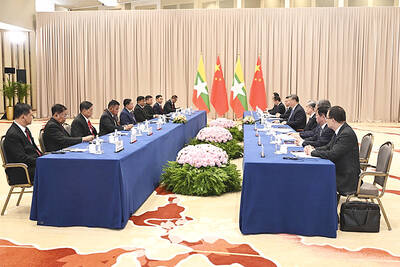
Myanmar’s junta chief met Chinese President Xi Jinping (習近平) for the first time since seizing power, state media reported yesterday, the highest-level meeting with a key ally for the internationally sanctioned military leader. Senior General Min Aung Hlaing led a military coup in 2021, overthrowing Myanmar’s brief experiment with democracy and plunging the nation into civil war. In the four years since, his armed forces have battled dozens of ethnic armed groups and rebel militias — some with close links to China — opposed to its rule. The conflict has seen Min Aung Hlaing draw condemnation from rights groups and pursued by the


 RSS
RSS