


They're united in the newly expanded EU -- yet still bitterly divided by a nearly six-decade-old dispute.
Politicians from the Czech Republic and Germany are quarreling over their uncomfortable wartime past -- an old war of words that's casting an awkward shadow on the two countries' relationship as neighbors, allies and key trading partners.
Edmund Stoiber, the conservative governor of the German state of Bavaria, renewed his attacks last week, calling on the rest of Europe to pressure the Czechs to repeal post-World War II decrees that expelled millions of ethnic Germans from then-Czechoslovakia.
"For the sake of its own credibility, Europe must ensure that such decrees are banished," said Stoiber, a major figure in German politics who unsuccessfully challenged Chancellor Gerhard Schroeder in 2002.
no repeal
"May 1 certainly does not mean we draw a line under our concerns," he said, referring to last month's historic enlargement of the EU from 15 to 25 countries.
The Czech response was swift and sharp.
Describing Stoiber's comments as "scandalous and unacceptable," Czech President Vaclav Klaus said he never would agree to abolish the 1945 decrees, which were issued shortly after the war by then-president Edvard Benes with the blessing of the victorious Allies.
The decrees provided for the expulsion of 3 million ethnic Germans from Czechoslovakia's border regions known as the Sudetenland, where they had lived for centuries, and the confiscation of their property.
The move was widely seen as an act of revenge for the Nazi occupation of the country. Many of the expellees settled in Germany's southern state of Bavaria, which adjoins the former Sudetenland and where they wield influence in Stoiber's Christian Social Union.
Czech politicians repeatedly have said the decrees no longer carried any legal weight and expressed their regrets over what happened.
But they have refused to repeal them, fearing such a move could strengthen restitution claims by those expelled and their heirs, especially now that the Czech Republic is in the EU.
lawsuits
Their position was unanimously approved by the Czech parliament in 2002 and nothing has changed since.
"This problem is definitely closed and I don't intend to open a new debate about it," Czech Prime Minister Vladimir Spidla said in reaction to Stoiber's remarks.
Tomas Kafka, who heads the Czech-German Fund for the Future, a forum for dialogue between the two uneasy neighbors, said the ongoing dispute is "a battle over the interpretation of the last century."
The fund recently distributed money from Germany to about 75,000 Czechs who were held in Nazi concentration camps or forced to work in German factories.
At the European Court of Human Rights, meanwhile, 79 Sudeten Germans have filed individual lawsuits demanding the return of confiscated property or compensation for what they consider an act of ethnic cleansing.
bad feelings
But their hopes -- and Stoiber's -- that the EU expansion will provide a new platform for getting the decrees overturned were dampened by European Parliament President Pat Cox.
During a recent visit to Prague, Cox said the decrees "were not an issue for the future of Europe, but a lesson from the past."
Czech and German leaders, working to seal their efforts at postwar reconciliation, signed a joint declaration in 1997 that later was approved by both parliaments. Germany expressed regret for Nazi evils, and the Czechs expressed regret over the expulsion of the Sudeten Germans.
Yet bad feelings over the decrees have resurfaced repeatedly since then.
Schroeder canceled a planned visit to Prague in March 2002 to show his displeasure over comments by Milos Zeman, the Czech prime minister at the time, who likened the Sudeten Germans to "Hitler's fifth column."
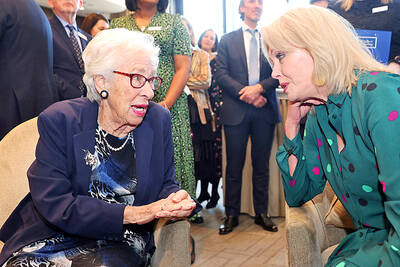
Auschwitz survivor Eva Schloss, the stepsister of teenage diarist Anne Frank and a tireless educator about the horrors of the Holocaust, has died. She was 96. The Anne Frank Trust UK, of which Schloss was honorary president, said she died on Saturday in London, where she lived. Britain’s King Charles III said he was “privileged and proud” to have known Schloss, who cofounded the charitable trust to help young people challenge prejudice. “The horrors that she endured as a young woman are impossible to comprehend and yet she devoted the rest of her life to overcoming hatred and prejudice, promoting kindness, courage, understanding

Tens of thousands of Filipino Catholics yesterday twirled white cloths and chanted “Viva, viva,” as a centuries-old statue of Jesus Christ was paraded through the streets of Manila in the nation’s biggest annual religious event. The day-long procession began before dawn, with barefoot volunteers pulling the heavy carriage through narrow streets where the devout waited in hopes of touching the icon, believed to hold miraculous powers. Thousands of police were deployed to manage crowds that officials believe could number in the millions by the time the statue reaches its home in central Manila’s Quiapo church around midnight. More than 800 people had sought

‘DISRESPECTFUL’: Katie Miller, the wife of Trump’s most influential adviser, drew ire by posting an image of Greenland in the colors of the US flag, captioning it ‘SOON’ US President Donald Trump on Sunday doubled down on his claim that Greenland should become part of the US, despite calls by the Danish prime minister to stop “threatening” the territory. Washington’s military intervention in Venezuela has reignited fears for Greenland, which Trump has repeatedly said he wants to annex, given its strategic location in the arctic. While aboard Air Force One en route to Washington, Trump reiterated the goal. “We need Greenland from the standpoint of national security, and Denmark is not going to be able to do it,” he said in response to a reporter’s question. “We’ll worry about Greenland in

PERILOUS JOURNEY: Over just a matter of days last month, about 1,600 Afghans who were at risk of perishing due to the cold weather were rescued in the mountains Habibullah set off from his home in western Afghanistan determined to find work in Iran, only for the 15-year-old to freeze to death while walking across the mountainous frontier. “He was forced to go, to bring food for the family,” his mother, Mah Jan, said at her mud home in Ghunjan village. “We have no food to eat, we have no clothes to wear. The house in which I live has no electricity, no water. I have no proper window, nothing to burn for heating,” she added, clutching a photograph of her son. Habibullah was one of at least 18 migrants who died


 RSS
RSS