


Pablo Picasso's 1905 painting Boy with a Pipe sold for US$104 million on Wednesday at Sotheby's, shattering the record for an auctioned painting.
The total includes the auction price of US$93 million plus the auction house's commission of about US$11 million.
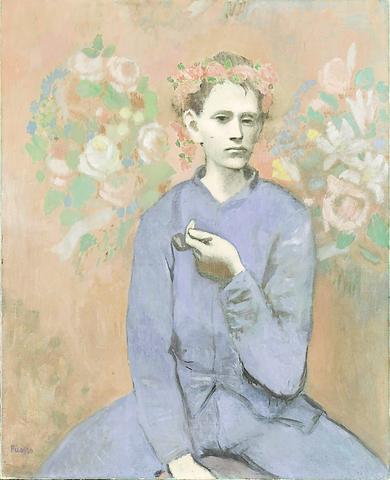
PHOTO: REUTERS
"This is the finest work in private hands that was going to be available for sale," Sotheby's senior vice president David Norman said.
The previous record was set by Vincent van Gogh's 1890 Portrait of Doctor Gachet, which was sold to a Japanese billionaire for US$82.5 million in 1990 at Christie's. That price included the auction house's premium.
Sotheby's did not say who bought Boy with a Pipe.
A 24-year-old Picasso painted Boy with a Pipe soon after settling in Montmartre, France. It depicts a young Parisian boy holding a pipe in his left hand and wearing a garland of flowers. John Hay and Betsey Whitney bought the painting in 1950 for US$30,000.
Sotheby's called the work, which had a presale estimate of US$70 million, "one of the most beautiful of the artist's Rose Period paintings and one of the most important early works by Pablo Picasso ever to appear on the market."
The previous highest-selling Picasso piece was Woman with Crossed Arms, a Blue Period painting done in 1901 and 1902, which sold for more than US$55 million in November 2000 at Christie's. It was the fifth-highest auction price paid for a work of art.
Boy with a Pipe was part of a collection of major works by Picasso, Edouard Manet, Edgar Degas and others that headlined an auction of 34 paintings from a charitable foundation created by Betsey Whitney, a philanthropist, Sotheby's said.
Also on the auction block was Courses au Bois de Boulogne by Manet. Painted in 1872, it depicts a sunny day at the horse races and features a top-hatted figure in the lower-right corner that is thought to be Manet's fellow racing enthusiast Degas. It sold for US$26.3 million.
The collection, which had a presale estimate of more than US$140 million, netted US$190 million.
The proceeds will go to the Greentree Foundation -- created in 1982 by Betsey Whitney following the death of her husband.
John Hay Whitney was editor in chief and publisher of The New York Herald Tribune from 1961 to 1966 as well as chairman of the International Herald Tribune from 1966 until his death. He also founded the venture capital firm of J.H. Whitney and Co.
Betsey Whitney died in 1998.
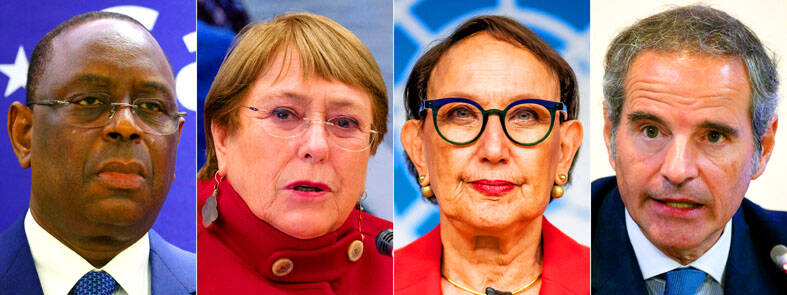
Four contenders are squaring up to succeed Antonio Guterres as secretary-general of the UN, which faces unprecedented global instability, wars and its own crushing budget crisis. Chile’s Michelle Bachelet, Argentina’s Rafael Grossi, Costa Rica’s Rebeca Grynspan and Senegal’s Macky Sall are each to face grillings by 193 member states and non-governmental organizations for three hours today and tomorrow. It is only the second time the UN has held a public question-and-answer, a format created in 2016 to boost transparency. Ultimately the five permanent members of the UN’s top body, the Security Council, hold the power, wielding vetoes over who leads the

South Korea’s air force yesterday apologized for a 2021 midair collision involving two fighter jets, a day after auditors said the pilots were taking selfies and filming during the flight and held them responsible for the accident. “We sincerely apologize to the public for the concern caused by the accident that occurred in 2021,” an air force spokesman told a news conference, adding that one of the pilots involved had been suspended from flying duties, received severe disciplinary action and has since left the military. The apology followed a report released on Wednesday by the South Korean Board of Audit and Inspection,

Young Chinese, many who fear age discrimination in their workplace after turning 35, are increasingly starting “one-person companies” that have artificial intelligence (AI) do most of the work. Smaller start-ups are already in vogue in Silicon Valley and elsewhere, with rapidly advancing AI tools seen as a welcome teammate even as they threaten layoffs at existing firms. More young people in China are subscribing to the model, as cities pledge millions of dollars in funding and rent subsidies for such ventures, in alignment with Beijing’s political goal of “technological self-reliance.” “The one-person company is a product of the AI era,” said Karen Dai

About 240 Indians claiming descent from a Biblical tribe landed at Tel Aviv airport on Thursday as part of a government operation to relocate them to Israel. The newcomers passed under a balloon arch in blue and white, the colors of the Israeli flag, as dozens of well-wishers welcomed them with a traditional Jewish song. They were the first “bnei Menashe” (“sons of Manasseh”) to arrive in Israel since the government in November last year announced funding for the immigration of about 6,000 members of the community from the states of Manipur and Mizoram in northeast India. The community claims to descend from


 RSS
RSS