


A Soyuz space capsule made a "bullseye" landing in the steppes of Kazakhstan early yesterday, bringing a Russian, a US astronaut and a Dutchman back to Earth from the International Space Station.
NASA's Michael Foale and Russian Alexander Kaleri spent six months aboard the 16-nation, US$95 billion station. Dutchman Andre Kuipers, from the European Space Agency, spent just 11 days doing scientific experiments in space on his maiden voyage.
"It was right on the money, almost a bullseye landing for Soyuz," said NASA spokesman Robert Navias at the landing site near the northern Kazakh town of Arkalyk.
Russia has borne the brunt of ferrying crews and cargo to the station since the US grounded its space shuttles following the disintegration of the Columbia over Texas in February last year, killing all seven astronauts on board.
A Russian recovery team pulled the cosmonauts out of the capsule, charred black from re-entry, and allowed them to recover in reclining chairs before conducting medical checks and flying them to a base in Kustanai, 375km away.
"This is tea, not cognac," said Foale, wrapped in an overcoat and sipping from a plastic cup in early morning sun.
"How do I feel? It's like the morning after a late night party," he said at a later news conference.
The craft had disengaged from the International Space Station a few hours before its touchdown and started its return to Earth, using a large orange parachute and thrusters to control its descent.
"Everything was just fine and the soft landing engines worked wonders," General Vladimir Popov, commander of the recovery operation, said.
A similar Soyuz capsule carrying the US astronauts Kenneth Bowersox and Donald Pettit and Russia's Nikolai Budarin back from the space station made a hard landing hundreds of kilometers off target last May because of a technical glitch that caused an early re-entry.
The next space station crew landed safely last October, even though one member of the crew apparently hit a wrong button.
The latest mission had suffered a small leak of helium gas in the capsule on Thursday but it was not judged a danger.
Russia has proposed extending the six-month ISS missions to the station to a year in order to reduce its burden and potentially free up Soyuz craft for paying space tourists, but NASA has so far rejected the proposals.

‘CROSSING THE LINE’: China’s embassy in Seoul criticized US Forces Korea Commander General Xavier Brunson, asking if his ‘hostile’ remarks were authorized by Washington South Korea and the US are in talks over recent public remarks by the commander of US Forces Korea, Seoul’s presidential office said yesterday, after the comments drew sharp criticism from China. In a recent podcast interview, US Forces Korea Commander General Xavier Brunson described South Korea as “the dagger in the heart of Asia” from China’s east coast, prompting the Chinese embassy in Seoul to say that he had “truly crossed the line.” The interview came amid growing speculation that Washington might seek to expand the role of US Forces Korea in countering the growing regional influence of China, a key

SEEKING ORDER: Rodrigo Paz said that ‘anyone who wants to destroy the nation will have to deal with this president and the full force of the constitution’ Bolivian President Rodrigo Paz on Wednesday said that the nation was at a “breaking point” after nearly a month of protests that have caused shortages of food, fuel and medicine. Paz, who took office six months ago amid the worst economic crisis there in four decades, is battling a groundswell of fury over his policies. The political capital, La Paz, has been besieged by low-income workers and members of the indigenous majority calling for his resignation. “The country needs order and is reaching breaking point,” the 58-year-old said at a public event in La Paz, renewing his appeal for dialogue. On Tuesday, the Bolivian
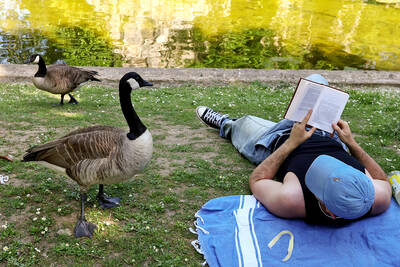
Forecasters in Europe yesterday warned of exceptional heat as record temperatures driven by a “heat dome” push temperatures well above seasonal norms across the continent. The surge follows a record-breaking Monday, with France logging its hottest day in the month of May on record, its weather agency said, and the UK also posting unprecedented highs. A so-called “heat dome” of warm air from northern Africa trapped under a high-pressure system over western Europe is behind the high temperatures not usually seen until high summer. Restrictions on outdoor work were imposed in parts of Italy, beaches in southwest France filled earlier than usual and

Australian researchers have trained lab-grown brain cells on a silicon computer chip to play the 1990s shooter game Doom and said they are just scratching the surface of what the neurons could be capable of doing. It is the science-fiction work of biotech boffins at Cortical Labs, who researched and developed the technology that harnesses the workings of the brain’s networking system. Each so-called “biological computer” contains about 200,000 living human brain cells, grown from stem cells that were harvested from blood donations. Having mastered the simple computer game Pong, where a paddle is moved up and down to send a ball


 RSS
RSS