


An Islamic militant accused of involvement in bombing Bali nightclubs and Jakarta's Marriott Hotel went on trial yesterday in the Indonesian capital and could face the death sentence if found guilty.
Jhoni Hendrawan, also known as Idris, is the last detained Bali bomb suspect to stand trial. He is charged with planning the Bali bombings by attending several meetings along with other suspects between August and September 2002.
He also detonated a bomb that did not claim casualties near the US consulate in the resort island on Oct. 12, 2002, prosecutor Tubagus Arief said.
The bomb exploded almost simultaneously with two other devices, killing 202 people, mostly young foreign holidaymakers, in the Kuta nightclub strip.
Hendrawan, 30, also allegedly took part in a survey to pick targets for the bombs.
The al-Qaeda-linked Jemaah Islamiyah (JI) is blamed for the Bali bombings and the attack on the Marriott last August which killed 12 people. The attacks were staged to avenge perceived Western oppression of Muslims.
Hendrawan, in comments before the trial began, admitted that he was involved in some bombings.
"What is clear we carried out some of those [bombings]," he said. "Those were intended to remind them not to treat Muslims tyranically."
But he said alleged JI chief Abu Bakar Bashir was not involved in the Bali bombings.
"I can only pray that he be granted salvation by Allah," he said.
Prosecutors also charged Hendrawan with transporting 130kg of explosives which were later used in the Marriott blast.
He could face a death sentence if convicted of the Bali bombings and receive 20 years if found guilty of involvement in the Marriott attack.
Hendrawan's trial had been transferred from Bali to Jakarta because of his alleged involvement in the Marriott blast.
Courts in Bali have sentenced 33 people for the bombings. Three people were sentenced to death by firing squad, four others were given life sentences and the remainder received jail terms ranging from 16 years to three years.
Several key Bali suspects are still being hunted, including Malaysian explosives experts Noordin Mohammad Top and Azahari Husin, who are also accused of involvement in the Marriott blast.

Through the noise of rushing papers and whirring belts at a print factory in Kyoto, two creators watch their photo essay come to life in broadsheet form — part of an effort to win new audiences in the age of artificial intelligence (AI). Despite the decline of the publishing industry, self-publication and handmade “zine” magazines are growing in popularity in Japan, reflecting the nation’s enduring love of paper in the digital era. While speaking to Agence France-Presse at the plant, his hands black with ink, one of the creators, Kazuma Obara, said: “I think [paper] is a medium that engages all five
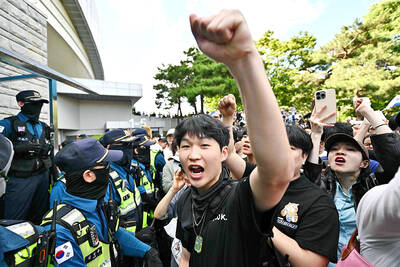
‘ABSURD MISTAKE’: The election commission said that there had been a failure to anticipate turnout after 14 polling stations ran short of ballot papers South Korean riot police yesterday cleared protesters from a Seoul polling station after a 35-hour blockade sparked by a shortage of ballot papers during local elections earlier this week. Wednesday’s election was the first nationwide vote since South Korean President Lee Jae-myung took office following the ouster of Yoon Suk-yeol over his short-lived martial law declaration. Lee’s ruling Democratic Party swept most races, but failed to flip the crucial Seoul mayoral seat. The South Korean National Election Commission apologized, blaming a failure to anticipate turnout after 14 polling stations in Seoul ran short of ballot papers. Some polling stations stayed open until 10pm to

Australian researchers have trained lab-grown brain cells on a silicon computer chip to play the 1990s shooter game Doom and said they are just scratching the surface of what the neurons could be capable of doing. It is the science-fiction work of biotech boffins at Cortical Labs, who researched and developed the technology that harnesses the workings of the brain’s networking system. Each so-called “biological computer” contains about 200,000 living human brain cells, grown from stem cells that were harvested from blood donations. Having mastered the simple computer game Pong, where a paddle is moved up and down to send a ball

France experienced its hottest spring on record, the French weather service said on Tuesday, after an exceptional early heat wave that also broke highs for the season in England and Wales. Meteo-France said the average nationwide temperature over March to May was 13.8°C — about 1.7°C above the norm, and surpassing records set in 2011 and 2020. “The warmest spring since records began in 1900,” it said in a bulletin. All three months were warmer than average, but the onset of an “unprecedented heatwave” late last month pushed the mercury to highs typically seen at the height of the summer. “Our country had never


 RSS
RSS