


He has been charged with two dozen crimes, voted into parliament three times and even from inside a jail cell Mohammed Shahabuddin reigns supreme over his lawless district where only the potholes outnumber his portraits.
Shahabuddin epitomizes the rough politics in the eastern Indian state of Bihar where candidates for elections that start tomorrow include suspected murderers, alleged rapists and fugitives who somehow manage to file nomination papers.
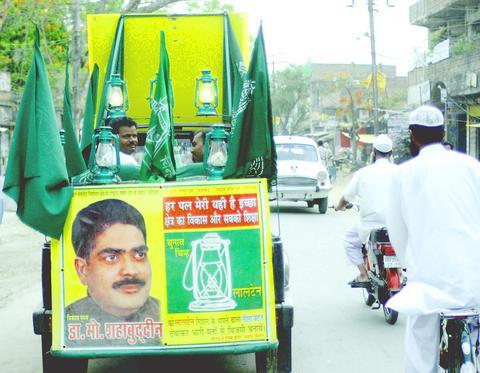
PHOTO: AP
Shahabuddin, who turns 37 on May 10, the last of five dates of the staggered national election, is in jail pending trial over the murder of Munna Chowdhary, a 17-year-old local political activist whose body was allegedly thrown into the furnace of a brick kiln.
But Shahabuddin remains the undisputed king of Siwan, a dusty town 200km northwest of Bihar's capital Patna, where his deep-set eyes stare out from pictures on the motorcycles and cycle-rickshaws which plough the beat-up streets.
"Such is his fear and clout that no other political party candidate, though they are contesting, have dared to put up their flags or posters," said Ajit Kumar Singh, a doctor.
His party office has a statue of Mahatma Gandhi, the icon of India's non-violent independence struggle.
But Gandhi would be unlikely to win an election in Bihar, a state of 83 million people where voting is colored by gun-slinging, tough-talking and open brawls.
"No one can win an election in Bihar without firing even a single bullet," said veteran Bihar journalist Kanhaiya Bhellary of The Week magazine.
Shahabuddin has denied involvement in all the criminal cases brought against him and has never been convicted, depriving the federal Election Commission of a possible way to bar him.
The only other political office in Siwan belongs to the Communist Party of India (Marxist-Leninist) (CPI-ML), a far-left agrarian party that is Shahabuddin's only credible rival and was the root of one of the most notorious cases against Shahabuddin.
In 1997, Chandrashekhar, a charismatic CPI-ML youth leader at New Delhi's prestigious Jawaharlal Nehru University, died in a hail of bullets when he was addressing a meeting on the busy market street in Siwan.
Four years later, when Shahabuddin and his posse led a drive against cheating during college exams, he clashed with a senior police officer who said he was in charge of the tests.
The police officer was reportedly slapped on the cheek, enraging him to such an extent that he launched an operation against Shahabuddin in his ancestral village of Pratapgarh.
"It was a 10-hour gun battle in which Shahabuddin's men fired from all kinds of automatic weapons," said a local witness.
"Shahabuddin managed to escape in the night after 11 of his men were killed," the witness said.
Shahabuddin's evasion of the law ended last year when a new state police chief, D.P. Ojha, reopened his file and slapped a slew of cases against him.
Ojha even sent a report to the federal home ministry claiming Shahabuddin had links with rival Pakistan's spy agency and gunrunners in violence-torn Kashmir.
After months of remaining underground, Shahabuddin surrendered with fanfare in August and vowed to "teach a lesson to madman Ojha."
Ojha was soon sacked by the state government.
Laloo Prasad Yadav, head of Shahabuddin's Rashtriya Janata Dal party and Bihar's de facto ruler, called Shahabuddin his "younger brother" and personally escorted him to file his election nomination.
Many of his constituents see Shahabuddin as a figure similar to Robin Hood.
"He opened so many colleges and schools. Even the girls are going to school.
"Siwan is so safe that women go out for late-night films. He is also opening a huge university. We are all very happy with him," Pradeep Kumar Jaiswal said at a teashop.
"We have put up flags on our own. There is no fear," said Mohammed Riyaz, a furniture shop owner.
But at the CPI-ML office, 24-year-old Abhiyuday, who is studying physics in the state capital Patna, swears his party would one day rid Siwan of "Shahabuddin's terror."
"Those who are putting his flag on their rooftops are doing so out of fear," he said.
"In their hearts, they want a change and we are going to give them this change. Comrade Chandrashekhar did not die in vain."

When a hiker fell from a 55m waterfall in wild New Zealand bush, rescuers were forced to evacuate the badly hurt woman without her dog, which could not be found. After strangers raised thousands of dollars for a search, border collie Molly was flown to safety by a helicopter pilot who was determined to reunite the pet and the owner. A week earlier, an emergency rescue helicopter found the woman with bruises and lacerations after a fall at a rocky spot at the waterfall on the South Island’s West Coast. She was airlifted on March 24, but they were forced to
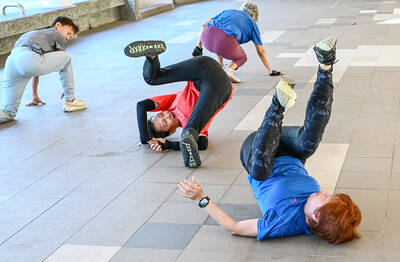
CONFIDENCE BOOSTER: ’After parkour ... you dare to do a lot of things that you think only young people can do,’ a 67-year-old parkour enthusiast said In a corner of suburban Singapore, Betty Boon vaults a guardrail, crawls underneath a slide, executes forward shoulder rolls and scales a steep slope, finishing the course to applause. “Good job,” the 69-year-old’s coach cheers. This is “geriatric parkour,” where about 20 retirees learned to tackle a series of relatively demanding exercises, building their agility and enjoying a sense of camaraderie. Boon, an upbeat grandmother, said learning parkour has aided her confidence and independence as she ages. “When you’re weak, you will be dependent on someone,” she said after sweating it out with her parkour classmates in suburban Toa Payoh,
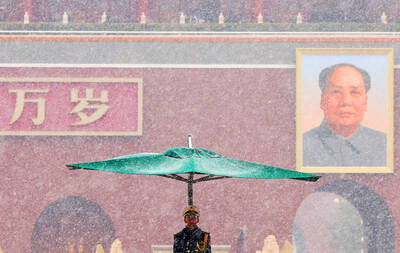
Chinese dissident artist Gao Zhen (高兟), famous for making provocative satirical sculptures of former Chinese leader Mao Zedong (毛澤東), was tried on Monday over accusations of “defaming national heroes and martyrs,” his wife and a rights group said. Gao, 69, who was detained in 2024 during a visit from the US, faces a maximum three-year prison sentence, said his wife, Zhao Yaliang (趙雅良), and Shane Yi, a researcher at the Chinese Human Rights Defenders group which operates outside the nation. The closed-door, one-day trial took place at Sanhe City People’s Court in Hebei Province neighboring the capital, Beijing, and ended without a
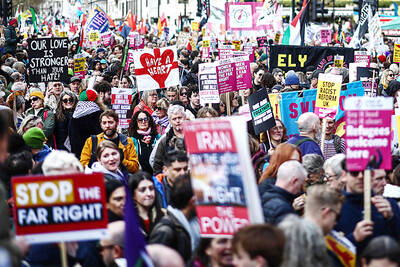
‘TOXIC CLIMATE’: ‘I don’t really recognize Labour anymore... The idea that you can implement far-right ideas in order to stop the far right is nonsense,’ a protester said Tens of thousands of people on Saturday marched through central London to protest against the far right, weeks ahead of local elections and six months after Britain saw one of its largest far-right demonstrations. Organized by hundreds of civic groups, including trade unions, anti-racism campaigners and Muslim representative bodies, Saturday’s Together Alliance event was billed as the biggest in UK history to counter right-wing extremism. A separate pro-Palestinian march had also converged with the main rally. While organizers claimed 500,000 had turned out in total, the police gave a figure of about 50,000. Protesters carrying placards with slogans such as


 RSS
RSS